
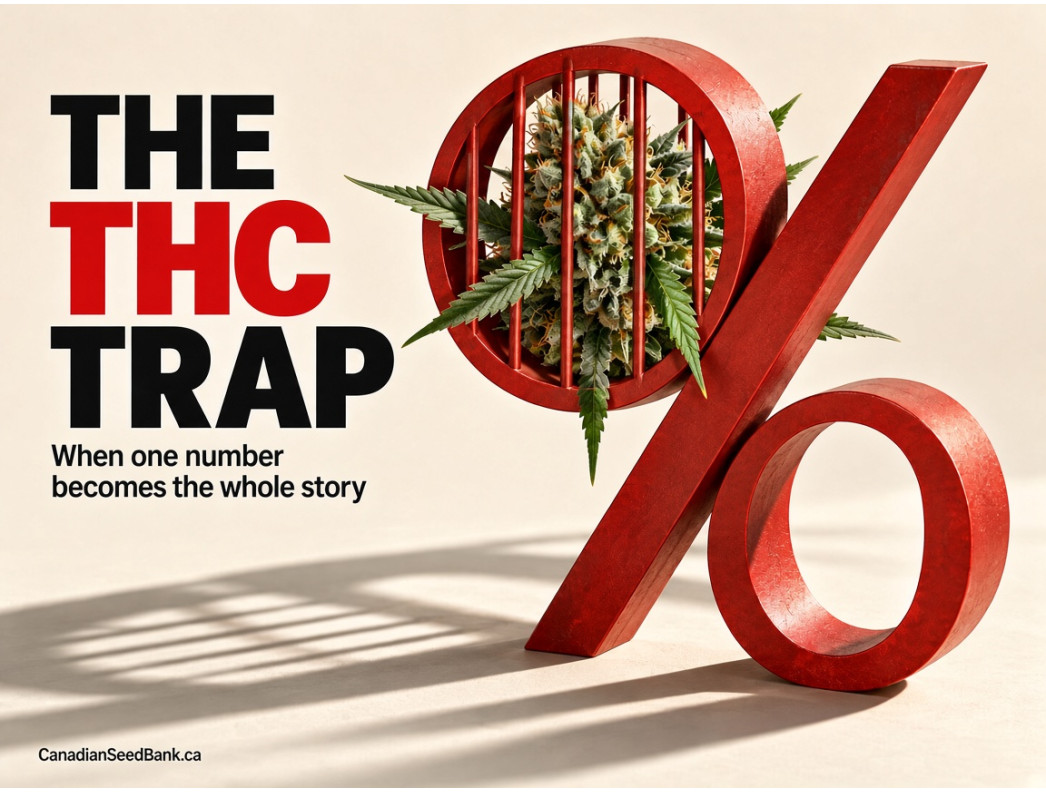
The THC Trap
When One Number Becomes the Whole Story
Walk into almost any legal cannabis shop in Canada and the ritual is the same. A customer points at a jar. The first question is not how it was grown, how it smells or how it made the last person feel. The first question is a number.
Twenty eight percent. Thirty two. Thirty five, if the label is feeling ambitious.
That single figure, total THC, has become the closest thing the legal market has to a grade. It sits on every package in a typeface large enough to read from the till. It sorts menus on provincial sites. It decides which bags move and which sit. In a category that spent decades talking in slang and strain folklore, THC percentage looks like science. It is measurable. It is official. It is printed under a Health Canada warning. It is also a poor way to describe a plant, and an even poorer way to describe an experience.
A number that looks precise and is not
THC, or delta 9 tetrahydrocannabinol, is the compound that most people mean when they say cannabis is strong. On a dried flower label in Canada, the figure that matters is usually total THC. That is not the amount of already active THC sitting in the jar. Most of the potency in raw flower exists as THCA, an acid form that converts to THC when it is heated. Labs estimate what the consumer will actually get after that conversion, then express it as a percentage of the flower’s dry weight.
The arithmetic is tidy. The plant is not.
Cannabinoids are not poured evenly through a crop like sugar into tea. Village Farms researchers, writing in Scientific Reports, sampled flower from the top, middle and bottom of the same plants and found that potency moved with the architecture of the plant. Tops and middles ran higher. A single label number, in other words, can be a snapshot of one sample from one part of one plant, then applied to an entire lot. That is a useful factory measurement. It is a blunt consumer guide.
Labs themselves do not always agree. A 2024 exercise in Colorado sent identical samples to multiple licensed laboratories and got THC readings that swung by more than a third on the same flower. Canadian lab operators have made a similar point at home. When eight testing firms split samples of legal dried flower and pre-rolls, they could land close to one another if they used the same methods. The larger gap was between those results and the numbers printed on packages. More than half of the 3.5 gram flower SKUs they checked came in more than 25 percent below the claim on the label. Two were more than 40 percent below. That is not a rounding error. That is a different product.
The inflation problem is no longer an industry rumour
For years, licensed producers and independent labs talked about “THC inflation” the way people talk about weather: everyone feels it, nobody owns it. Health Canada has now put a federal stamp on the complaint.
In the first published results of its Cannabis Data Gathering Program, the department tested 50 legal dried flower products and 50 illegal samples seized mainly in British Columbia and Ontario. Among the legal products, 48 percent contained less than 80 percent of the total THC declared on the label. Twenty percent contained less than 70 percent of what the package promised. Only about half of the legal samples cleared the 80 percent mark. Product age was not a convincing excuse. Levels of CBN, a marker that rises as THC breaks down, were low.
The same survey found illegal flower all over the map, from under 10 percent THC to more than 25 percent, with no labels at all. Legal cannabis is supposed to be the market that tells the truth. On the metric consumers trust most, it often does not.
The pattern is not uniquely Canadian. A University of Colorado Boulder team that sent a blinded shopper into 52 dispensaries across 19 counties found that 44 percent of flower products missed the state’s 15 percent accuracy threshold. Most of the misses ran in one direction: the label was higher than the lab. Concentrates, which are more uniform chemically, were far more accurate. Flower, the product that built the culture and still dominates many retail floors, was the problem child.
An earlier Colorado study in PLOS One was blunter. Across 23 retail samples, measured THC sat 23 percent below the low end of the label range and 36 percent below the high end. About 70 percent of the samples were more than 15 percent weaker than advertised. Three contained roughly half the maximum potency on the package. None of this requires a conspiracy theory. It requires incentives.
Retail software and store staff still sort the world by potency. Consumers who learned cannabis in the illegal market learned to ask for “the strongest.” Producers noticed that jars labelled 30 percent left the shelf faster than jars labelled 22 percent, even when the second jar was the better smoke. Labs that returned conservative numbers lost contracts to labs that returned flattering ones. High North Labs in Vaughan once reported that of some 350,000 samples it had run, only a handful cleared 32 percent. Meanwhile, store menus filled with figures that would have sounded like science fiction a decade earlier.
Beena Goldenberg, then running a major Canadian producer, put the contradiction in plain language. Companies that had been selling flower in the 21 to 22 percent range were suddenly showing 28 to 32 percent. “This is not something that even the most advanced cultivation techniques could make happen,” she said. The plant can be bred stronger. It cannot be bred into a cartoon.
Why the number won the argument
Potency worship did not start in a boardroom. It started in a culture that had no labels.
Before legalization, quality was a story you heard from a friend. After 2018, Canada built a regulated market that had to put something on a package besides a strain name. THC was already famous. It was the compound police and public health officials talked about. It was the compound that made people high. Putting it in large type felt like transparency. It also flattened a complicated product into something a spreadsheet could rank.
Ontario’s legal market shows where that logic leads. Dried flower remains a sales giant, even as pre-rolls and vapes take share. Listings on the Ontario Cannabis Store routinely advertise ranges in the high twenties and thirties. A 2025 analysis of products in the province found that 97 percent of dried flower SKUs were “very strong,” meaning 20 percent THC or more. Average high end potency on dried flower moved from about 24.7 percent in 2022 to 29.4 percent in 2024. Prices fell. The numbers on the bag went up.
Public health researchers have watched that climb with less enthusiasm than buyers. THC content in typical illicit flower in the 1980s often sat near 8 percent. Today’s legal shelf is a different pharmacological object. Higher exposure is associated, in a growing literature, with higher rates of cannabis use disorder and with mental health risks that were easier to shrug off when the average joint was milder. The label arms race does not only distort shopping. It moves the entire category toward a narrower, stronger product, then tells the public that this is what cannabis is.
There is a second distortion, quieter and more commercial. If the number is the product, everything that is not the number becomes decoration. Aroma becomes a nice extra. Burn quality becomes a complaint for forums. How the flower was dried and cured becomes a craft footnote. The plant is reduced to a stimulant with a percentage attached. Wine did this to itself for a while with alcohol by volume. Whisky did it with proof. Both categories grew up. Cannabis, eight years into adult use legality in Canada, is still in the phase where the loudest number wins.
What a percentage cannot say
A THC figure cannot tell you whether the flower was harvested too early or dried too fast. It cannot tell you whether the terpene fraction is two percent or half a percent. It cannot tell you whether the smoke will feel bright, heavy, anxious or simply dull.
Terpenes are the fragrant oils that make one cultivar smell like lemon peel and another like diesel and black pepper. For years they were treated as flavouring. That was lazy chemistry. A 2022 sensory study found that the best predictor of a positive cannabis experience was not THC content and not even the measured terpene concentrations. It was whether the person liked the smell. In blind tests of commercial cultivars, aroma preference tracked mood and enjoyment. Higher THC did not.
Neurologist Ethan Russo has spent two decades arguing that cannabis pharmacology is a conversation among compounds, not a monologue by THC. In 2024 he co-authored a controlled trial in which occasional consumers vaporized THC with and without d-limonene, the citrus terpene. Limonene did not cancel the high. It did reduce the anxiety and paranoia that a strong THC dose can bring, and the effect grew as the limonene dose grew. Limonene alone did little. Together, the two compounds produced a different experience than THC by itself. That is the “entourage effect” stated without mysticism: some constituents change the character of others.
Newer laboratory work from Israel has pushed the point further. Sixteen common cannabis terpenes were tested for activity at CB1 and CB2 receptors, the same receptors THC uses. Several acted as partial agonists. They were weaker than THC, but they were not inert. Some reached what the authors called a clinically relevant level at concentrations comparable to THC, especially at CB2. The finding does not turn a pine smelling jar into medicine by itself. It does make the old habit of ignoring everything but THC look scientifically out of date.
A practical rule has followed the research into buying guides, if not yet onto most Canadian labels. Flower at 22 percent THC with a rich terpene fraction often feels more complete than flower at 30 percent with a thin one. The second product hits hard and then falls away. The first has a shape. Consumers already know this in their bodies. They just have not been given a shelf language for it.
The things quality actually is
Ask a grower what quality means and the answer is rarely a percentage. It is density without foam. It is a cure that leaves the flower springy rather than brittle or wet. It is a grind that is not dust. It is an ash that does not fight you. It is a nose that is still alive after the bag has been open for a minute.
Those are not romantic extras. They are evidence that the plant was finished, not just tested.
Moisture and water activity decide whether flower burns or stews. A sloppy trim leaves chlorophyll in the smoke. A rushed dry drives off the volatile fraction that makes one batch of the same cultivar memorable and the next batch a generic “loud.” None of that appears in the giant THC box. Some licensed producers now print terpene totals on the package for that reason. Village Farms has argued, in public, that listing terpenes is closer to how wine talks about a vintage than how a gas station talks about octane.
Canada’s legal market already collects the data. Every lot that reaches a provincial wholesaler has been through a lab. The certificate of analysis behind the package usually includes a longer cannabinoid panel and, increasingly, a terpene panel. Almost none of that reaches the customer in a form they can use at a glance. The interface of the industry, the menu and the sticker, still behaves as if one column matters.
That is a design choice. It can be changed.
A market that trained its customers badly
Ontario consumer research keeps stumbling over the same contradiction. A large share of shoppers say they want higher potency so they can “feel it.” A large share also say they want subtle effects. Higher potency is not the same thing as a stronger desired effect. The first is chemistry. The second is taste. The legal market has spent years teaching people to confuse them.
The illegal market is happy to exploit the confusion. Among people who still buy outside the legal system, “potency is too low” sits near the top of complaints about licensed shops, just behind price. If the legal shelf is racing to print bigger numbers, and those numbers are often optimistic, the illicit seller can always claim to be stronger. There is no Health Canada auditor at the kitchen table.
The cost of that race is paid in trust. When nearly half of legal samples miss 80 percent of their claim, every accurate producer is dragged toward the same suspicion. Lab operators who refuse to play have said they lose work. Retail staff who try to talk about flavour get talked over by the percentage. New consumers learn a vocabulary that will disappoint them the first time a 32 percent bag tastes like lawn clippings and anxiety.
Health Canada has begun to treat the problem as more than a trade gripe. The department has issued fresh guidance on validating analytical methods for cannabis testing and has used targeted inspections to look at high potency claims. The Data Gathering Program exists because the regulator needed its own measurements, not just the ones companies paid for. That is progress. It is not yet a standard that a shopper can feel.
Other regulated pleasures solved a version of this. Coffee moved from “dark roast” as a proxy for strength to origin, process and sensory notes. Chocolate moved from a cacao percentage that meant little by itself to talk about fermentation and roast. Alcohol still prints ABV, but nobody buys a bottle of Burgundy because it is 13.5 instead of 13. Cannabis is stuck in the cacao percentage phase, except the number is easier to game and harder for a civilian to verify.
What should be on the bag
A better label would not hide THC. People have a right to know how much of a psychoactive drug they are buying. Dose still matters for edibles, oils and anyone who is new. The mistake is letting that figure colonize the whole conversation.
A grown up package would treat total THC as one line among several. It would give a terpene total and the two or three dominant terpenes, because those predict character better than the words indica and sativa, which have been marketing categories for years. It would say when the lot was packaged, because THC and terpenes both fade in light, heat and air, a point Health Canada itself has made. It would leave room for the sensory facts a good retailer already knows: how the flower smells when the bag opens, how it burns, whether the cultivar actually tastes like what the name promises.
Stores can do this before the regulations catch up. Some already do. They keep flower in glass, they open a sample, they talk about gas and citrus instead of a leaderboard. The ones that still greet every customer with “how high do you want the THC” are not being helpful. They are running the old script because it is fast.
Consumers can do it too, without becoming amateur chemists. If two bags are close in price, the one with a louder, cleaner nose is usually the better bet. If a brand’s numbers jump five points in a season while the plant looks and smells the same, believe the plant. If a 24 percent flower knocks out a 31 percent flower in a side by side, trust the result. Your nervous system is a more sensitive instrument than a sticker.
The trap
The THC trap is not that potency is fake. Plenty of modern flower is genuinely strong, and some people want exactly that. The trap is the belief that the number is the product. A percentage is a tool. Used honestly, it tells you the ceiling of how hard a dose can hit. Used as a substitute for quality, it trains a market to breed for a test, to shop for a test and to argue about a test, while the things that make cannabis worth buying, aroma, balance, cleanliness, pleasure, slide off the page.
Canada built a legal system so people would not have to take a dealer’s word for what was in the bag. That was the right instinct. The system then put one figure in the largest font and wondered why everyone stared at it. The way out is not a war on strong cannabis. It is a refusal to let one measurement do the talking for a plant that never agreed to be that simple.
Sources Health Canada, Cannabis Data Gathering Program; StratCann reporting on Canadian multi lab testing and Health Canada method guidance; The Globe and Mail on label claims; University of Colorado Boulder and MedPharm retail label study; Schwabe et al., PLOS One (2023); Village Farms / Scientific Reports on within plant potency; Journal of Cannabis Research on Ontario product potency after legalization; Russo et al. on vaporized d-limonene and THC; Biochemical Pharmacology work on terpene activity at cannabinoid receptors; OCS consumer and sales reporting.