
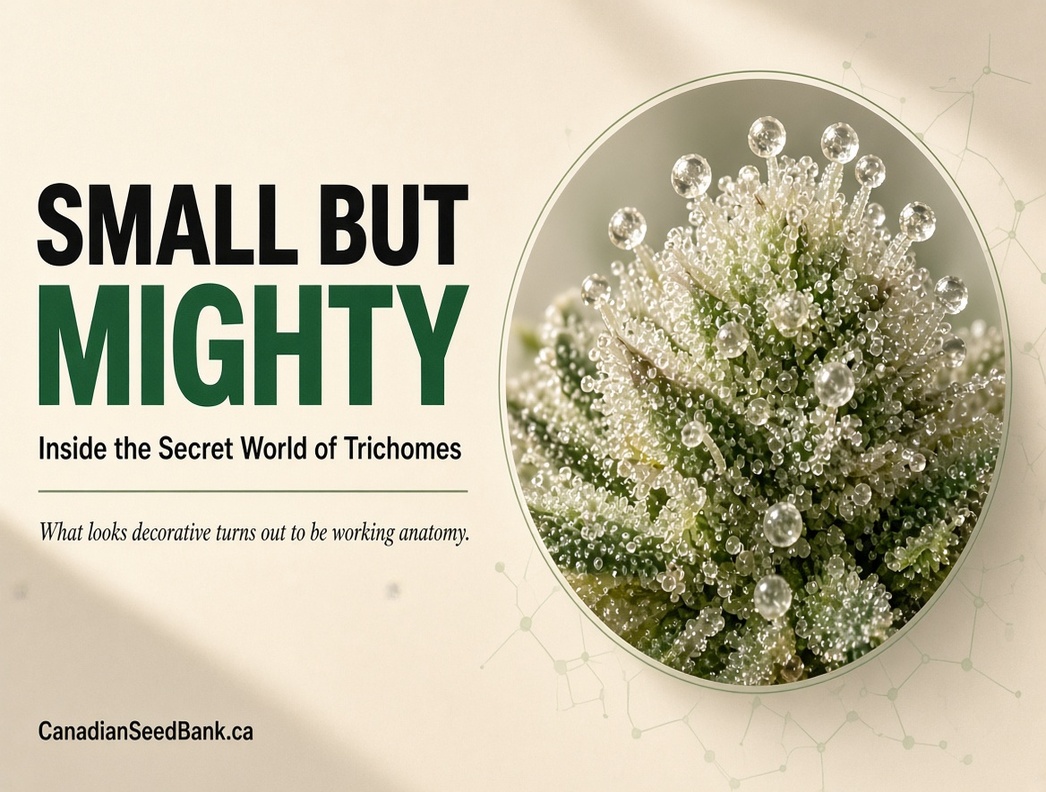
Small but Mighty
Inside the Secret World of Trichomes
Beneath cannabis’s frosted surface lies a microscopic system of extraordinary chemical organisation.
From a distance, a resinous cannabis flower can look dusted with sugar. Under magnification, that impression gives way to something stranger: a landscape of stalks and rounded heads, crowded together like a forest designed on a scale the eye was never meant to navigate. These structures are trichomes. Some are closely involved in producing and storing the compounds that make cannabis chemically distinctive. What looks decorative in a photograph turns out to be working anatomy.
The familiar cannabis leaf gets most of the public recognition. It appears on signs, packaging and an improbable number of socks. Yet some of the plant’s most consequential biology occurs in structures so small that their internal organisation remained poorly understood long after the leaf became an international symbol.
By 2025, microscopy and molecular research have begun to bring that hidden world into sharper focus. The findings reveal a plant doing more than accumulating resin. It is organising cells, directing chemical pathways and managing storage in specialised compartments. The surface sparkle is merely the part we can see without asking too many questions.
More than one kind of hair
In botany, a trichome is an outgrowth of the plant’s outer surface. The term covers a variety of structures across the plant kingdom. Some are glandular, meaning they produce or secrete substances; others have different physical roles.
Cannabis glandular trichomes are commonly described in three broad forms: bulbous, sessile and stalked. Their names point towards visible differences in size and shape. The stalked form, with its rounded glandular head raised above the surface, is the one most likely to resemble a tiny lollipop in a close photograph. A 2021 review explains these categories while emphasising that development can complicate identification. Tanney and colleagues, 2021
This is a useful warning against trusting the silhouette too quickly. A structure’s appearance at one stage does not always tell us its eventual identity. Biology moves; a photograph freezes it.
The distinction matters because trichomes are often discussed as if they were identical containers, differing only in how many appear on a flower. A more accurate picture begins with variety. Their anatomy and chemistry can differ, and understanding those differences requires more than counting visible points of light.
A Canadian team looks inside
Research led by Samuel Livingston and colleagues at the University of British Columbia, published online in 2019 and in The Plant Journal in 2020, examined cannabis trichomes using microscopy, chemical analysis and gene expression data. The team found differences in secretory cell numbers and chemical profiles between stalked and sessile glands. The evidence also supported a developmental relationship in which some apparently sessile structures become stalked trichomes. Livingston and colleagues, 2020
The study used the structures’ own fluorescence under specialised imaging conditions to help distinguish them. That is not the same thing as judging flower colour in ordinary light. It is an analytical technique that turns otherwise difficult differences into measurable information.
The larger lesson is that a gland’s outward shape and its internal work belong in the same investigation. Anatomy can help explain chemistry, while chemistry can reveal distinctions anatomy alone might miss.
There is a practical scientific reason to care about these definitions. If two researchers use the same name for different developmental structures, their results may appear to disagree even when both sets of measurements are sound. Shared terminology helps make comparisons meaningful. The everyday word “frost” cannot do that work. It describes an impression rather than a precisely identified structure. Moving from that impression to a reproducible description is part of the unglamorous craft of research, and one reason the most valuable paper is not always the one with the most dramatic conclusion.
This is the kind of research that rarely produces a dramatic retail slogan. It produces something more durable: a better description of what the plant actually is. Once the categories improve, future experiments can ask better questions and make more meaningful comparisons.
The remarkable organisation of a gland
In 2022, Livingston and colleagues took the investigation further in Current Biology. Using rapid freezing methods and electron microscopy, they described metabolically active cells connected through extensive bridges, functioning as a coordinated “supercell.” They also examined the spatial arrangement of structures and enzymes involved in cannabinoid production. Livingston and colleagues, 2022
The term sounds borrowed from science fiction, but the interest is practical. Producing specialised compounds requires organisation. Materials must reach the right places, reactions must occur in a workable sequence and products must be accommodated without the whole system becoming chemically chaotic.
The finding helps move the discussion from a list of ingredients towards the machinery that makes them possible. A chemical profile tells researchers what is present. Cell biology asks how the plant manages to produce and arrange it. That shift matters well beyond cannabis. A plant cell is not a miniature beaker in which everything happens everywhere. Its compartments and connections influence what reactions can occur. Studying those relationships reveals a form of organisation that an ingredient list cannot capture.
For a reader, the reward is a different kind of appreciation. The small gland is interesting because it has an internal life, not merely because people place value on some of its contents.
Chemistry has a workforce
Terpenes offer another route into this hidden system. They contribute to the aromatic character of many plants, including cannabis. Their production depends on enzymes, including terpene synthases, that guide the formation of particular molecules.
In a 2017 paper, Judith Booth, Jonathan Page and Jörg Bohlmann identified and characterised cannabis terpene synthases. Their work connected genes and enzyme activity with the chemical diversity of cannabis resin. Booth and colleagues, 2017
This is a more informative explanation than imagining that a plant simply contains a flavour. A scent emerges from compounds, and compounds emerge from biochemical processes. The language of aroma is the human description of a result; enzymes are part of how the result is made.
A later study by Booth and colleagues, published in 2020, examined terpene variation and additional synthases across cannabis varieties. It added detail to the relationship between genetic machinery and diverse terpene profiles. Booth and colleagues, 2020
That research does not turn an aroma into a guaranteed effect on a person. It explains production and variation within the plant. Keeping those questions separate prevents a useful botanical discovery from being converted into an unsupported promise about mood or medicine.
The distinction is especially valuable in popular writing. “This enzyme contributes to making a compound” and “this compound produces a particular experience” are different claims, requiring different evidence. Moving casually from one to the other skips much of the science.
Why sparkle cannot replace analysis
A dense covering of visible glands is striking, and it is understandable that people associate the appearance with resin. But a photograph does not measure the exact contents of those glands. It cannot establish a complete cannabinoid profile, quantify every aromatic compound or demonstrate the absence of contaminants. The reason is simple: a visible structure and a measured substance are not the same object of enquiry. A glass bottle tells us something about packaging. It does not tell us everything about the liquid inside.
Research by Zamir Punja and colleagues in 2023 examined glandular trichome development across plant ages and genotypes. The study documented variation in morphology and maturation, reinforcing the importance of developmental context when comparing flowers. Punja and colleagues, 2023
For an ordinary reader, that finding should encourage restraint rather than a new visual scoring system. An image records a particular sample under particular conditions. It is evidence worth considering, but its limits remain even when the photograph is spectacular.
This is also why colour descriptions of gland heads should not be promoted into universal guarantees about a finished product’s effects. Observation can be meaningful without supplying every answer. Laboratory analysis and human research exist because appearance cannot resolve all the questions we ask.
The plant beyond the product
One of the subtler problems in cannabis writing is the tendency to explain every trait through its usefulness to people. A gland becomes a delivery device. An aroma becomes a selling point. A flower becomes a collection of specifications.
Those perspectives are understandable, but incomplete. The plant’s biology did not begin with a menu. To understand it properly, researchers must ask questions about development, function and variation that may have no immediate commercial answer.
That is where the trichome story becomes especially rewarding. It takes a familiar surface and restores its complexity. The structures have different forms. Their cells coordinate activity. Their chemical products depend on particular pathways. Their appearance changes with development. None of that requires a marketing superlative to be interesting. There is a lesson here for how cannabis research is communicated in 2025. Discovery does not always arrive as a newly named cannabinoid or a claim about a future treatment. Sometimes it arrives as a better image of a cell, a more accurate description of a gland or an enzyme whose role has finally been tested.
These advances may appear small because their subjects are small. Their value lies in the foundation they provide. Reliable explanations accumulate through details that can be checked, challenged and built upon.
The next time a cannabis photograph shows a frosted flower, the most interesting question may be what lies beneath that apparent dusting. There is architecture there, and coordinated labour, and a chemical history that no glamour shot can fully reveal.
The leaf may remain the celebrity. The trichomes are doing much of the work.