
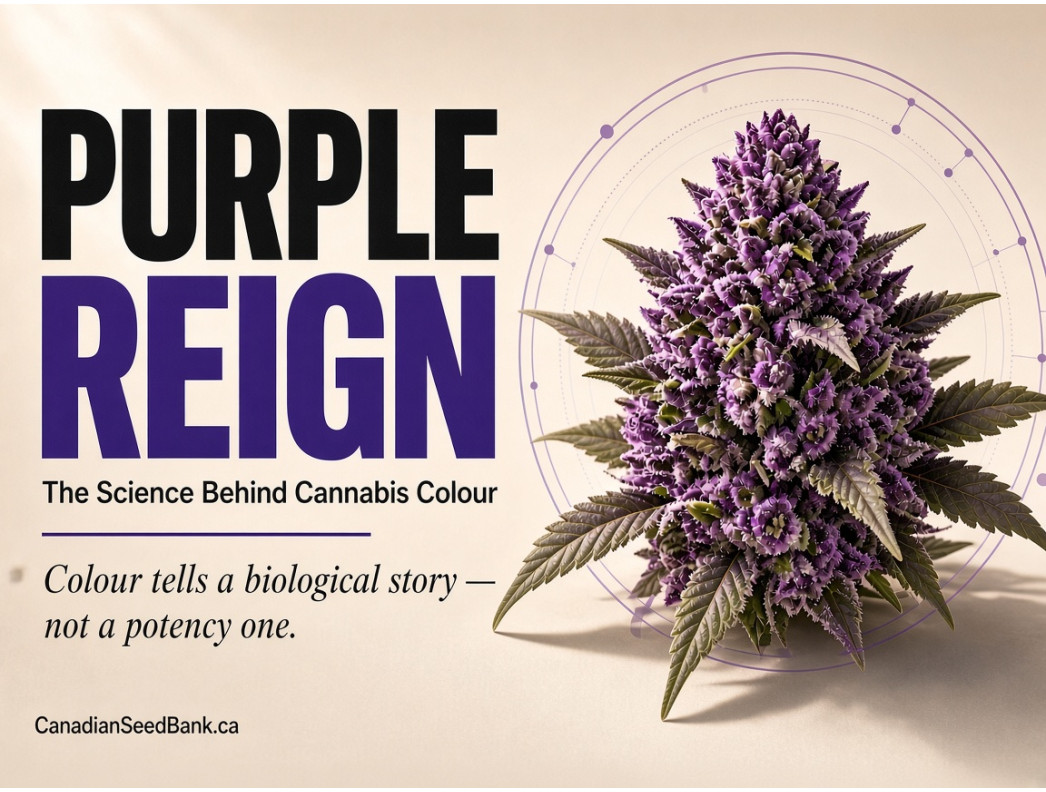
Purple Reign
The Science Behind Cannabis Colour
The plant’s most photogenic trait tells a fascinating biological story. It is less forthcoming about potency.
A purple cannabis flower makes its entrance before anyone reads the label. Against a background of green, its colour suggests something unusual, perhaps rare, perhaps luxurious. It is an impressive amount of public relations for a pigment.
The visual appeal is real. The conclusions attached to it are another matter. A flower can look like a small velvet sculpture without offering any dependable clue about how strong it is, what it smells like or how a person will respond to it. Colour is evidence of colour. Everything beyond that requires another question.
That does not make the subject superficial. The science behind cannabis pigmentation connects genetics, cellular chemistry and plant development. By 2025, researchers are beginning to describe those connections in greater detail, moving the conversation beyond the convenient idea that purple is simply what happens when green becomes more interesting.
Look closely and the flower becomes a collection of overlapping stories. Its green tissues, darker patches, pale resin glands and fine hairs belong to different biological systems. The eye blends them into an impression. Science has the less glamorous job of separating them again.
Meet the pigments behind the performance
The main characters in purple plant colour are anthocyanins, a group of pigments within the wider flavonoid family. Their familiar territory includes the reds, blues and purples seen across many fruits and flowers. They are stored in cellular compartments called vacuoles, where their chemical surroundings help influence their appearance. The pigment molecule is part of the explanation; its setting matters too. Chemistry of anthocyanin colour
This helps explain why “purple” is an imprecise chemical description. Two tissues can look broadly similar while containing different mixtures or amounts of pigments. Conversely, a related pigment system can contribute to different shades depending on its environment. A colour name is a useful piece of ordinary language, not an inventory of molecules.
The distinction is familiar outside cannabis. We do not expect every red apple to have identical flavour or every dark grape to make the same wine. Yet cannabis colour can acquire an unusual burden of expectation, as though the plant were publishing its entire character in a visible code.
It is not. Purple gives us a reason to investigate the pigment system. It does not give us permission to skip the investigation.
A genetic story comes into focus
In a 2024 paper in Plant Direct, Kristina Gagalova and colleagues examined anthocyanin biology in four cannabis varieties with different pigmentation. The researchers compared chemical profiles and gene activity, identifying associations between anthocyanin accumulation in leaves and the expression of several genes involved in the pigment pathway. Gagalova and colleagues, 2024
The emphasis on leaves is worth retaining. A study of one tissue does not automatically explain every coloured feature of every flower. Nor does a correlation between gene activity and pigment accumulation prove that a single gene controls the entire visible result. What the research offers is a more detailed view of a coordinated biological process.
For readers accustomed to a simple “purple gene” explanation, that complexity is useful. Plants do not generally manufacture elaborate traits through a single switch labelled dramatic. They rely on biochemical pathways, regulation and interactions among processes.
The result also changes how a photograph should be read. A striking image captures an expression of biology at a particular moment. It is not a guarantee that every individual sharing a commercial name will reproduce every detail in the frame. A name, an image and a measured characteristic provide different kinds of information.
Botanists distinguish a genotype, the genetic constitution of an organism, from its phenotype, the characteristics it expresses. The vocabulary can sound academic until a visual promise depends on it. A description of inherited potential and a description of an observed specimen are not interchangeable. Keeping them separate allows a reader to appreciate variation without treating every difference as a contradiction. It also encourages better documentation: photographs of more than one specimen, clear descriptions of the tissue shown and honest language about how consistently a characteristic has been observed.
For a seed business, this is an opportunity to communicate with more precision. There is a meaningful difference between describing a tendency associated with a lineage and promising an identical appearance in every plant. The first respects biological variation. The second asks a catalogue photograph to perform a laboratory’s job.
Green deserves some credit
Purple attracts attention partly because green is doing so much of the background work. Chlorophyll is central to the familiar green appearance of plant tissues and to the light absorbing machinery of photosynthesis. Carotenoids contribute additional pigment chemistry, including yellow and orange tones. Their visual prominence depends on the tissue and the surrounding mixture of pigments.
These are basic features of plant biology, but they are easy to forget when colour is discussed as if it were an optional cosmetic upgrade. A cannabis flower does not begin as a neutral object awaiting decoration. Its appearance emerges from living structures with different jobs.
That distinction also prevents a common interpretive mistake: assuming every visible colour change has the same cause. A darker patch, a pale surface and a reddish hair may look like parts of one palette, yet they need not share a mechanism. Identifying the structure comes before explaining its colour.
The fine threads protruding from female cannabis flowers, for example, are associated with reproductive anatomy. They are distinct from the glandular trichomes that give many flowers a sparkling appearance. Botanical research on female cannabis architecture describes these structures as parts of a complex flowering system, rather than interchangeable decorations. Spitzer Rimon and colleagues, 2019
That may sound like a distinction reserved for microscopes and examination papers. In practice, it changes the quality of everyday descriptions. Saying precisely what is purple, pale or orange is more informative than treating the entire flower as one coloured object.
The flower is not wearing a potency label
Anthocyanin colour and cannabinoid concentration are different measurements. Seeing abundant purple tissue does not quantify THC, just as seeing green tissue does not quantify chlorophyll without an appropriate analytical method. A camera can document appearance. It cannot replace chemical testing.
Nor can visual drama establish a predictable effect. The route from a plant’s composition to a person’s experience involves questions that pigmentation alone does not address. A claim that purple necessarily means stronger, more relaxing or more medicinal therefore needs evidence beyond photographs and repeated anecdotes.
This is a question of inference, not an insult to colourful plants. Purple cannabis may have characteristics someone values. The issue is whether the colour establishes those characteristics. A product can be both beautiful and accurately described without claiming a scientific connection that has not been demonstrated.
The same restraint applies to health language. Research on anthocyanins in foods or experimental preparations does not establish that consuming purple cannabis produces an equivalent benefit. The material, amount, preparation and route of exposure would all need consideration. A pigment’s presence cannot carry an entire medical argument.
There is a temptation to make beauty useful by giving it an additional function. Perhaps a flower cannot simply be attractive; it must also be exceptionally potent or unusually beneficial. But aesthetic interest does not need a therapeutic excuse. Admiring a colour is perfectly reasonable. Turning admiration into a health claim is a different activity.
What a photograph leaves out
Even the visible evidence arrives through a filter. Lighting changes the balance of colour in a photograph. Exposure, camera settings and editing influence what a viewer sees. A close photograph can also emphasise a small region that is less prominent when the whole specimen is considered. None of that makes photography inherently misleading. It makes context valuable. A useful image shows the feature clearly and represents it fairly. A useful caption identifies what is being shown. If an illustration exaggerates colour for artistic effect, it should not be confused with a documentary record of a particular plant. The distinction is especially relevant in a market where the image may be the reader’s first encounter with the product.
Science photography asks related questions. Which tissue was sampled? Was it examined under ordinary light or a specialised imaging method? Is the colour natural, enhanced or assigned to make otherwise invisible information understandable? An image can be accurate while requiring explanation.
That is why a laboratory image and a product photograph should not be expected to answer the same questions. One may reveal anatomy; the other may communicate appearance. Both can be valuable without becoming substitutes for the rest of the evidence.The deeper fascination of purple cannabis lies in this movement between scales. From across a room, there is a colour. Closer in, there are tissues. Closer still, there are cells, pigments and patterns of gene activity. Each view reveals something the previous one concealed.
It is a richer story than a ranking of the darkest flowers. It also provides a better vocabulary for appreciating variation. Burgundy, violet and near black impressions can invite curiosity about the plant without being promoted into claims about superiority.For readers in 2025, the most useful shift is from asking what purple promises to asking what purple reveals. That question leads towards botany, evidence and careful observation. It makes room for wonder without requiring credulity.
The flower has already done something remarkable: it has made a complex piece of cellular chemistry visible. There is no need to improve the story by inventing a hidden potency certificate.
Purple can keep the crown for making an entrance. The rest of its reputation should still have to earn an explanation.