
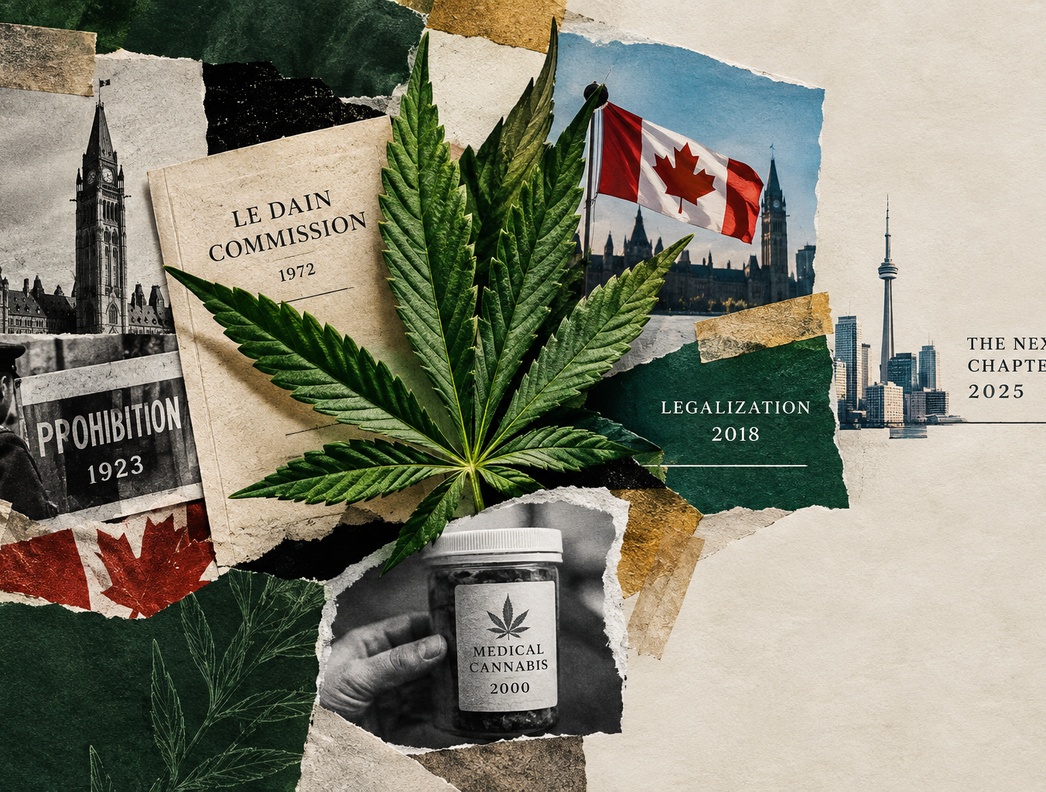
Canada’s Cannabis Plot Twist
How a Plant Became a National Debate
The journey from prohibition to legalisation was never a straight line. In 2025, its most revealing questions remain unfinished.
Canada’s cannabis story contains a peculiar reversal. A plant once treated as a matter for the criminal courts now appears in conversations about retail competition, product labels and public company balance sheets. The substance did not undergo a sudden botanical transformation in October 2018. The country changed the rules around it.
That distinction is easy to lose in the familiar before and after picture. Prohibition occupies one side; legalisation occupies the other. Between them sits a date, apparently explaining everything.
The actual story is more revealing. It involves obscure legislative decisions, commissions whose recommendations outpaced political action, patients who challenged the law and a national experiment that exchanged one set of difficult questions for another. By 2025, the most useful way to understand Canadian cannabis is to examine those turning points without pretending the ending has already been written.
Legalisation was a major decision. It was never a declaration that the work was finished.
A prohibition with an uncertain origin story
Cannabis entered Canada’s prohibited drug framework in 1923. A later Senate examination described how Health Minister Henri Séverin Béland referred to a new drug being added to the schedule, while noting that the circumstances behind the decision remained obscure. The record does not support the tidy impression of a comprehensive national debate followed by a clearly documented verdict. Senate Special Committee on Illegal Drugs, historical review (https://sencanada.ca/en/content/sen/committee/371/ille/rep/repfinalvol2-e)
That uncertainty matters. When a policy lasts for decades, longevity can begin to look like justification. People inherit the existence of the rule and assume that someone, somewhere, must have settled the argument before making it.
Historical investigation asks a less comfortable question: what if the confidence attached to the rule exceeds the surviving explanation for it?
This does not mean every later concern about cannabis was invented. It means the origin of a prohibition and the evidence relevant to present policy are separate subjects. Neither should be allowed to substitute for the other.
The point is especially important when discussing a substance with both real risks and a long history of exaggerated claims. A useful account must leave room to criticise the law without romanticising the product. Otherwise, history becomes another instrument in an argument it was supposed to illuminate.
The report that arrived before the politics
By the early 1970s, the country had produced a remarkably searching reconsideration of its approach. The Le Dain Commission’s 1972 cannabis report examined harm, criminal penalties and the limits of available evidence. Its majority recommendations supported repealing the prohibition on simple possession and cultivation for personal use, while retaining controls over commercial distribution. Le Dain Commission majority conclusions, 1972 (https://www.druglibrary.org/schaffer/Library/studies/ledain/ldc6a.htm)
The reasoning was significant because it separated concern about a substance from support for every punishment imposed on its users. A government could recognise health and social risks while also asking whether criminal penalties created additional damage.
That is a more demanding position than either unconditional approval or blanket condemnation. It requires comparing imperfect options. It asks whether a policy works, what it costs and who bears those costs.
The majority’s recommendations did not immediately become the country’s operating model. Cannabis prohibition persisted for decades. The gap between the report and the eventual change is a reminder that producing an argument and building the political conditions for action are different achievements.
There is something recognisably Canadian about a major policy debate arriving with a substantial report and then spending years waiting for the next meeting. Yet the delay was not merely bureaucratic theatre. During those years, the law continued to affect real people.
The commission’s enduring contribution was a framework for asking better questions. It treated the response to cannabis as a subject of evidence and judgement, rather than an automatic consequence of the plant’s reputation.
Patients changed the terms of the conversation
Medical access brought another challenge to the established framework. In 2000, the Ontario Court of Appeal’s decision in R. v. Parker addressed the constitutional problems created by prohibiting possession without an adequate medical exemption. The case concerned Terry Parker, who used cannabis to manage severe epilepsy. The judgment became a pivotal part of the legal history of medical access. R. v. Parker, Ontario Court of Appeal, 2000 (https://www.canlii.org/en/on/onca/doc/2000/2000canlii5762/2000canlii5762.html)
The importance of that development extends beyond one patient or one condition. Medical access disputes forced institutions to engage with particular circumstances that broad slogans could overlook. A general prohibition had to be considered alongside a person’s liberty, security and health needs.
None of this established that cannabis was an effective treatment for every illness, or that patient testimony could replace clinical research. Those would be different conclusions. The constitutional question concerned the defensibility of the legal framework, not a universal medical endorsement of the plant.
That distinction still matters in 2025. Medical access, evidence of therapeutic benefit and the commercial availability of cannabis overlap, but they are not interchangeable. A court can identify a rights problem without settling every scientific question. A retail market can expand without resolving every patient’s difficulty obtaining appropriate care.
The history becomes clearer when these developments are allowed to retain their separate meanings. Patients were not simply a prelude to a consumer market. Their needs helped expose limits in the existing system and remain a policy subject in their own right.
What changed in 2018
The Cannabis Act came into force on October 17, 2018. The federal framework established legal, regulated adult access while retaining restrictions. Its stated objectives included protecting young people, reducing criminal involvement and protecting public health and safety. Responsibilities were divided across levels of government, producing a national framework with provincial and territorial differences. Department of Justice, cannabis legalisation and regulation (https://www.justice.gc.ca/eng/cj-jp/cannabis/)
That was a major departure from prohibition, but it was not the absence of regulation. The country moved from broadly prohibiting a market to defining how a legal market could operate.
It also moved beyond decriminalisation, a term often used loosely in public debate. Removing criminal penalties for a particular act does not by itself create a regulated supply system. Legalisation requires decisions about what activity is permitted and under which conditions. The difference helps explain why reform proposals that sound similar can produce very different institutions. One may change what happens after a person is found in possession. Another must decide who may produce, distribute and sell, and how those activities will be supervised. Canada’s eventual framework had to address the second set of questions as well as the first.
This distinction helps explain why legalisation could generate apparently contradictory complaints. A business might find the rules burdensome. A public health advocate might worry about commercial incentives. A consumer might want more convenient access. Each could be responding to a different objective within the same framework.
Those tensions are built into the task. A policy intended to displace illegal supply must offer an alternative that people will use. A policy intended to reduce harm cannot treat every increase in sales as an uncomplicated success. A functioning market and a successful public health strategy are related, but their scorecards are not identical.
The harder question is how to balance them openly. Arguments become less useful when a commercial concern is presented as the whole public interest, or when every practical obstacle is dismissed as evidence that regulation itself has failed.
The past did not disappear from the record
Legalisation also raised an obvious question about people who already had criminal records for simple possession. In 2019, Canada introduced an expedited process for eligible cannabis record suspensions, removing the application fee and waiting period associated with that process. A record suspension is distinct from erasing the historical existence of a conviction. Parole Board of Canada, cannabis record suspensions (https://www.canada.ca/en/parole-board/corporate/publications-and-forms/applying-for-a-cannabis-record-suspension.html)
The distinction reveals something larger about policy transitions. Changing the rule for tomorrow does not automatically repair the consequences of yesterday’s rule. A society can redefine an activity while leaving people to navigate the administrative remains of its earlier position.
For that reason, the history of legalisation cannot be written entirely through store openings and sales figures. It also concerns whose burdens were reduced, whose circumstances remained complicated and how a new system acknowledged the old one.
This is not an argument for a single simple remedy. It is an argument for keeping the question visible. A national success story should be capable of examining the people who do not fit neatly inside its celebratory photograph.
The view from 2025
Canada’s 2024 expert review reported substantial progress, including a sharp reduction in possession charges and movement towards legal supply. It also identified continuing concerns about youth, potent products, medical access and the treatment of Indigenous communities within the framework. These were the panel’s findings and recommendations, not proof that every proposed reform had been implemented. Cannabis Act expert panel, 2024 (https://www.canada.ca/en/health-canada/services/publications/drugs-medication/legislative-review-cannabis-act-final-report-expert-panel.html)
That mixed assessment is more informative than declaring the experiment either a triumph or a disaster. A policy can improve one outcome while struggling with another. It can deserve credit and revision at the same time.
The Canadian story therefore resists the clean ending that political storytelling prefers. Prohibition did not begin with all the clarity later attached to it. Reform did not arrive as soon as serious arguments supported it. Legalisation did not eliminate the need for judgement.
What changed was the range of questions the country could ask in public. The debate could move beyond whether cannabis existed outside the law to how a regulated system should function, whom it should serve and how its results should be measured.
That is substantial progress. It is also a continuing obligation. In 2025, the most interesting chapter in Canada’s cannabis history is the one in which the country learns to evaluate its own decisions without defending them as permanent monuments.
A law can change on a particular morning. Learning what to do with that change takes considerably longer.