
Beyond THC
The Cannabis Story a Percentage Cannot Tell
Imagine two jars of cannabis flower sitting side by side. One carries a higher THC percentage. The other has a distinctive aroma: citrus peel, something woody, a sharp note that is difficult to name. Which one tells the more interesting story?
A percentage offers an immediate answer to a narrow question: concentration. Everything else takes more investigation. What creates that smell? Does a familiar strain name reliably identify what is inside? How much can a laboratory report explain about something people experience through their senses?
Those questions are drawing researchers into territory that cannabis marketing often compresses into a number or a catchy name. Their findings reveal a plant whose character is considerably more complicated than its most famous ingredient.
For Canadian Seed Bank readers, this is where cannabis becomes especially interesting: at the meeting point of genetics, chemistry, human perception and the stories attached to particular varieties.
What THC Can Actually Tell Us
THC deserves attention. Health Canada identifies it as the substance primarily responsible for cannabis intoxication. Its effects can include impaired attention and memory, and some people experience anxiety or panic. Discussing aroma and diversity does not make potency irrelevant; concentration remains meaningful information with real implications. Health Canada.
A potency figure measures one aspect of a product. Health Canada’s label guidance explains that “Total THC” represents the THC available when the product is heated. It does not give the product a score for aroma, establish its ancestry or promise a particular personal experience. Reading that number accurately is useful; asking it to answer unrelated questions is where confusion begins. Health Canada’s cannabis label guide.
When Researchers Put Aroma to the Test
One intriguing challenge to potency as a stand-in for quality appeared in a 2022 study published in Psychoactives. Researchers analysed anonymous reports from volunteers evaluating cannabis flower in competitions. Samples were distributed under blinded conditions, reducing the influence of knowing a product’s identity beforehand.
Pleasant aroma was associated with pleasant subjective effects. THC potency, by contrast, was not associated with overall subjective appeal in the analysis. Neither was the total amount of terpenes measured. Plumb and colleagues, 2022.
The finding is provocative, but its boundaries matter. This was an observational analysis involving competition participants, rather than a clinical trial proving that a particular smell causes a better experience. It cannot establish what every consumer will prefer.
What it does offer is a reason to question the assumption that increasing one laboratory number automatically improves the experience being judged.
The Chemical Mystery Behind the Skunky Smell
The discovery behind cannabis’s unmistakable skunky note reads almost like a chemical detective story.
In 2021, researchers reporting in ACS Omega identified a family of volatile sulfur compounds associated with that characteristic scent. One compound, 3-methyl-2-butene-1-thiol, emerged as the principal contributor. The important detail is its chemical family: the explanation lay beyond the terpenes that usually dominate conversations about cannabis aroma. Oswald and colleagues, 2021.
The researchers used sophisticated analytical equipment to separate and identify aromatic compounds. They also tracked the sulfur compounds over time, finding that their concentrations changed during development and after harvest. In that experiment, concentrations rose late in flowering, peaked during curing and subsequently declined in storage.
That gives the familiar smell another dimension. Aroma reflects chemistry that can change over time. It is not simply a permanent feature captured by a strain name. The findings also explain why discussing cannabis scent solely through a short list of dominant terpenes leaves part of the story untold.
What Is Really Behind a Strain Name?
A separate line of research has investigated the names themselves. “Indica” and “sativa” are among the most recognisable words in cannabis, but how closely do those labels match the plant’s underlying biology?
A 2021 study in Nature Plants, involving researchers at Dalhousie University and collaborators, examined chemical data from 297 samples and genetic data from 137 of them. Samples carrying indica and sativa labels did not form clearly distinct groups across the genome. Instead, the labels were associated with variation in a relatively small number of terpenes. Watts and colleagues, 2021.
The researchers also found that samples sharing a cultivar name could be as genetically and chemically different as samples with different names. That does not make every name meaningless. It does make a name alone a weak substitute for documented identity. The work was funded primarily by cannabis producer Bedrocan, and two authors were company employees—relevant context when assessing industry-connected research.
For readers exploring cannabis genetics, the distinction opens up more useful questions. Who documented the lineage? What evidence accompanies the description? Is a claim about ancestry, measured chemistry or someone’s interpretation of an experience?
Those are different kinds of information, even when they appear together in the same paragraph.
Building a Better Language for Cannabis Aroma
The next challenge is giving people a better vocabulary for what they actually smell.
In October 2025, a study published in PLOS One introduced an aroma lexicon containing 25 descriptive terms. A human panel evaluated 91 cannabis samples using that vocabulary. The aim was to make descriptions more consistent and allow meaningful comparisons between samples. Participants smelled the flower; they did not consume it as part of the assessment. Isaacson and colleagues, 2025.
The researchers found overlapping sensory characteristics between THC-dominant and CBD-dominant samples. They also found that terpene profiles alone predicted sensory character poorly. Even the measured sulfur compound profiles did not strongly predict perception. The lesson is subtle: identifying important molecules and predicting the complete human experience of a mixture are different scientific tasks.
A common vocabulary helps close that gap. If two people use “citrus” differently, their descriptions can sound precise while communicating different things. Reference standards give sensory researchers a way to make those words more comparable.
Reading Cannabis Descriptions with a Sharper Eye
Taken together, these studies suggest a more demanding approach to cannabis information. A responsible description should make clear what has been measured, what has been observed and what remains an interpretation. Readers should be able to distinguish a research finding from a colourful adjective without becoming chemists themselves.
Consider how differently a description reads when it separates its evidence. An ancestry statement can name the source of the lineage. A chemistry statement can identify the sample tested. An aroma description can acknowledge that it records a sensory impression. None needs to promise an identical result for every person.
This approach gives readers information they can examine, compare and question.
That also changes what makes an article or variety profile worth reading. A string of superlatives offers little to investigate. A documented lineage, an explanation of an unusual aroma or an honest account of uncertainty gives a reader something to understand and remember. Specific information invites curiosity in a way that another claim of exceptional strength cannot.
A Plant with More to Reveal
There is still plenty scientists have not resolved. The studies discussed here ask different questions, use different samples and measure different outcomes. An aroma experiment cannot establish medical benefits. A genetic analysis cannot predict an individual’s response. Bringing the findings together is useful precisely when those distinctions remain visible.
The emerging story is richer than a contest between percentages. Cannabis can be examined as a plant with ancestry, a complex chemical composition and a sensory identity that researchers are still learning to describe. Each perspective reveals something the others leave out.
For CSB readers, the invitation is to stay curious about those details. Follow the evidence behind familiar names. Ask what a number actually measures. Notice when a confident claim runs ahead of the research.
The most revealing cannabis stories begin where the label runs out of room.

The Overlooked Elements
Why Trace Minerals Matter in Cannabis Plant Health
When
discussing plant nutrition, most attention goes to nitrogen,
phosphorus, and potassium. These primary nutrients are widely recognized
for driving visible growth. Yet behind every healthy leaf, sturdy stem,
and balanced growth pattern lies another group of elements working
quietly in the background.
These are the trace minerals that support the biochemical machinery of the plant.
Although required in very small quantities, these elements are essential for metabolic efficiency, structural development, and genetic expression. Without them, the larger nutrients cannot function properly. To truly understand cannabis plant health, it is important to look beyond the basics and examine the subtle but powerful role of these supporting minerals.
The Catalysts of Plant Metabolism
Unlike macronutrients, which become part of plant tissue in significant amounts, trace elements often act as catalysts. They assist enzymes, regulate chemical reactions, and help convert raw materials into usable energy and structural compounds.
Enzymes control nearly every internal function within a plant. Photosynthesis, respiration, hormone production, and protein synthesis all depend on properly activated enzymes. Many of these enzymes require small amounts of specific minerals to operate efficiently. When these elements are present in balanced amounts, metabolic processes flow smoothly. When they are absent or imbalanced, plant performance may decline even if primary nutrients are available.
Iron and Chlorophyll Formation
Iron plays a crucial role in the production of chlorophyll, the pigment responsible for capturing light energy. While iron is not a structural part of the chlorophyll molecule itself, it is essential for the enzymes that create it. Chlorophyll allows cannabis plants to convert light into carbohydrates through photosynthesis. Without adequate iron, this process becomes less efficient, and young leaves may struggle to develop rich green coloration. This illustrates how even small mineral imbalances can influence visible plant vitality.
Zinc and Growth Regulation
Zinc contributes to hormone regulation and protein formation. It influences how plants produce auxins, hormones that help control stem elongation and node spacing. In cannabis biology, structural balance is closely tied to hormone signaling. When zinc levels are appropriate, growth patterns tend to be steady and proportional. Because this element interacts with enzyme systems tied to gene expression, it indirectly affects how inherited traits are expressed during development.
Manganese and Energy Conversion
Manganese supports photosynthetic reactions and assists in breaking down water molecules during energy transfer. It also plays a role in nitrogen metabolism and cellular defense mechanisms. Plants continuously produce reactive oxygen molecules during metabolic activity. Manganese helps neutralize these byproducts, protecting cellular structures. Its contribution reinforces the interconnected nature of plant biology, where energy production and cellular protection operate together.
Boron and Structural Stability
Boron is involved in cell wall formation and sugar transport. It strengthens structural integrity and supports reproductive development. During active growth phases, cannabis plants rely on efficient transport systems to move sugars from leaves to other tissues. Boron helps maintain this internal flow. Even in tiny quantities, it supports the architecture that keeps plants stable and functional.
Molybdenum and Nitrogen Utilization
Nitrogen is one of the most important elements in plant development, but it cannot be fully used without molybdenum. This trace mineral enables the conversion of nitrate into usable forms that can be incorporated into amino acids and proteins. This relationship highlights an important principle: nutrients do not work in isolation. The presence of nitrogen alone is not enough. Supporting elements ensure that it can be properly absorbed and transformed.
Interconnected Biological Systems
Trace minerals are part of a complex web of interactions inside the plant. They influence enzyme activation, hormonal balance, energy conversion, and structural formation. Each element may seem minor in isolation, but together they sustain the plant’s internal balance.
Cannabis growth depends on precise coordination at the cellular level. When all essential elements are available in balanced proportions, genetic potential can be expressed more consistently. When deficiencies occur, subtle variations in leaf color, structure, or growth rate may emerge. This connection between mineral availability and phenotypic expression reinforces a broader truth in plant science: environment shapes how genetics are realized.
Why Small Elements Have Large Impact
Because these minerals are needed in such small amounts, they are sometimes overlooked. However, their absence can disrupt enzyme systems and reduce metabolic efficiency. Over time, even minor imbalances may influence plant resilience and overall structure.
From a cultivation biology perspective, understanding the role of trace elements encourages a more comprehensive view of plant health. It shifts the focus from visible feeding schedules to the invisible processes driving growth. Healthy cannabis plants are not built solely on large nutrient inputs. They are supported by a finely tuned network of chemical reactions that depend on both primary and supporting elements.
The Science Behind Balanced Growth
Every cannabis plant represents a dynamic biological system. Major nutrients provide bulk structure and energy. Trace minerals fine tune the reactions that transform that energy into organized living tissue. Although they operate quietly and in small quantities, these elements are foundational to chlorophyll production, enzyme function, nitrogen conversion, and structural integrity. They ensure that the plant’s internal systems operate efficiently and that genetic traits can be expressed within stable metabolic conditions.
In the science of plant development, size does not determine importance. Sometimes the smallest components play the most critical roles. By understanding the contribution of these supporting minerals, we gain a deeper appreciation for the complexity and precision behind healthy cannabis growth.
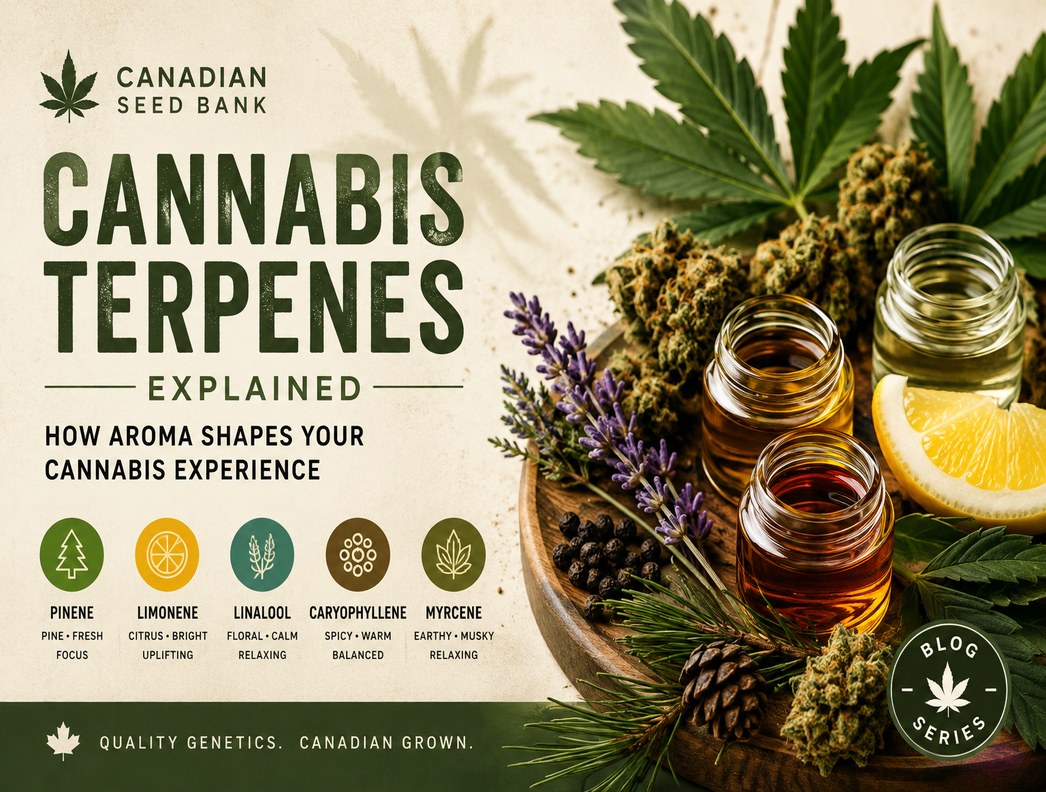
Cannabis Terpenes Explained:
How Aroma Shapes Your Cannabis Experience
When people first start exploring cannabis, most focus almost entirely on THC percentages. It's common to hear someone ask, "What's the strongest strain you have?" While THC certainly plays a significant role in the overall experience, experienced cannabis consumers know that potency is only one piece of a much larger puzzle.
The true personality of a cannabis strain comes from compounds called terpenes.
Terpenes are responsible for the unique aromas and flavors found in cannabis, from citrus and pine to berries, pepper, lavender, and even the unmistakable diesel scent found in some popular cultivars. More importantly, they are believed to influence how different strains make consumers feel when combined with cannabinoids like THC and CBD. This means two strains with nearly identical THC percentages can offer surprisingly different experiences based largely on their terpene profiles.
As cannabis research continues to evolve, terpenes are becoming one of the most discussed topics among growers, budtenders, medical patients, and recreational consumers alike.
What Are Terpenes?
Terpenes are naturally occurring aromatic compounds found throughout nature. They are produced by thousands of different plants, fruits, herbs, flowers, and even some insects. Their primary purpose is to create distinctive scents that serve various biological functions.
You've experienced terpenes every day without even realizing it.
Think about the smell of freshly cut lemons, the aroma of pine trees during a hike, the relaxing scent of lavender before bed, or the fresh fragrance of basil in your kitchen. These familiar scents all come from terpenes.
Cannabis simply happens to produce an exceptionally diverse range of these compounds, with scientists identifying well over 150 individual terpenes within the plant. Every strain contains its own unique combination, creating an almost endless variety of aromas and flavor profiles.
Why Do Cannabis Plants Produce Terpenes?
In nature, terpenes serve several important purposes beyond simply producing pleasant aromas.
They help protect cannabis plants from insects and herbivores, attract beneficial pollinators, defend against fungal infections, and even help the plant respond to environmental stress such as excessive heat or drought.
Some terpenes can also help discourage animals from feeding on the plant, while others attract insects that benefit the surrounding ecosystem. Nature has spent millions of years refining these chemical defenses.
For cultivators, terpene production is often viewed as an indicator of a healthy, carefully grown cannabis plant. Premium flower is usually recognized not only by its appearance but also by its rich, pungent aroma that fills the room as soon as the container is opened.
Terpenes vs THC
THC is the primary psychoactive cannabinoid responsible for the classic cannabis "high."
Terpenes themselves do not produce intoxication.
Instead, researchers believe terpenes may influence how cannabinoids interact with the body's endocannabinoid system. This concept is commonly known as the entourage effect, which suggests that cannabinoids, terpenes, and other naturally occurring compounds work together to create a more balanced and nuanced experience than THC alone.
Although research is still ongoing, countless consumers report that strains with similar THC levels often produce noticeably different effects due to their unique terpene compositions. This is one reason many experienced cannabis users pay just as much attention to terpene profiles as they do cannabinoid percentages.
The Most Common Cannabis Terpenes
Myrcene
Myrcene is often the most abundant terpene found in cannabis.
Common aromas
Earthy
Herbal
Musky
Cloves
Naturally found in:
Mangoes
Thyme
Hops
Lemongrass
Many consumers associate myrcene-rich strains with relaxation and evening use. While individual experiences vary, myrcene has earned a reputation for contributing to the classic "couch-lock" sensation often associated with certain indica-dominant cultivars.
Limonene
As the name suggests, limonene delivers bright citrus aromas that many people immediately recognize.
Common aromas
Lemon
Orange
Grapefruit
Naturally found in:
Citrus peels
Rosemary
Peppermint
Limonene-rich strains are frequently chosen by daytime consumers who appreciate vibrant flavors and refreshing aromas. The bright citrus scent also makes these strains particularly popular among new cannabis users.
Pinene
Pinene smells exactly like walking through a dense evergreen forest after a rainfall.
It exists in two forms:
Alpha-pinene
Beta-pinene
Naturally found in:
Pine needles
Rosemary
Basil
Dill
Pinene contributes a clean, crisp aroma that many consumers find refreshing. It is one of the most common terpenes found throughout nature and plays an important role in the familiar scent of forests.
Caryophyllene
Caryophyllene is one of the most fascinating terpenes discovered in cannabis.
Unlike most other terpenes, beta-caryophyllene has been shown to interact directly with CB2 receptors within the body's endocannabinoid system, making it unique among common cannabis terpenes.
Common aromas
Black pepper
Spice
Woody
Clove
Naturally found in:
Black pepper
Cinnamon
Oregano
Its spicy profile makes it relatively easy to identify, and many modern cannabis cultivars feature caryophyllene as one of their dominant terpenes.
Linalool
If you've ever enjoyed the relaxing scent of lavender, you've experienced linalool.
Common aromas
Floral
Lavender
Sweet herbs
Naturally found in:
Lavender
Coriander
Birch
Linalool contributes soft floral notes that stand out from the earthier aromas found in many cannabis strains. Many consumers enjoy these varieties during quiet evenings because of their pleasant fragrance.
Reading a Terpene Profile
Today, more licensed producers are providing terpene information directly on product packaging.
A terpene profile may look something like this:
Myrcene – 0.72%
Caryophyllene – 0.41%
Limonene – 0.38%
Pinene – 0.18%
While these percentages may appear small, terpenes are incredibly potent aromatic compounds. Even fractions of a percent can significantly influence how a cannabis product smells and tastes.
Many experienced consumers now compare terpene percentages before making a purchase rather than relying solely on THC levels.
Why Two 25% THC Strains Can Feel Completely Different
Imagine purchasing two dried flower products that both contain exactly 25% THC.
One strain is rich in limonene and pinene, creating a bright citrus aroma with fresh pine notes.
The second strain contains mostly myrcene and linalool, producing earthy, floral characteristics.
Although the THC percentage is identical, many consumers describe these products as providing very different overall experiences. This demonstrates why THC should be viewed as only one measurement of cannabis quality rather than the only factor worth considering.
How Storage Affects Terpenes
Terpenes are highly volatile compounds.
Exposure to excessive heat, oxygen, sunlight, and improper humidity can gradually cause terpenes to evaporate. As terpene levels decline, cannabis may lose much of its original aroma, flavor, and overall freshness.
To preserve terpene content:
Store cannabis in airtight glass containers.
Keep products in a cool, dark environment.
Avoid direct sunlight.
Minimize repeated exposure to oxygen.
Never leave cannabis in a hot vehicle for extended periods.
Proper storage not only helps preserve flavor but also allows consumers to enjoy the product much closer to how it was originally cultivated.
Terpenes Beyond Flower
Terpenes are present in far more than dried cannabis flower.
Consumers will also find terpene-rich products including:
Pre-rolls
Vape cartridges
Live resin
Live rosin
Cannabis concentrates
Full-spectrum oils
Some infused edible products
Live resin products have become especially popular because they are produced using fresh frozen cannabis, helping preserve more of the plant's original terpene profile than many traditional extraction methods.
Shopping Smarter
Instead of asking for the highest THC percentage, consider asking your budtender more detailed questions such as:
Which terpenes are most dominant?
Is this strain more fruity or earthy?
Does it have citrus, floral, or pine aromas?
Was it grown indoors or outdoors?
Was it harvested recently?
Is the terpene profile lab tested?
Is this cultivar known for preserving high terpene content?
These conversations often lead consumers to products that better suit their individual tastes and preferences.
The Future of Cannabis Selection
As cannabis science continues to expand, terpene education is becoming increasingly important.
Many industry experts believe future cannabis shopping will resemble the way enthusiasts purchase wine or craft coffee. Consumers will place greater emphasis on aroma, cultivation methods, terpene profiles, freshness, and overall quality rather than focusing exclusively on THC percentages.
Understanding terpenes allows consumers to make more informed purchasing decisions while developing a greater appreciation for the incredible complexity of the cannabis plant.
The next time you visit a dispensary, don't stop at the THC percentage. Take a moment to smell the product when possible, examine the terpene profile, ask questions, and explore the remarkable diversity that cannabis has to offer.
You may discover that your favorite cannabis product isn't necessarily the strongest one on the shelf. Instead, it may simply be the strain whose unique terpene profile best matches your personal preferences, making every session more enjoyable, flavorful, and memorable.
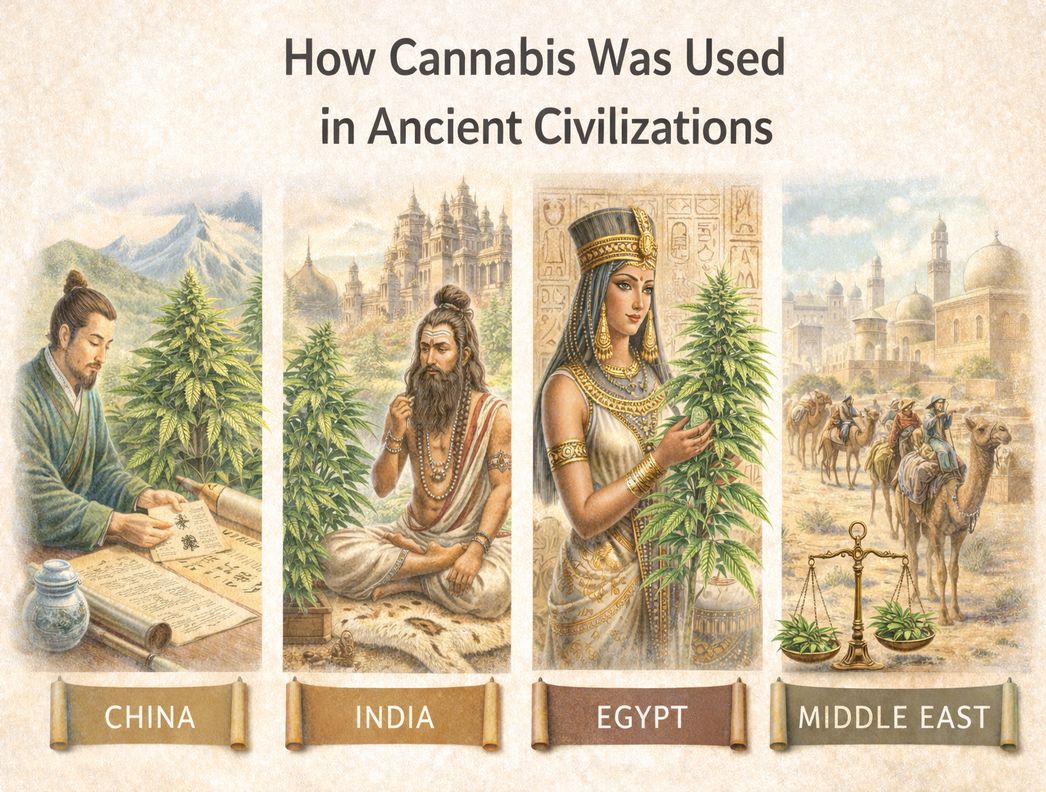
Cannabis in Ancient Civilizations
How Cannabis Was Used in Ancient Civilizations
Long before cannabis became a topic
of modern discussion, it was an integral part of daily life in many
ancient civilizations. Across Asia, Africa, and the Middle East,
cannabis was cultivated and valued for its versatility; used in
medicine, textiles, rituals, and trade.
Exploring these early uses
reveals how deeply cannabis is woven into human history and why it has
endured for thousands of years.
Ancient China: Medicine, Fiber, and Innovation
China is widely regarded as one of the earliest regions to cultivate cannabis. Archaeological evidence suggests cannabis was grown as early as 3000 BCE, primarily for its strong fibers. Hemp was essential for making rope, clothing, fishing nets, and early forms of paper -- innovations that supported trade, communication, and agriculture.
Cannabis also played a role in traditional Chinese medicine. Ancient texts attributed to Emperor Shen Nong reference the plant as part of early herbal practices. Cannabis preparations were documented for a variety of traditional applications, reflecting a sophisticated understanding of plants and their properties. In China, cannabis was valued not for a single purpose, but for its practicality -- serving both industrial and medicinal roles in a rapidly advancing civilization.
Ancient India: Spirituality and Ayurvedic Tradition
In India, cannabis held a unique dual role as both a medicinal plant and a spiritual substance. References to cannabis appear in ancient sacred texts such as the Atharva Veda, where it is described as one of the sacred plants of the earth.
Within Ayurvedic traditions, cannabis was incorporated into herbal formulations and consumed in regulated forms. It was also used in religious ceremonies and rituals, particularly those associated with spiritual introspection and devotion. Cannabis in India was deeply connected to philosophy, ritual, and balance; used thoughtfully within cultural and spiritual frameworks rather than as a casual substance.
Ancient Egypt: Medicine and Ritual Use
Evidence of cannabis use in ancient Egypt appears in medical papyri dating back over 3,500 years. These texts describe plant-based remedies used by physicians of the time, reflecting an advanced medical system that relied heavily on natural ingredients.
Cannabis is believed to have been included in certain medicinal preparations, possibly used in topical or oral forms. Some historians also suggest cannabis may have had ritual significance, given Egypt’s strong connection between medicine, religion, and the afterlife. Egypt’s use of cannabis highlights its role within structured medical knowledge rather than informal or recreational use.
The Middle East: Trade, Textiles, and Cultural Exchange
The Middle East played a crucial role in the spread of cannabis through ancient trade routes. Positioned between Asia, Africa, and Europe, the region served as a hub for exchanging goods, knowledge, and agricultural practices.
Cannabis was widely cultivated for hemp fiber, which was essential for making ropes, sails, and textiles: materials critical for transportation and commerce. As trade expanded, cannabis seeds and cultivation knowledge traveled along routes such as the Silk Road, contributing to the plant’s global distribution. In some Middle Eastern cultures, cannabis also held social and ceremonial importance, though its primary value remained agricultural and industrial.
Cannabis and Ancient Trade Routes
One of the most significant factors in cannabis’s global spread was trade. Merchants transported seeds and fibers across continents, introducing the plant to new environments and cultures. As cannabis adapted to different climates, regional varieties emerged; laying the foundation for the diverse genetics known today. These early trade networks transformed cannabis from a regional crop into a global agricultural staple, long before modern breeding techniques existed.
A Plant Rooted in Civilization
Across ancient China, India, Egypt, and the Middle East, cannabis was respected as a multipurpose plant; supporting medicine, industry, spirituality, and trade. Its widespread use was not accidental; it reflected careful observation, cultural integration, and practical necessity.
Understanding cannabis’s role in ancient civilizations provides important context for its continued relevance today. Far from being a modern phenomenon, cannabis is a plant with a long, complex, and deeply human history.
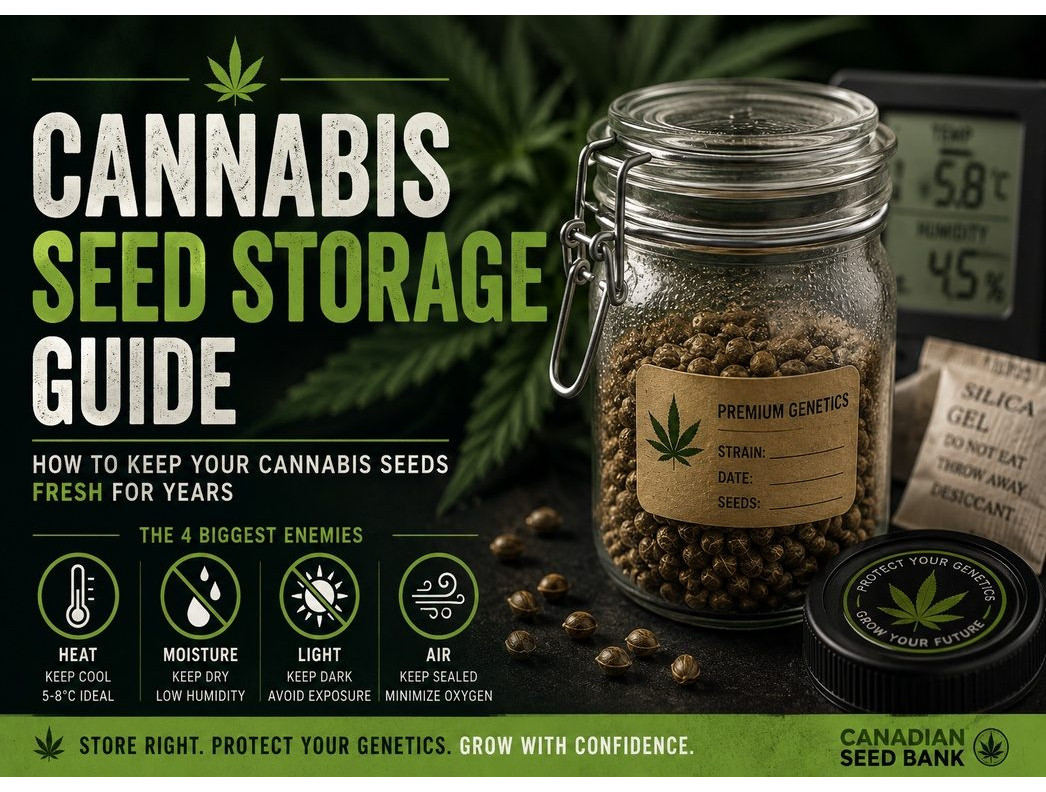
How to Keep Your Cannabis Seeds Fresh for Years
Cannabis Seed Storage Guide:
Whether you're a first time grower or a seasoned cannabis enthusiast, purchasing premium cannabis seeds is only the beginning. Proper storage plays a crucial role in preserving seed viability, protecting valuable genetics, and ensuring high germination rates when you're ready to grow.
Many growers unknowingly shorten the lifespan of their cannabis seeds by exposing them to heat, moisture, or light. Fortunately, storing cannabis seeds correctly is simple and can keep them viable for many years.
Why Proper Cannabis Seed Storage Matters
Cannabis seeds are living organisms in a dormant state. While they appear inactive, they continue to respond to environmental conditions. Excessive heat, humidity, oxygen, and light gradually degrade the seed's protective shell and reduce its ability to germinate successfully.
Proper storage helps:
- Preserve genetic quality
- Maintain high germination rates
- Protect rare or limited edition strains
- Prevent mold and premature sprouting
- Extend seed life for future grows
Under ideal storage conditions, cannabis seeds can remain viable for several years, with many growers reporting excellent germination even after five years or more.
The Four Biggest Enemies of Cannabis Seeds
1. Heat
Heat accelerates the natural aging process of seeds. High temperatures cause cellular damage that lowers germination success.
Ideal storage temperature:
- 5°C to 8°C (41°F to 46°F)
- A cool cupboard is acceptable for short term storage
- A refrigerator is ideal for long term storage
Avoid storing seeds near:
- Windows
- Heating vents
- Electronics
- Garages with temperature swings
2. Moisture
Humidity is one of the fastest ways to ruin cannabis seeds.
Too much moisture can:
- Trigger premature germination
- Encourage mold growth
- Damage the seed embryo
Aim for a dry environment with low humidity. Adding a silica gel desiccant packet to your storage container can help absorb excess moisture.
3. Light
Seeds naturally remain underground in complete darkness until conditions are right for germination.
Continuous exposure to sunlight or indoor lighting slowly damages stored seeds.
Always store cannabis seeds in:
- Opaque containers
- Dark drawers
- Refrigerators away from interior lights whenever possible
4. Air Exposure
Frequent exposure to oxygen speeds up seed aging.
Use airtight containers such as:
- Glass jars with rubber seals
- Film canisters
- Vacuum sealed bags
- Laboratory sample tubes
The less air inside the container, the better.
Should You Refrigerate Cannabis Seeds?
Yes, refrigeration is one of the best options for long term cannabis seed storage.
Benefits include:
- Stable temperatures
- Reduced metabolic activity
- Longer seed lifespan
However, avoid repeatedly removing and replacing the container, as condensation can form when temperatures fluctuate.
If removing seeds from the refrigerator, allow the sealed container to reach room temperature before opening it. This prevents moisture from collecting on the seeds.
Can You Freeze Cannabis Seeds?
Freezing remains a debated topic among experienced growers.
While some professional breeders successfully freeze seeds under carefully controlled conditions, freezing improperly can damage delicate cells inside the seed.
For most home growers, refrigeration offers an excellent balance between convenience and long term preservation.
Label Everything
If you purchase multiple strains throughout the year, proper labeling saves frustration later.
Include:
- Strain name
- Breeder
- Purchase date
- Number of seeds
- Autoflower, Feminized, or Regular
This makes organizing your collection much easier as it grows.
Signs Your Cannabis Seeds Are Still Healthy
Healthy cannabis seeds typically have:
- A hard outer shell
- Brown, tan, or dark coloration
- Speckled or tiger stripe patterns
- No cracks or mold
Very pale, soft, green, or damaged seeds are generally less likely to germinate successfully.
Common Storage Mistakes
Avoid these common errors:
- Leaving seeds in direct sunlight
- Storing them in plastic bags without protection
- High humidity environments
- Frequent temperature changes
- Handling seeds with wet hands
- Opening storage containers unnecessarily
Small mistakes over time can significantly reduce germination rates.
Before Germination
When you're finally ready to grow, remove your seeds from storage and allow them to slowly reach room temperature before beginning your preferred germination method.
This simple step helps prevent condensation from forming on the seed coat and gives your seeds the best possible start.
Final Thoughts
Premium cannabis genetics deserve premium care. Proper storage is one of the easiest ways to protect your investment and ensure your favorite strains remain viable whenever you're ready for your next grow.
Whether you're saving seeds for next season or building a collection of elite genetics, keeping them cool, dark, dry, and airtight will maximize their lifespan and improve future germination success.
At CanadianSeedBank.com, we believe great harvests begin long before germination. By storing your cannabis seeds correctly from day one, you'll give every future grow the strongest possible foundation.

Feminized vs Regular Seeds
How Plant Sex Is Determined
Plant reproduction is one of the most
fascinating areas of botanical science. In cannabis, understanding how
plant sex is determined helps explain the difference between regular and
feminized seeds, and why this distinction matters in cultivation
biology.
At its core, this topic is about chromosomes, hormones, and natural reproductive strategy.
The Basics of Plant Sex
Cannabis is classified as a dioecious species, meaning individual plants typically develop as either male or female. Male plants produce pollen. Female plants produce flowers and, when pollinated, generate seeds. While some plant species carry both reproductive organs on the same plant, cannabis usually separates them. The determining factor begins at the chromosomal level.
XX and XY in Plants
Much like humans and many animals, cannabis plants use a chromosomal system to determine sex. Female plants carry two X chromosomes, written as XX. Male plants carry one X and one Y chromosome, written as XY.
When a regular seed is formed through natural pollination, it inherits one chromosome from each parent. The female plant always contributes an X chromosome. The male plant contributes either an X or a Y chromosome through its pollen. If the resulting seed receives XX, it develops as female. If it receives XY, it develops as male. This natural genetic lottery is why regular seeds typically produce a mix of male and female plants.
Hormonal Influence on Expression
While chromosomes establish the genetic framework, plant hormones play a powerful role in how sex traits are expressed. Plants rely on internal chemical messengers to regulate growth and development. In cannabis, hormones such as ethylene influence the formation of female reproductive structures, while other hormonal balances support male expression.
Environmental factors can also affect hormonal pathways. Light cycles, temperature, and stress conditions can influence how strongly certain traits are expressed. In rare cases, plants may develop both male and female characteristics due to hormonal shifts, demonstrating how dynamic plant biology can be.
However, it is important to distinguish between genetic sex and environmental expression. The chromosome configuration remains the foundation. Hormones help regulate how those genetic instructions are carried out.
Regular Seeds: Natural Genetic Diversity
Regular seeds are produced through traditional pollination between male and female plants. Because the male parent can contribute either an X or Y chromosome, the offspring may express either sex.
From a breeding perspective, regular seeds preserve the full genetic spectrum of a cultivar. They allow breeders to select both male and female individuals for future generations. This genetic diversity is essential for maintaining strong breeding lines and long term vigor.
Regular seeds reflect the plant’s natural reproductive cycle and maintain broad genetic variation within a population.
Feminized Seeds: Chromosomal Control
Feminized seeds are developed using breeding techniques designed to ensure that the pollen source carries only X chromosomes. When this pollen fertilizes a female plant, the resulting seeds inherit XX chromosomes and therefore develop as female.
At a high level, this process relies on influencing hormonal pathways in a controlled breeding environment so that a female plant can produce viable pollen. Because no Y chromosome is introduced, all offspring carry female genetic coding.
The science behind feminized seeds is rooted in chromosomal inheritance, not genetic modification. The goal is simply to control which chromosomes are passed forward.
Why Plant Sex Matters in Cultivation Biology
Understanding plant sex is critical in cultivation biology because male and female plants serve different roles in reproduction.
Female plants are responsible for producing flowers and seeds. Male plants produce pollen that fertilizes female flowers. Once pollination occurs, the female plant shifts energy toward seed production. In natural ecosystems, this ensures species survival.
In controlled cultivation settings, knowing the difference between regular and feminized seeds allows for predictable plant populations. Regular seeds offer genetic diversity and breeding potential. Feminized seeds offer uniform female expression based on chromosomal science. From a biological standpoint, neither is superior. Each serves a purpose within the larger framework of plant reproduction and genetics.
The Science Behind the Choice
Feminized and regular seeds represent two approaches within the same biological system. One reflects natural chromosomal variation. The other applies scientific understanding of chromosomes and hormones to guide predictable outcomes.
By understanding XX and XY chromosomes, hormonal influence, and breeding strategy at a scientific level, we gain a deeper appreciation for how plant sex is determined. It reinforces an important truth in plant biology: genetics establish possibility, and reproduction follows precise chromosomal rules.
At its foundation, the difference between feminized and regular seeds is not marketing language. It is applied reproductive science, grounded in chromosomes, hormones, and the remarkable adaptability of plants.

Genotype vs. Phenotype
Why No Two Plants Are Exactly Alike
Walk
through any healthy garden and you will notice something remarkable.
Even when plants are grown from seeds of the same cultivar, no two
individuals look exactly alike. Height may vary. Leaf shape may shift
slightly. Growth speed can differ as well.
This natural variation is not a flaw.
It is a reflection of the powerful relationship between genetics and
environment. To understand why this happens, we need to explore two
foundational concepts in plant biology: genotype and phenotype.
What Is Genotype?
Genotype refers to the complete genetic makeup of a plant. It is the internal blueprint encoded within the seed. This blueprint contains instructions for traits such as plant structure, leaf morphology, growth rate, resilience, and reproductive characteristics. Inside every seed are chromosomes that carry genes. These genes exist in different versions known as alleles. Some alleles are dominant, meaning they are more likely to be expressed in the plant’s visible characteristics. Others are recessive, meaning they remain hidden unless paired with another matching recessive allele.
For example, if a plant carries one dominant allele for tall growth and one recessive allele for shorter growth, the dominant trait will typically be expressed. However, the recessive trait does not disappear. It remains part of the genetic code and can appear in future generations depending on how traits combine. The genotype sets the potential range of what a plant can become. It defines the limits within which expression can occur.
What Is Phenotype?
Phenotype is the observable expression of that genetic blueprint. It includes everything you can see and measure such as height, leaf structure, branching pattern, flowering time, and overall vigor. While genotype provides the instructions, phenotype reflects how those instructions are carried out in real world conditions. This is where the environment becomes a powerful influence.
Two seeds from the same cultivar may share similar genetic foundations. However, if one plant experiences different temperature, humidity, light intensity, or soil conditions, its phenotype may shift within the range allowed by its genotype. In simple terms, genetics load the possibilities. Environment shapes the outcome.
Dominant and Recessive Traits in Action
Dominant and recessive traits play a major role in variation. When breeders create new cultivars, they carefully select parent plants that display desirable characteristics. These may include strong structure, stable growth, or consistent expression.
Even within a stable line, genetic variation remains present. This variation is natural and expected. It allows for diversity within the population and ensures long term adaptability. A breeder level perspective recognizes that variation is not chaos. It is controlled diversity within a defined genetic framework. Skilled breeding reduces extreme inconsistency while preserving enough variation to maintain vigor and resilience.
Environmental Stress and Expression
Environmental stress can further influence phenotypic expression. Plants are highly responsive organisms. They continuously monitor light cycles, temperature changes, water availability, and nutrient levels.
When conditions shift, internal signaling pathways adjust growth patterns. A plant exposed to cooler temperatures may develop tighter internodal spacing. One grown in higher light intensity may produce thicker stems or broader leaves. These changes are not random mutations. They are adaptive responses within the boundaries of the plant’s genotype. This phenomenon is known as environmental expression. It demonstrates how flexible and responsive plant systems are.
Why Variation Is Natural?
Variation is a fundamental principle of biology. In natural ecosystems, diversity strengthens populations. It increases the likelihood that some individuals will thrive under changing conditions.
In cultivation, slight differences between plants of the same cultivar reflect this natural biological reality. No two seeds are genetic clones unless they originate from identical tissue. Seeds carry recombined genetic material from their parent lines. That recombination introduces subtle differences. Rather than viewing variation as inconsistency, it should be understood as evidence of living genetics at work.
A Breeder Level Perspective
From a breeder perspective, the goal is not to eliminate variation entirely. The goal is to stabilize desirable traits while maintaining plant health and vigor. Over successive generations, selection reduces extreme outliers and strengthens predictable characteristics. Well developed classic cultivars often show high stability because they have been refined through careful selection. Yet even within these lines, each plant expresses its own individuality within a defined range.
Genotype and phenotype together explain why no two plants are exactly alike. Genetics establish potential. Environment shapes expression. Variation emerges naturally from this interaction. Understanding this relationship deepens appreciation for plant biology and reinforces an important truth. Every plant represents a dynamic partnership between inherited code and environmental influence. That partnership is what makes cultivation both scientific and endlessly fascinating.
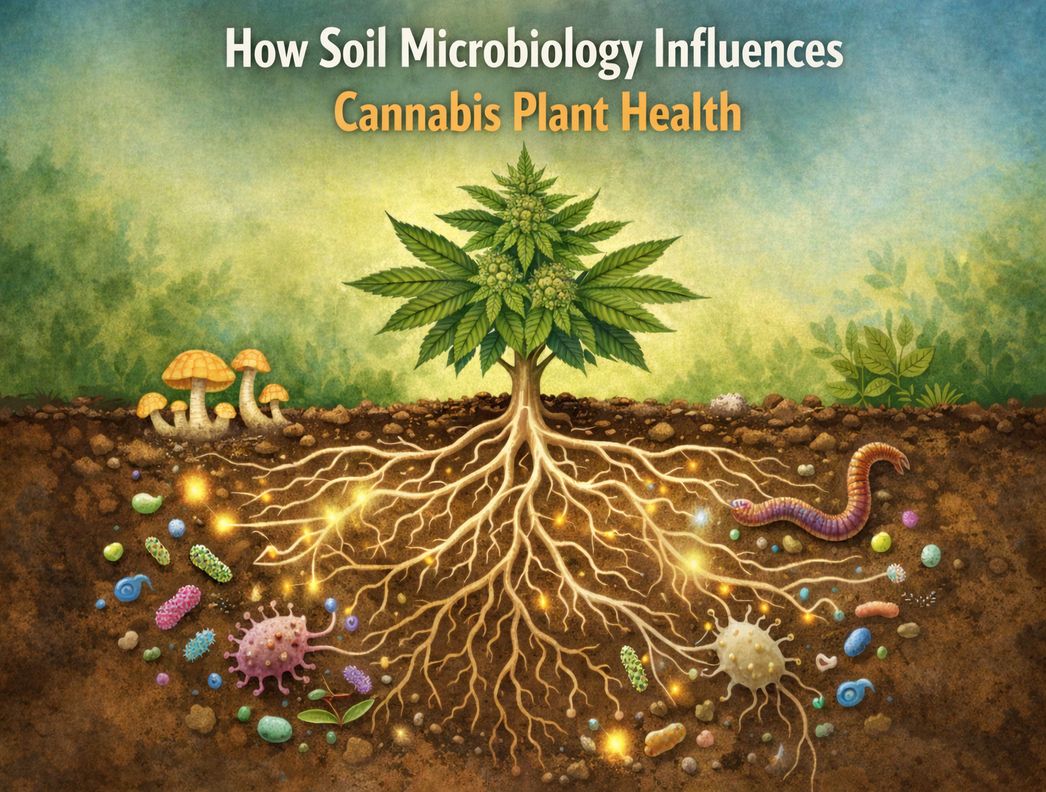
Soil Microbiology 101
How Soil Microbiology Influences Cannabis Plant Health
When discussing cannabis plant health, attention often focuses on what happens above ground -- leaves, stems, and flowering structures. Yet some of the most important biological activity occurs beneath the surface. Hidden in the soil is a complex ecosystem of microorganisms that quietly supports plant development, resilience, and genetic expression.
Understanding soil microbiology reveals that cannabis plants do not grow alone. They are part of a dynamic underground network that plays a crucial role in overall plant vitality.
The Living Soil Ecosystem
Soil is not simply a medium that holds roots in place. It is a living environment filled with bacteria, fungi, protozoa, nematodes, and other microscopic organisms. These organisms interact continuously with plant roots, forming relationships that influence nutrient cycling and structural stability.
Healthy soil contains billions of microorganisms in just a single handful. Together, they create a balanced ecosystem that supports plant growth naturally. For cannabis, this underground activity helps determine how efficiently nutrients are absorbed and how well the plant adapts to environmental conditions.
Beneficial Microbes and Root Support
Certain soil bacteria form mutually beneficial relationships with plant roots. These microbes assist in breaking down organic matter into forms that roots can absorb more easily. In exchange, plants release small amounts of sugars and organic compounds through their root systems to feed these microorganisms.
This exchange system is part of a highly evolved biological partnership.
Beneficial bacteria can:
-
Improve nutrient availability
-
Enhance root surface area efficiency
-
Contribute to overall soil balance
-
Support natural resilience
This interaction demonstrates that plant health is not just about genetic potential — it is also about microbial cooperation.
Mycorrhizal Networks: The Underground Web
One of the most fascinating components of soil microbiology is the mycorrhizal network. Mycorrhizal fungi attach to plant roots and extend far into the surrounding soil through thread-like structures called hyphae. These extensions dramatically increase the effective reach of the root system.
Through this network, fungi help plants access water and nutrients beyond the immediate root zone. In return, the plant supplies carbohydrates produced through photosynthesis. This symbiotic relationship has existed for hundreds of millions of years and is found across countless plant species. In cannabis, mycorrhizal partnerships can support root stability and environmental adaptability.
Underground Communication Between Plants
Research in plant biology suggests that mycorrhizal networks may also facilitate indirect plant-to-plant signaling. Through shared fungal connections, plants can respond to environmental stress in coordinated ways.
While cannabis-specific studies continue to develop, broader botanical research has shown that underground microbial networks contribute to plant awareness within an ecosystem. This concept reinforces an important point: plants are not isolated organisms. They are connected participants in a larger biological system.
Soil Health and Genetic Expression
Genetics determine a cannabis plant’s potential: its structure, growth rate, and biochemical capacity. However, environmental factors influence how that potential is expressed.
Soil microbiology is one of those key environmental variables.
When roots function efficiently and nutrient cycling is balanced, the plant can allocate energy toward structural growth and reproductive development. When soil ecosystems are disrupted, plant stress may increase, affecting overall vigor.
The relationship between genetics and environment is continuous. Healthy soil ecosystems provide a supportive foundation that allows genetic traits to express more consistently.
A Deeper Appreciation for the Underground World
The health of a cannabis plant is not determined solely by what is visible above ground. Beneath the surface, roots and microbes form partnerships that have evolved over millions of years.
Understanding soil microbiology highlights the importance of biodiversity, not just in plant genetics, but in the ecosystems that sustain them. For those interested in cannabis botany, appreciating the hidden life of soil adds another layer of depth to the plant’s remarkable biology. Healthy roots begin in healthy soil. And healthy soil begins with life.
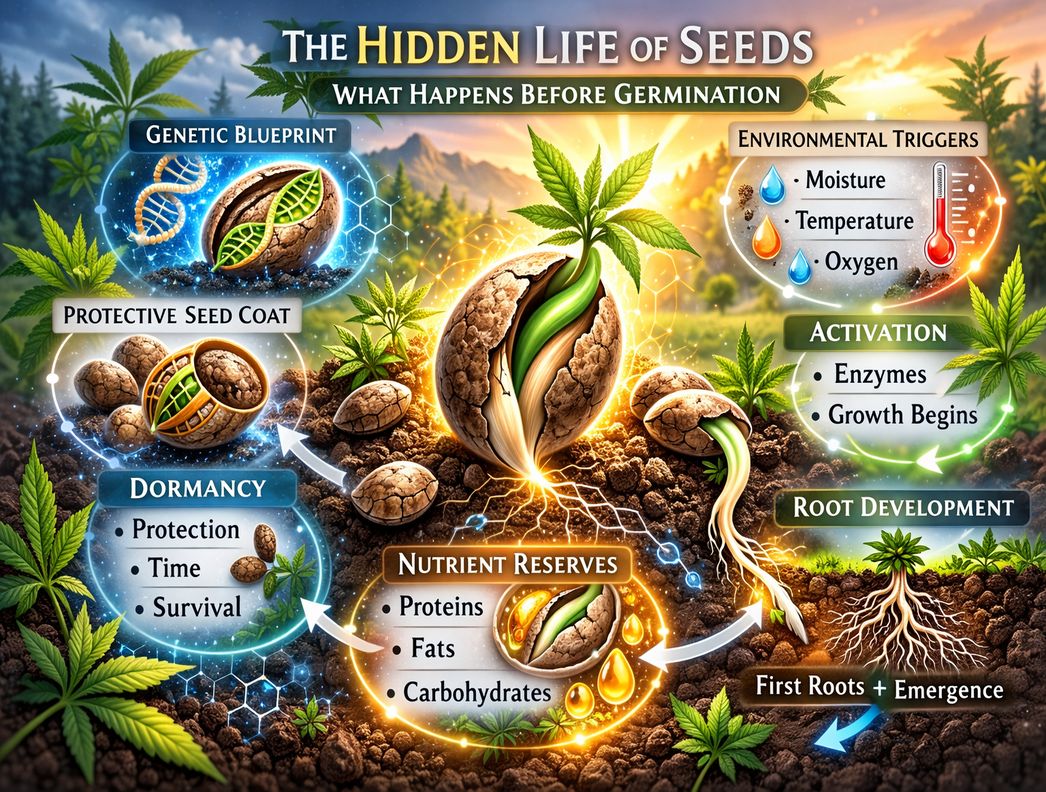
The Hidden Life of Seeds
What Happens Before Germination
Every cannabis plant begins its life as a seed; small, compact, and seemingly inactive. Yet inside that protective shell lies a fully encoded biological blueprint, carefully designed to preserve genetic information until the right conditions signal growth. While much attention is given to visible plant stages, the most fascinating activity happens long before a sprout ever emerges. Understanding what occurs inside a seed before germination reveals just how sophisticated plant biology truly is.
A Genetic Time Capsule
A cannabis seed is more than a starting point: it is a genetic archive. Within the seed’s outer shell is an embryo containing all the genetic instructions required to produce a mature plant. This includes information about:
-
Plant structure
-
Growth patterns
-
Leaf formation
-
Branching tendencies
-
Flower development
-
Cannabinoid and terpene potential
These traits are encoded in DNA and remain preserved during dormancy. Even when inactive, the seed safeguards this blueprint until environmental conditions indicate that survival is possible.
Seed Dormancy: Nature’s Pause Button
Dormancy is a natural protective state. During this phase, the seed is metabolically quiet, conserving energy and preventing premature growth. This mechanism evolved to protect the species. If a seed were to begin developing at the wrong time, during drought, cold temperatures, or unstable conditions, survival would be unlikely. Dormancy ensures that growth only begins when external signals suggest a favorable environment. The seed coat, or outer shell, plays a major role in this process. It shields the embryo from moisture fluctuations, pathogens, and physical damage while maintaining internal stability.
Energy Storage and Future Growth
Inside the seed are stored nutrients that support early development. These reserves are carefully packaged to fuel the first stage of growth once dormancy ends. The seed does not immediately rely on external nutrients. Instead, it draws from internal energy stores to support:
-
Initial root emergence
-
Early leaf formation
-
Structural establishment
This self-contained energy system allows the young plant to begin life independently before transitioning to full environmental dependence.
Genetic Stability and Preservation
The quality and stability of a seed directly influence its long-term viability. Over time, exposure to environmental stress, such as heat, humidity, or light, can degrade genetic integrity.
Preserving seeds properly supports:
-
Genetic longevity
-
Stable trait expression
-
Consistent plant development
-
Biodiversity protection
Seed banks play an important role in maintaining genetic diversity by protecting viable seed stock under controlled conditions. This stewardship ensures that important genetic lines are not lost across generations.
The Moment of Activation
Germination begins when environmental signals, particularly moisture and temperature, trigger biochemical activity within the seed. Dormancy ends, enzymes activate, and growth processes initiate. This transition marks a dramatic shift from preservation to expansion. The once-dormant embryo begins dividing and developing, starting with root formation. From that point forward, the plant enters the visible stages of its life cycle. But all of this potential existed long before the first visible sign of growth.
Why the Seed Stage Matters
Understanding the hidden life of seeds highlights why genetics matter so much at the earliest stage. Every visible trait later expressed by the plant, from structure to chemical profile, originates in the seed. For those interested in cannabis genetics, the seed represents the purest expression of inherited potential. It is where lineage, adaptation, and evolutionary history converge into a single, compact form. Before leaves unfold and stems strengthen, the story of the plant has already been written; quietly stored within the seed, waiting for the right moment to begin.
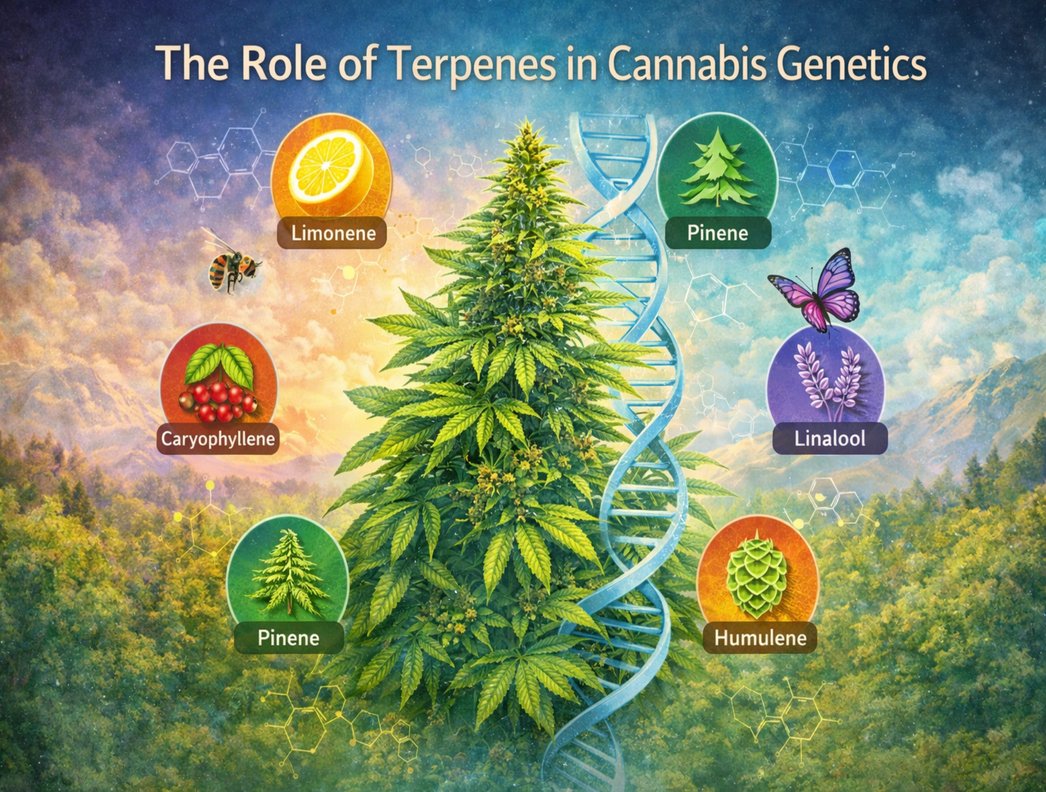
The Role of Terpenes
The Role of Terpenes in Cannabis Genetics
When discussing cannabis genetics, cannabinoids often receive most of the attention. However, another equally important component plays a critical role in plant identity, evolution, and breeding: terpenes.
Terpenes are aromatic compounds found throughout the plant kingdom. In cannabis, they contribute to scent, plant resilience, and genetic differentiation. Understanding terpenes from a botanical and breeding perspective reveals how deeply they are tied to cannabis genetics -- far beyond aroma alone.
What Are Terpenes?
Terpenes are naturally occurring organic compounds produced in the resin glands of many plants, including cannabis. They are responsible for the distinctive scents associated with different botanical species: citrus, pine, spice, earth, floral notes, and more. Cannabis produces dozens of identifiable terpenes, including:
Myrcene
Limonene
Pinene
Caryophyllene
Linalool
Humulene
Each strain expresses a unique terpene profile, influenced by its genetic lineage and environmental conditions.
Terpenes as Genetic Markers
From a breeding perspective, terpenes function almost like genetic fingerprints. Just as plant structure and flowering time are inherited traits, terpene profiles are also genetically encoded. When breeders cross two strains, they are not only combining cannabinoid potential: they are blending terpene expression patterns as well. This is why certain aromatic traits consistently appear in specific genetic lines. For example:
Pine-forward strains often trace back to particular regional genetics.
Earthy or musky profiles may connect to traditional landrace lines.
Citrus-heavy strains often share related ancestry.
Terpenes help preserve and identify genetic heritage within breeding programs.
Evolutionary Purpose of Terpenes
Terpenes did not evolve for human appreciation. In nature, they serve protective and adaptive functions. Across plant species, terpenes may:
Deter herbivores
Attract pollinators
Protect against environmental stress
Contribute to UV resilience
Support plant-to-plant signaling
In cannabis specifically, terpene expression likely evolved as a survival mechanism in diverse climates; from mountainous regions of Central Asia to tropical environments near the equator. Different growing environments encouraged different terpene dominance, shaping the aromatic diversity seen in landrace strains.
Breeding for Terpene Expression
Modern cannabis breeding increasingly emphasizes terpene preservation and enhancement. Breeders may select parent plants based on:
Stability of terpene output
Uniqueness of aromatic profile
Consistency across generations
Environmental adaptability
Unlike early breeding that focused primarily on yield or cannabinoid levels, modern genetic refinement often includes terpene balance as a core objective. This shift reflects a broader understanding of cannabis as a chemically complex plant rather than a single-compound crop.
The Relationship Between Cannabinoids and Terpenes
Cannabinoids and terpenes are produced in the same glandular structures of the plant. While they are chemically distinct compounds, they develop within interconnected biological systems. Breeding decisions that influence cannabinoid production can also impact terpene expression. As a result, strain identity is shaped by a combined genetic profile rather than a single measurable trait. This complexity is why two plants with similar cannabinoid levels may exhibit entirely different structural, aromatic, and genetic characteristics.
Preserving Terpene Diversity in Cannabis Genetics
As breeding narrows around a limited number of popular genetic lines, preserving terpene diversity becomes increasingly important. Maintaining diverse terpene profiles supports:
Genetic resilience
Broader breeding potential
Agricultural adaptability
Long-term biodiversity
For seed banks, protecting terpene-rich genetics helps safeguard the plant’s evolutionary legacy while supporting future innovation.
A Deeper Layer of Cannabis Science
Terpenes represent one of the most fascinating layers of cannabis genetics. They reflect the plant’s evolutionary history, environmental adaptation, and breeding progression. Understanding terpene expression moves the conversation beyond simple strain labels and toward a more sophisticated appreciation of cannabis as a dynamic and genetically complex species. For those interested in cannabis genetics, terpenes are not just about aroma -- they are about identity.
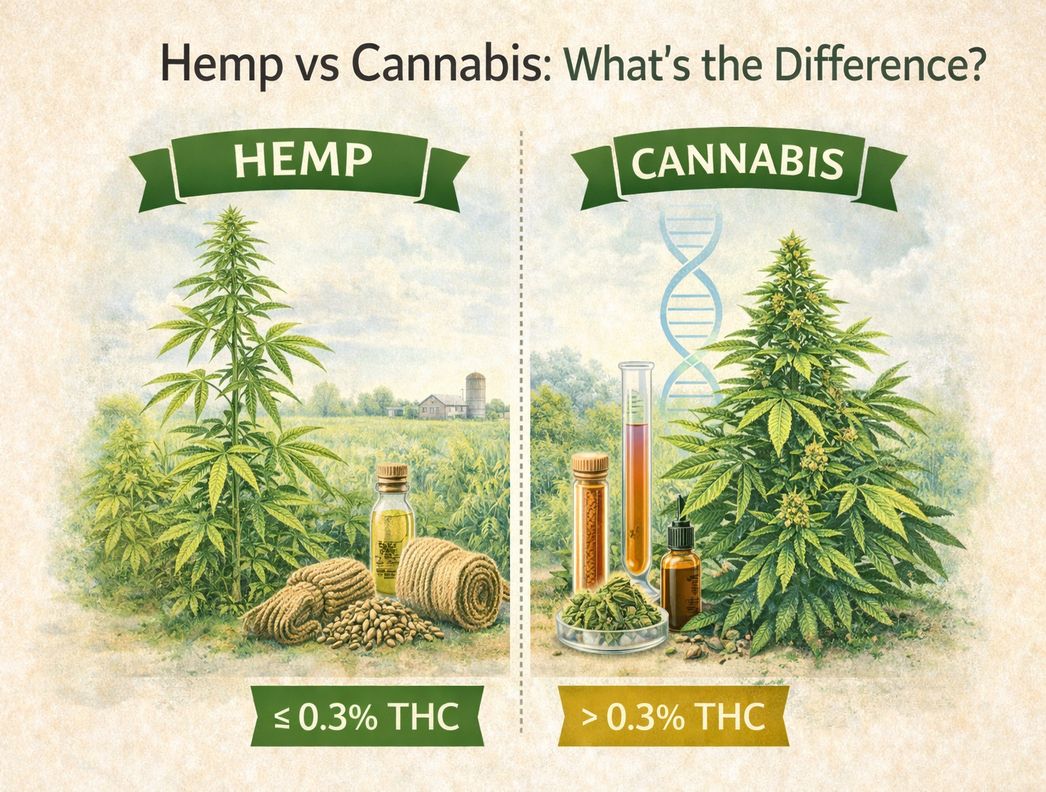
Hemp vs Cannabis
What’s the Difference?
The terms hemp and cannabis are often used interchangeably, but they are not the same thing. While both come from the Cannabis sativa plant species, their cultivation, chemical composition, and historical uses differ significantly. Understanding the distinction helps clarify common misconceptions and provides important context for how these plants are used today.
The Botanical Relationship
Botanically speaking, hemp and cannabis belong to the same plant family. In fact, hemp is a type of cannabis. The key difference lies in how the plant is cultivated and the specific traits it expresses. Over time, humans selectively bred cannabis plants for different purposes. Some varieties were optimized for fiber and industrial use -- these are what we commonly call hemp. Others were cultivated for their resin production and cannabinoid content: these are typically referred to as cannabis in modern conversation. Though genetically related, selective breeding has created clear functional differences between the two.
The THC Threshold
One of the primary legal distinctions between hemp and cannabis is THC content. In Canada, hemp is defined as cannabis containing 0.3% THC or less. THC (tetrahydrocannabinol) is the compound most commonly associated with psychoactive effects. Because hemp contains very low levels of THC, it is not considered intoxicating. Cannabis varieties cultivated for higher THC content exceed this threshold and are regulated differently under Canadian law. This THC limit is what legally separates hemp from other cannabis varieties, even though they are botanically connected.
Differences in Appearance and Growth
Hemp and cannabis plants often look different due to how they are grown and what traits they were bred to emphasize.
Hemp plants:
Tall and slender
Minimal branching
Grown closely together in fields
Focused on fiber or seed production
Cannabis plants:
Shorter and bushier
Dense branching
Cultivated with more spacing
Bred for resin production and cannabinoid profiles
These structural differences reflect the plant’s intended agricultural use.
Industrial Uses of Hemp
Hemp has been cultivated for thousands of years for its durability and versatility. Historically and today, hemp is used for:
Rope and textiles
Paper production
Building materials
Bioplastics
Food products (such as hemp seeds and oil)
Hemp’s strong fibers and sustainable growth cycle make it a valuable agricultural crop worldwide.
Cannabis and Specialized Cultivation
Cannabis varieties bred for higher cannabinoid expression are cultivated differently, often in more controlled environments. These plants are selected for traits such as aroma, resin production, and specific genetic profiles. While hemp is typically harvested for fiber and seed, cannabis plants are cultivated for different plant characteristics, depending on their genetic lineage.
A Shared History, Different Roles
Despite modern distinctions, hemp and cannabis share a deep historical connection. Ancient civilizations used hemp for textiles and tools, while cannabis varieties were incorporated into traditional medicine and cultural practices. As legal frameworks evolved, clearer definitions were created to distinguish industrial hemp from other cannabis types. Today, these classifications help regulate agriculture, trade, and research.
Why Understanding the Difference Matters
Clarity around hemp and cannabis supports informed conversations and responsible regulation. While they originate from the same species, their breeding history, chemical composition, and applications have led them down different agricultural paths. Understanding these differences highlights the plant’s remarkable versatility and the importance of precise terminology when discussing cannabis in any context.

How Circadian Rhythms Influence Cannabis
How Circadian Rhythms Influence Cannabis Growth
Plants do not sleep, but they do keep time.
Just like humans and animals, cannabis plants operate on an internal biological clock known as a circadian rhythm. This built in timing system regulates growth patterns, energy production, hormone signaling, and developmental transitions. Understanding how circadian rhythms influence cannabis growth reveals an important truth in plant biology: light is not just energy, it is information.
What Is a Circadian Rhythm?
A circadian rhythm is a roughly twenty four hour internal cycle that helps organisms respond predictably to day and night changes. In plants, this timing mechanism evolved to anticipate sunrise and sunset, rather than simply react to them.
Cannabis plants contain photoreceptors that detect changes in light duration and intensity. These specialized cells communicate with internal genetic pathways, activating or suppressing certain biological processes at specific times of day. This means the plant is not passively responding to light. It is actively preparing for it.
How Light Signals Trigger Growth Patterns
During daylight hours, cannabis plants prioritize photosynthesis. Chloroplasts convert light energy into sugars that fuel structural growth, root expansion, and cellular repair. Enzymes involved in carbohydrate production are most active when the circadian clock signals daylight conditions.
At night, the plant shifts focus. Instead of producing energy, it redistributes stored sugars to support internal development. Hormonal pathways related to stem elongation and cellular expansion are often more active in darkness. This daily rhythm ensures balanced growth. Disrupting that rhythm can influence metabolism, structural development, and overall vigor.
The Role of Photoperiod in Development
Cannabis is considered a photoperiod sensitive plant, meaning flowering is influenced by the length of uninterrupted darkness rather than simply the amount of light received.
As days shorten naturally, the circadian system detects longer periods of darkness. This signals the plant to transition from vegetative growth into reproductive development. Internally, genes responsible for flowering are activated when specific timing thresholds are reached.
This is why consistency in light cycles matters in controlled environments. The plant relies on stable signals to maintain predictable biological responses.
Internal Clocks and Hormonal Regulation
The circadian rhythm does more than regulate photosynthesis. It also influences hormone production. Hormones such as auxins and gibberellins, which impact plant structure and elongation, are released in cycles tied to internal timing systems.
When these hormonal rhythms are aligned with light exposure, cannabis plants tend to exhibit balanced growth patterns, steady node spacing, and stable structural development. However, irregular light patterns can confuse these signals. When timing becomes inconsistent, metabolic efficiency may decrease. The plant must expend additional energy recalibrating its internal clock rather than focusing fully on growth.
Circadian Rhythms and Stress Response
Circadian timing also plays a role in how cannabis plants respond to environmental stress. Research in plant biology shows that stress tolerance can vary depending on the time of day exposure occurs. For example, plants may be more resilient to certain environmental challenges when internal defense genes are already active. This adaptive advantage evolved to help plants survive fluctuating outdoor conditions. In natural ecosystems, this timing system improves survival rates. In controlled cultivation biology, it reinforces the importance of consistent environmental conditions.
Why Circadian Biology Matters in Cultivation Science
Understanding circadian rhythms highlights a broader principle in cannabis genetics and plant reproduction science. Growth is not simply about providing light, water, and nutrients. It is about delivering those inputs in harmony with the plant’s internal clock.
Stable light cycles support predictable metabolic patterns. Predictable metabolism supports consistent phenotypic expression. Consistent expression reinforces genetic integrity within a cultivar. This relationship between internal timing and external environment explains why two plants grown under different light schedules may display subtle structural differences, even when they share similar genetics.
The Science Behind Predictable Development
From a breeder level perspective, circadian rhythm research adds another layer to understanding genotype and phenotype interaction. Genetics define potential traits. Environmental timing influences how efficiently those traits are expressed.
Cannabis plants are not passive organisms. They anticipate sunrise, prepare for darkness, regulate hormone cycles, and adjust metabolic activity according to an internal clock refined through evolution.
Recognizing the role of circadian rhythms deepens appreciation for plant biology and reinforces the scientific foundation behind cultivation practices. At its core, cannabis growth is not random. It is a coordinated, time regulated biological process shaped by both genetics and environmental signals. When light becomes information rather than simply illumination, the science of plant development becomes far more fascinating.
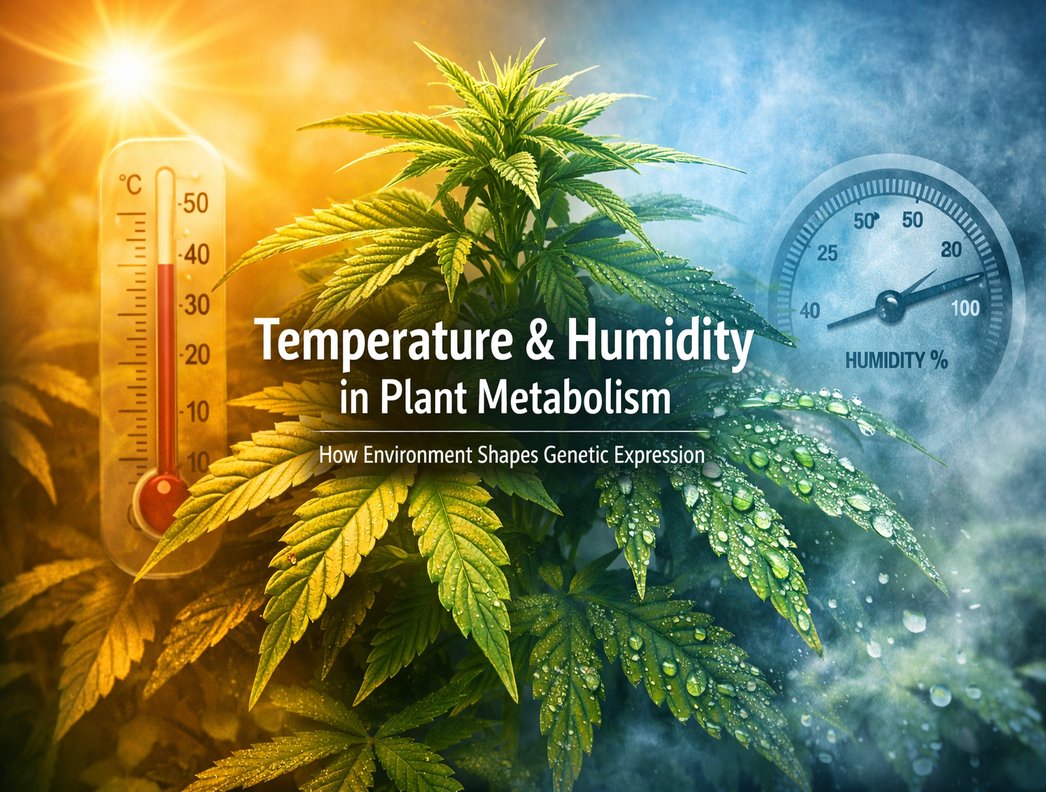
Temperature & Humidity
How Temperature & Humidity Influence Plant Metabolism
Plants are living biochemical systems. Every stage of development, from early vegetative growth to flowering. is guided by internal metabolic processes that are directly influenced by environmental conditions. Among the most important of these conditions are temperature and humidity. For cannabis plants, understanding how these two factors interact with plant metabolism provides insight into growth patterns, structural development, and overall expression of genetic traits.
Temperature: The Regulator of Enzymatic Activity
At the cellular level, plant metabolism depends on enzymes. These specialized proteins drive essential processes such as photosynthesis, respiration, and nutrient assimilation. Temperature directly affects how efficiently these enzymes function.
When temperatures fall too low, enzymatic reactions slow down. Photosynthesis becomes less efficient, nutrient uptake decreases, and overall growth can appear stalled. Conversely, excessively high temperatures may cause enzymes to denature — meaning they lose their functional shape, which disrupts metabolic balance. In cannabis, moderate and stable temperature ranges support:
-
Efficient chlorophyll production
-
Strong stem development
-
Balanced carbohydrate synthesis
-
Healthy root expansion
Temperature also influences the rate of transpiration, the process by which water moves from roots to leaves and evaporates into the air. This movement is critical for nutrient transport and internal cooling. Because metabolism is temperature-sensitive, fluctuations can alter how genetic traits are expressed. Two seeds of the same cultivar may develop differently when exposed to different thermal environments -- a reflection of phenotype variation rather than genetic change.
Humidity: Managing Water Balance & Gas Exchange
Humidity refers to the amount of water vapor in the air. It plays a major role in regulating transpiration and stomatal behavior. Stomata are microscopic pores located on leaf surfaces. These pores open and close to control gas exchange that allow carbon dioxide in for photosynthesis and releasing oxygen as a byproduct. They also regulate water loss.
When humidity is very low, plants may lose water rapidly through transpiration. To prevent dehydration, stomata partially close, which can limit carbon dioxide intake and reduce photosynthetic efficiency. On the other hand, excessively high humidity can slow transpiration too much. This may reduce nutrient movement from the roots upward and create conditions where metabolic processes become less dynamic.
Balanced humidity supports:
-
Stable water movement
-
Efficient nutrient transport
-
Optimal photosynthesis
-
Structural resilience
This balance is particularly important during active growth phases when metabolic demand is highest.
The Interaction Between Temperature & Humidity
Temperature and humidity do not function independently. Together, they influence vapor pressure deficit (VPD), a measure of how readily water evaporates from leaf surfaces. When temperatures are high and humidity is low, water loss accelerates. When temperatures are moderate and humidity is balanced, transpiration remains steady and metabolic processes operate efficiently.
Cannabis plants respond dynamically to these environmental signals. Internal hormonal pathways adjust growth rate, leaf size, and structural development to maintain equilibrium. These adjustments demonstrate the plant’s natural ability to sense and respond to its surroundings.
Environmental Conditions & Genetic Expression
A seed contains genetic instructions, but the environment influences how those instructions are expressed. Temperature and humidity can impact:
-
Internodal spacing
-
Leaf morphology
-
Resin gland development
-
Overall plant structure
These variations are examples of phenotypic expression, differences in appearance and growth patterns that arise from environmental interaction rather than changes in DNA. Understanding this relationship reinforces an important principle in plant science: genetics set the potential, but environment shapes the outcome.
Why This Matters
Temperature and humidity are not simply background conditions; they are active regulators of plant metabolism. By influencing enzyme efficiency, water movement, gas exchange, and hormonal signaling, these environmental factors shape how cannabis plants grow and express their traits. From a botanical perspective, this highlights the remarkable adaptability of plants. Cannabis, like all plant species, continuously monitors its environment and adjusts internally to maintain balance.
Recognizing the role of temperature and humidity deepens our understanding of plant biology and genetic expression. It reminds us that every plant is the result of both its inherited blueprint and the environment in which it develops, a dynamic partnership between nature and condition.
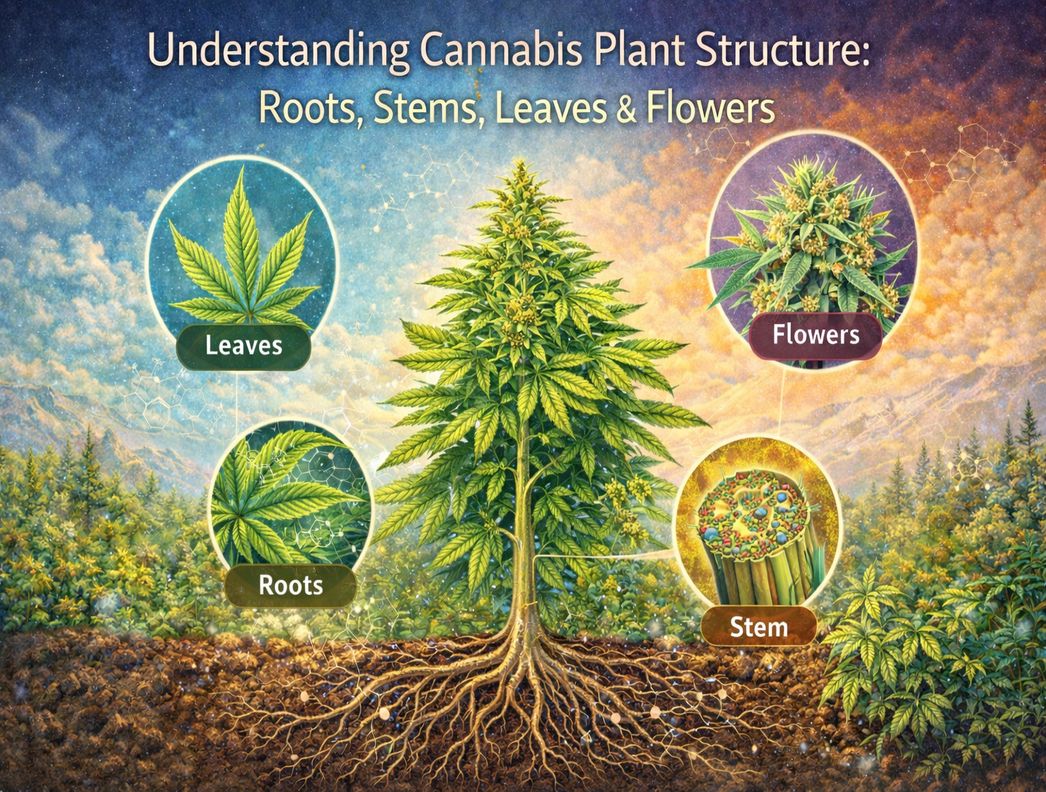
Understanding Cannabis Plant Structure
Understanding Cannabis Plant Structure: Roots, Stems, Leaves & Flowers
Every cannabis plant is a carefully organized biological system. Beneath its recognizable leaves and branching structure lies a coordinated network of roots, stems, and reproductive organs working together to support growth and genetic expression.
Understanding cannabis plant anatomy provides insight into how genetics shape physical traits, from plant height and leaf shape to overall structure and development patterns. This botanical perspective helps deepen appreciation for the complexity of the plant itself.
The Root System: The Hidden Foundation
Though often overlooked, roots are the foundation of the cannabis plant.
Primary Functions of Roots:
Anchor the plant securely in its growing medium
Absorb water and nutrients
Store energy reserves
Support overall stability
Genetics influence root development patterns, including root density, branching structure, and resilience. Some genetic lines naturally develop more aggressive root systems, while others grow more compact and concentrated beneath the soil surface. A strong root system supports structural growth above ground. In many ways, what happens below the surface determines how the plant expresses its potential above it.
The Stem: Structural Support and Transport
The stem acts as the plant’s central support column and transportation network.
Stem Functions:
Moves water from roots to leaves
Distributes nutrients throughout the plant
Provides physical support for branching
Determines plant height and spacing
Stem thickness, internodal spacing (distance between branches), and overall strength are heavily influenced by genetics. Some strains naturally exhibit tighter node spacing and compact growth, while others stretch vertically with wider gaps between branches. These structural traits are part of genetic identity and contribute to how different cannabis varieties are categorized botanically.
Leaves: The Energy Producers
Leaves are the plant’s energy engines. Through photosynthesis, they convert light into chemical energy that fuels growth and development.
Cannabis leaves are instantly recognizable due to their serrated edges and multi-fingered shape. However, leaf structure varies depending on genetic lineage.
Genetic Influence on Leaf Shape:
Broader leaves often appear in genetics adapted to cooler climates
Narrower leaves are commonly associated with genetics from equatorial regions
Leaf density can vary significantly between strain families
Leaf structure plays a role in light absorption efficiency and environmental adaptation. Over generations, cannabis evolved leaf patterns that supported survival in different climates.
Branching Patterns and Growth Structure
The way a cannabis plant branches is another genetically influenced trait. Some plants grow:
Short and bushy
Tall and slender
Balanced with moderate branching
These growth patterns reflect evolutionary adaptations to regional environments. Mountainous regions favored compact structures, while tropical regions supported taller, more elongated plants. Breeders observe these structural traits closely when selecting parent plants for stability and consistency.
Flowers: Reproductive Expression
The flowering stage represents the plant’s reproductive phase. In botanical terms, cannabis is a dioecious species, meaning male and female reproductive organs typically grow on separate plants. Female plants produce flowers that contain resin glands. These glands house cannabinoids and terpenes, which are also genetically determined. Flower structure varies based on:
Genetic lineage
Environmental conditions
Development timing
Some genetics produce denser flower clusters, while others develop longer, more elongated formations. These structural differences are part of the plant’s inherited blueprint.
How Structure Reflects Genetics
Plant structure is not random. Every aspect, root development, stem strength, leaf shape, branching style, and flower formation, reflects the genetic instructions encoded within the seed. This relationship is often described through:
Genotype → Phenotype
The genotype (genetic code) determines potential. The phenotype (observable structure) reflects how that potential expresses itself under specific environmental conditions. Understanding anatomy helps explain why plants from different genetic backgrounds can look distinct, even before flowering begins.
A Botanical Perspective
Viewing cannabis through a botanical lens highlights its sophistication as a plant species. It is not defined by a single characteristic, but by a coordinated system of structures working together to ensure survival and reproduction. For seed-focused brands and enthusiasts of plant science, understanding plant anatomy reinforces the importance of strong, stable genetics. Structure begins at the seed -- and the seed carries the blueprint for everything that follows
From Counterculture to Craft
How Cannabis Became a Cultural Movement in Canada
There was a time when cannabis lived quietly in the background of Canadian culture. It existed in basements, at music festivals, and in whispered conversations between friends who trusted each other. It was not polished, not branded, and certainly not discussed openly in everyday life.
Yet even then, it carried something powerful. It was a symbol of rebellion, creativity, and connection. Today, that same plant sits at the center of a completely different story.
Canada became the first major G7 nation to legalize recreational cannabis in 2018, marking a shift that went far beyond policy. It signaled a cultural reset. What was once underground stepped into the light, bringing with it decades of history, community, and identity. But legalization did not erase the past. Instead, it layered new meaning onto something that had already shaped music, art, and social spaces for generations.
In the early days, cannabis culture in Canada was deeply tied to creativity. From the reggae influences that echoed through Toronto neighborhoods to the laid back West Coast energy of Vancouver, the plant often moved alongside music and expression. It was present in late night studio sessions, poetry circles, and long conversations that stretched into the early hours of the morning. People were not just consuming cannabis. They were using it as a tool to slow down, reflect, and connect.
As legalization arrived, the image of cannabis began to evolve. Clean retail stores replaced hidden transactions. Carefully designed packaging replaced improvised storage. The experience became curated. But something interesting happened along the way. Instead of losing its cultural depth, cannabis began to split into two parallel worlds.
On one side, there is the polished industry. Sleek branding, controlled environments, and a focus on consistency. On the other, there is the enduring culture. The growers who still talk about soil like it is alive. The collectors who value rare genetics not just for potency, but for story. The consumers who remember when finding a specific strain felt like discovering something rare and meaningful.
This blend of old and new has created a uniquely Canadian cannabis identity.
Unlike markets that focus purely on commercialization, Canada still carries a strong sense of craft. Small batch growing has gained attention, with cultivators focusing on terpene richness, flavor, and overall experience rather than just numbers on a label. There is a growing appreciation for the subtle differences between strains, not just in strength, but in how they make people feel. Conversations have shifted from simply asking how strong something is to asking what kind of experience it creates.
Cannabis has also become part of everyday lifestyle in a way that feels natural rather than forced. It appears at social gatherings, creative workspaces, and even wellness routines. For some, it replaces a glass of wine at the end of a long day. For others, it becomes part of a creative ritual. The stigma that once surrounded it has softened, replaced by curiosity and openness.
What makes this cultural shift so interesting is that it is still unfolding.
There is still tension between legacy growers and large scale producers. There are ongoing conversations about quality, authenticity, and what the future of cannabis should look like. But that tension is part of what keeps the culture alive. It prevents cannabis from becoming just another product on a shelf.
At its heart, cannabis in Canada is no longer just about consumption. It is about identity, experience, and evolution. It reflects a country that is willing to rethink old narratives while still respecting the communities that built them.
And as the culture continues to grow, one thing remains clear.
Cannabis may be legal now, but its story is still being written.
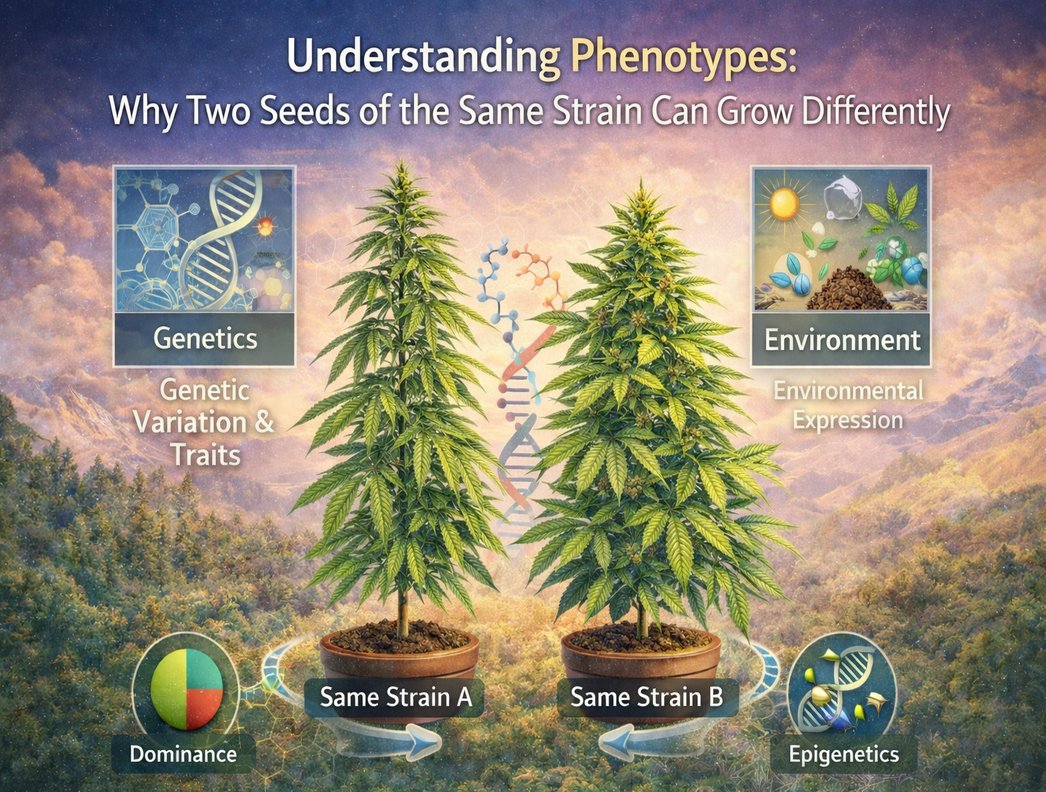
Understanding Phenotypes
Why Two Seeds of the Same Strain Can Grow Differently
One of the most fascinating aspects of cannabis genetics is this: You can plant two seeds from the same strain, grown side-by-side, under identical conditions, and still see noticeable differences.
Why does this happen?
The answer lies in phenotypes, genetic variation, dominant traits, and environmental expression. Understanding this concept is essential for growers, breeders, and anyone interested in the science behind cannabis development.
Genotype vs Phenotype: The Foundation
To understand phenotypes, we first need to separate two key terms:
Genotype
The plant’s genetic code: its DNA blueprint inherited from parent plants.
Phenotype
How those genes actually express themselves physically. Think of
genotype as the recipe, and phenotype as the finished dish. Even when
seeds come from the same strain, each seed carries a slightly different
genetic combination from its parents. That’s where variation begins.
Why Genetic Variation Happens
Cannabis is a highly heterozygous plant, meaning it carries diverse genetic material from its lineage. When two parent plants are crossed, each seed receives:
-
A random combination of dominant and recessive genes
-
Slight variations in structural traits
-
Different terpene expression potential
-
Variation in growth patterns
Unless a strain is heavily stabilized through multiple generations (F4, F5, BX lines), variation is completely normal. This is why two seeds labeled as the same cultivar can show differences in:
-
Height and structure
-
Leaf shape
-
Internodal spacing
-
Resin production
-
Flower density
-
Aromatic profile
Dominant vs Recessive Traits
Every plant inherits pairs of genes, one from each parent. Some traits are dominant, meaning they are more likely to express visibly. Others are recessive, meaning they may remain hidden unless paired correctly. For example:
-
Broad leaf structure may dominate over narrow leaf expression
-
Compact growth may override taller morphology
-
Certain terpene pathways may express more strongly
However, even dominant traits can express differently depending on environmental triggers and epigenetic factors. This is why phenotype hunting is such a critical process in breeding.
What Is “Phenotype Hunting”?
Phenotype hunting is the process of:
-
Growing multiple seeds from the same strain
-
Observing structural and aromatic differences
-
Selecting the most desirable expression
-
Stabilizing that expression through selective breeding
Breeders often grow 10–100+ seeds from a single genetic cross to identify standout phenotypes worth preserving.
Those selected expressions may later become:
-
Stabilized seed lines
-
Backcrossed varieties (BX)
-
Elite clones
-
Refined hybrid foundations
Without phenotype selection, genetic refinement wouldn’t be possible.
The Role of Environment (Environmental Expression)
Genetics provide potential — but environment determines expression. This is where phenotype expression meets environmental influence. Factors that influence how genes express include:
-
Light intensity and spectrum
-
Soil composition
-
Nutrient availability
-
Temperature fluctuations
-
Humidity levels
-
Stress factors
Two genetically identical plants (clones) grown in different environments can even show variation. This phenomenon is linked to epigenetics -- changes in gene expression triggered by environmental conditions rather than DNA changes.
In short: Genetics load the blueprint. Environment activates the switches.
Stability vs Variation
Some strains are more uniform than others. Highly stabilized lines (after multiple generations of selective breeding) tend to produce:
-
Consistent structure
-
Predictable flowering patterns
-
Uniform terpene layering
-
Reduced phenotype spread
Less stabilized crosses may display wider variation, which isn’t a flaw, but a natural part of genetic diversity. Variation is how new elite cultivars are discovered.
Why This Matters for Growers
Understanding phenotypes helps growers:
✔ Expect natural variation
✔ Identify standout plant expressions
✔ Recognize dominant structural traits
✔ Make informed breeding selections
✔ Appreciate genetic complexity
It also explains why two growers comparing the “same strain” may describe slightly different experiences in structure and aroma.
They may simply be growing different phenotypes.
The Bigger Picture: Genetic Diversity Is Strength
Cannabis evolution, both natural and breeder-driven, depends on diversity. Without genetic variation:
-
Landrace preservation wouldn’t exist
-
Hybrid innovation would stall
-
Stabilized elite lines couldn’t be developed
Phenotypic variation isn’t inconsistency — it’s genetic opportunity.
Final Thoughts
Two seeds of the same strain growing differently isn’t a mistake -- it’s science.
Cannabis genetics are dynamic, complex, and highly expressive. Each seed carries a unique combination of inherited traits, influenced by dominance patterns and environmental conditions. Understanding phenotypes deepens appreciation for:
-
Selective breeding
-
Genetic stabilization
-
Terpene inheritance
-
Structural refinement
-
Modern cultivar development
Behind every elite strain lies generations of phenotype selection and careful genetic preservation. And that process continues to shape the future of cannabis genetics.
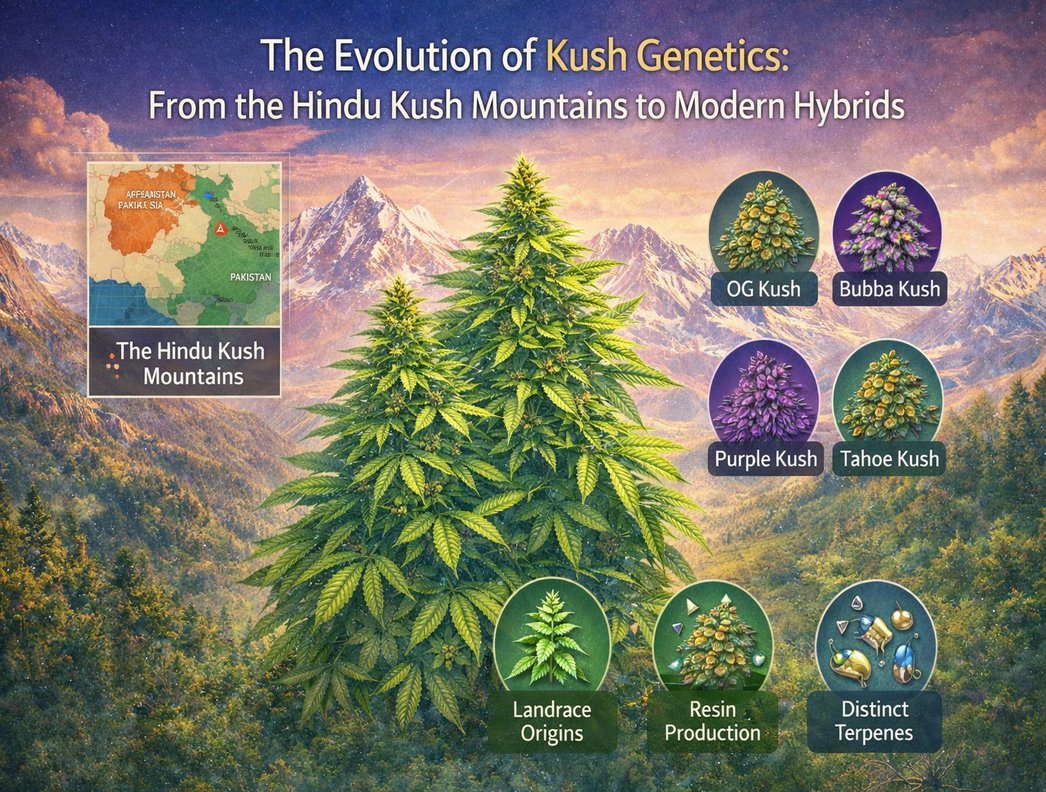
The Evolution of Kush Genetics
From the Hindu Kush Mountains to Modern Hybrids
Few cannabis lineages have shaped modern breeding as profoundly as Kush genetics. From rugged mountain ranges in Central Asia to today’s stabilized hybrid cultivars, Kush has become a foundational pillar in global cannabis development. Understanding Kush isn’t just about history; it’s about appreciating the genetic backbone behind countless modern strains.
Origins: The Hindu Kush Mountains
The name “Kush” traces back to the Hindu Kush mountain range, which stretches across Afghanistan and northern Pakistan. For centuries, cannabis plants grew naturally in this harsh, high-altitude environment. These landrace plants developed unique survival traits:
Dense, compact structure
Broad leaf morphology
Thick resin production
Early finishing cycles
High resistance to cold and stress
Because of the dry climate and intense sun exposure, these plants evolved to produce abundant resin; a natural protective mechanism against environmental pressures. This resilience made Kush genetics incredibly valuable to breeders decades later.
Landrace to Global Icon
In the 1960s and 1970s, travelers and breeders collected seeds from the Hindu Kush region and brought them to North America and Europe. These landrace genetics became the building blocks of many foundational cultivars. From there, selective breeding transformed Kush into stable hybrid lines such as:
OG Kush
Master Kush
Bubba Kush
Purple Kush
Tahoe Kush
Each new generation refined structural traits, terpene expression, and flowering consistency while preserving the core Kush characteristics.
What Defines Kush Genetics?
While modern hybrids vary, Kush lines often share distinct genetic markers and growth traits:
Structural Traits
Short to medium height
Strong lateral branching
Dense, compact bud formation
Resin & Trichome Development
Heavy trichome density
Thick resin glands
High terpene concentration potential
Terpene Profiles
Kush lines frequently express dominant terpene patterns such as:
Myrcene
Caryophyllene
Limonene
Pinene
These terpenes contribute to the aromatic complexity that Kush cultivars are known for in breeding circles.
The Kush Influence on Modern Hybrids
Kush genetics became especially influential when crossed with:
Haze lines (for height and flowering variation)
Diesel genetics (for terpene complexity)
Skunk genetics (for vigor and stability)
This blending created balanced hybrids that combine:
Structural stability
Enhanced resin production
Diverse terpene expression
Improved indoor adaptability
Today, many premium modern cultivars trace part of their lineage back to Kush ancestry.
Why Breeders Value Kush
From a genetic standpoint, Kush offers:
✔ Strong structural stability
✔ Predictable flowering patterns
✔ Dense trichome coverage
✔ Reliable terpene inheritance
✔ Adaptability in controlled environments
Because of this reliability, Kush remains a cornerstone in modern breeding programs.
Kush in Today’s Seed Market
Modern Kush-based seeds are often selected for:
Stabilized phenotypes
Consistent growth patterns
Refined terpene layering
Enhanced resin structure
Breeders continue to preserve original landrace traits while refining performance for contemporary cultivation environments.
Preserving Genetic Heritage
As hybridization expands globally, maintaining authentic Kush genetics becomes increasingly important. Preserving landrace foundations ensures:
Genetic diversity
Strong breeding stock
Historical continuity
Sustainable cultivar development
Kush is more than a strain family; it’s a genetic cornerstone of modern cannabis evolution.
Final Thoughts
From the mountains of Central Asia to sophisticated breeding programs worldwide, Kush genetics have shaped the cannabis landscape in profound ways. Understanding this lineage allows growers and breeders to better appreciate the structure, stability, and terpene complexity found in many of today’s most respected cultivars. The evolution of Kush is still unfolding -- and its genetic influence continues to expand.
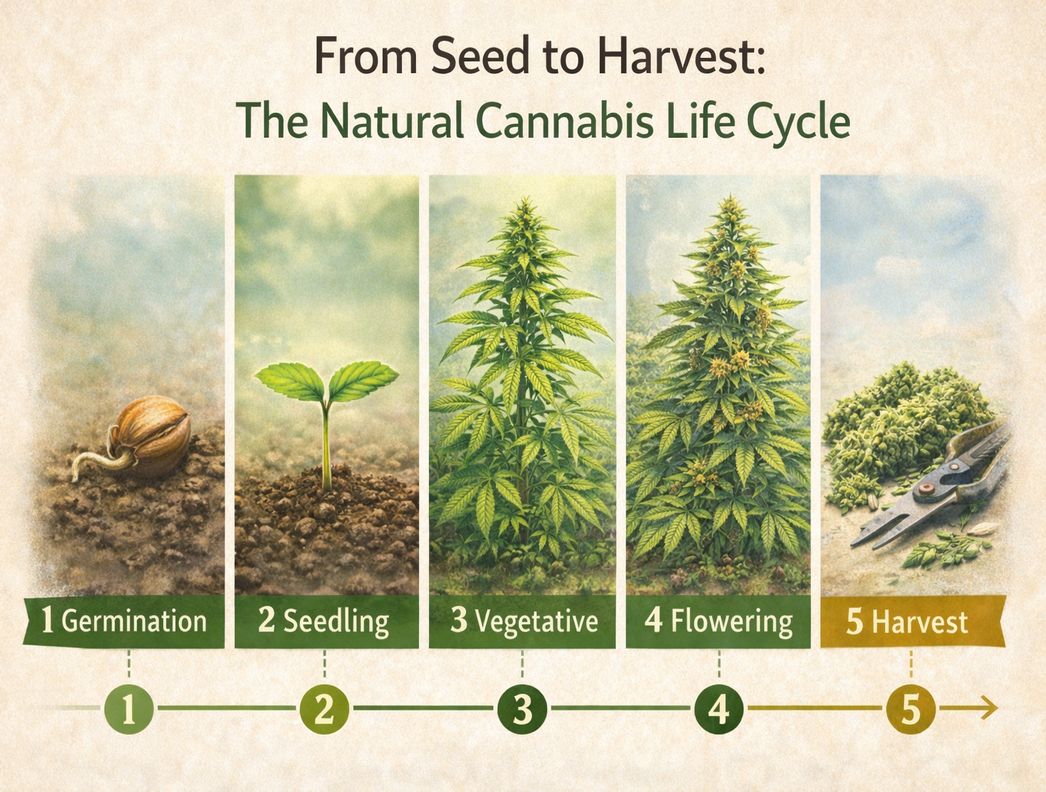
From Seed to Harvest
The Natural Cannabis Life Cycle
Every cannabis plant begins
the same way -- as a seed. Within that small, protective shell lies the
full genetic blueprint of the plant’s future structure, growth pattern,
and potential characteristics.
Understanding the natural life cycle of
cannabis provides insight into how genetics express themselves over time
and why seed quality matters from the very beginning. While cultivation
methods may vary, the cannabis life cycle follows a predictable
biological progression. Here’s a clear overview of how the process
unfolds.
1️⃣ Germination: The Beginning of Growth
The cannabis life cycle begins when a viable seed is exposed to the right environmental conditions. During germination, moisture activates the seed’s internal processes, signaling it to begin growth. As the seed awakens:
The outer shell softens
A small root (radicle) emerges
The seed begins its transformation into a seedling
This stage is delicate, as the plant transitions from dormancy to active growth. Strong genetics and proper care during this phase set the tone for everything that follows.
2️⃣ Seedling Stage: Establishing Structure
Once the initial root anchors into its growing medium, the plant enters the seedling stage. Small, rounded leaves known as cotyledons appear first, followed by the plant’s first “true” serrated leaves. During this phase:
The root system develops
The plant focuses on vertical growth
Early leaf structure forms
Seedlings are small but biologically active, establishing the foundation for future growth. Stability and consistency during this stage help promote healthy development.
3️⃣ Vegetative Stage: Rapid Expansion
The vegetative stage is where the cannabis plant truly begins to expand. Leaves grow larger and more numerous, stems thicken, and the plant increases in height and width. Key characteristics of this stage include:
Strong root development
Branch formation
Rapid leaf production
Structural strengthening
This is when a plant’s genetic traits become more visible. Differences in height, leaf shape, spacing, and growth patterns begin to reflect whether the plant expresses more indica, sativa, or hybrid characteristics. The vegetative stage is essential for building the plant’s overall framework before flowering begins.
4️⃣ Flowering Stage: Genetic Expression
As the plant transitions into the flowering stage, its energy shifts from structural growth to reproductive development. This stage reveals the plant’s full genetic potential. During flowering:
Bud sites develop
Resin production increases
Aromatic compounds become more pronounced
The plant’s structure stabilizes
Flowering is where cannabinoid and terpene profiles are expressed. While genetics determine the plant’s potential, environmental factors influence how those traits fully develop. This stage requires patience, as maturation takes time and varies depending on strain lineage.
5️⃣ Maturation and Harvest
The final phase of the life cycle occurs when the plant reaches peak maturity. Signs of readiness vary by strain, but generally reflect full development of the plant’s reproductive structures. At this point:
Growth slows
Resin production stabilizes
The plant completes its biological cycle
The life cycle concludes, but the process begins again with seeds, continuing the generational chain of cannabis genetics.
Why Understanding the Life Cycle Matters
Understanding the cannabis life cycle helps growers appreciate the importance of strong genetics and proper care. Each stage builds upon the last, and healthy progression depends on starting with quality seeds.
For seed banks, the life cycle represents more than just plant growth -- it reflects the preservation and continuation of cannabis genetics across generations. From a single seed to full maturity, the cannabis plant follows a remarkable natural progression. Respecting that cycle is the foundation of responsible cultivation.
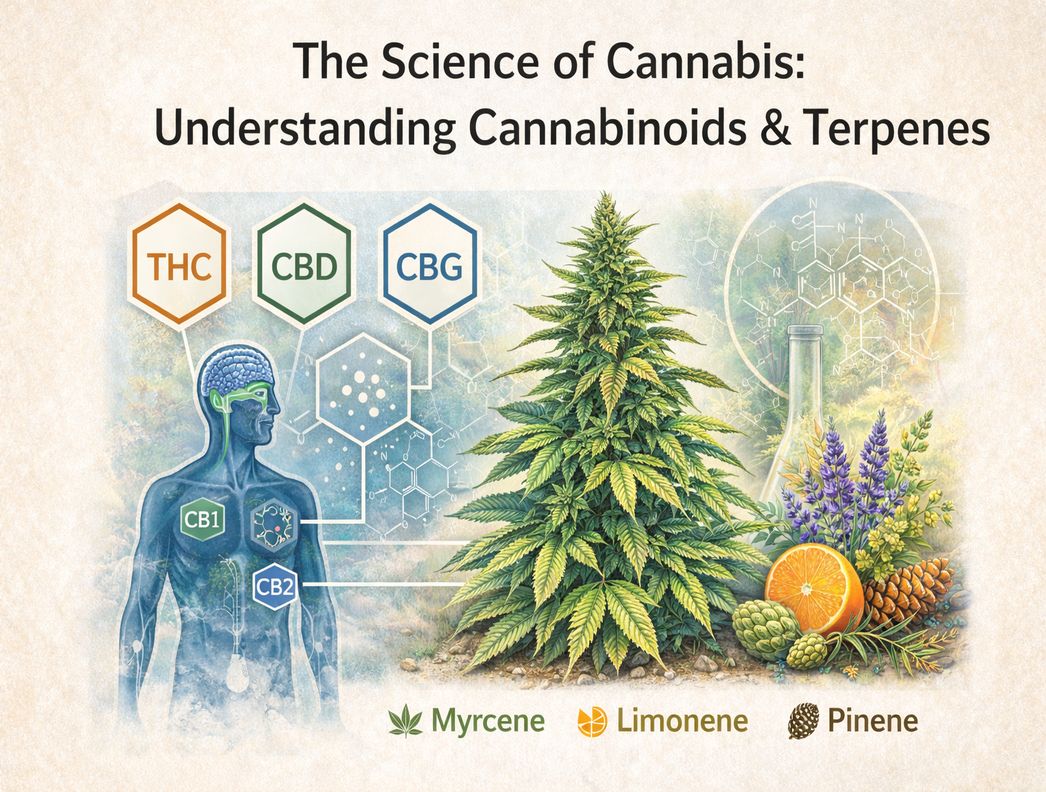
The Science of Cannabis
Understanding Cannabinoids & Terpenes
Cannabis is far more than a single
compound or experience. Behind every cannabis plant is a complex
chemical profile made up of cannabinoids, terpenes,
and other natural compounds that work together to shape how the plant
behaves and how it is commonly perceived.
Understanding these components
helps demystify cannabis and provides a clearer picture of why
different strains can feel so distinct.
What Are Cannabinoids?
Cannabinoids are naturally occurring compounds found in cannabis plants. To date, scientists have identified more than 100 cannabinoids, each with unique properties and structures. These compounds interact with the body’s endocannabinoid system (ECS) - a network of receptors involved in maintaining balance within the body.
The ECS exists naturally in humans and animals, regardless of cannabis use. Cannabinoids from the cannabis plant interact with this system in different ways, which helps explain why strains can produce varied effects.
THC: Tetrahydrocannabinol
THC (tetrahydrocannabinol) is the most well-known cannabinoid. It is primarily responsible for the psychoactive effects commonly associated with cannabis. THC interacts mainly with CB1 receptors, which are found largely in the brain and central nervous system. Because of this interaction, THC-rich strains are often associated with noticeable changes in perception, mood, and sensory awareness. In modern cannabis genetics, THC levels can vary widely depending on strain lineage, cultivation methods, and breeding goals.
CBD: Cannabidiol
CBD (cannabidiol) is another major cannabinoid, but unlike THC, it is non-intoxicating. CBD interacts differently with the endocannabinoid system and does not produce the same psychoactive response.
CBD has become widely recognized for its versatility and presence in both cannabis and hemp varieties. Many modern strains are bred to emphasize specific THC-to-CBD ratios, offering a broad range of cannabinoid profiles for different preferences.
CBG: Cannabigerol
CBG (cannabigerol) is often referred to as a “minor cannabinoid,” but it plays a major role in cannabis chemistry. CBG is considered a precursor cannabinoid, meaning other cannabinoids such as THC and CBD develop from it as the plant matures.
Because CBG typically exists in smaller quantities in mature plants, strains high in CBG are the result of careful breeding and harvesting strategies. Interest in CBG has increased as research continues to explore the full complexity of cannabis compounds.
What Are Terpenes?
Terpenes are aromatic compounds found not only in cannabis but in many plants, fruits, and herbs. They are responsible for the distinctive scents and flavors associated with different cannabis strains, ranging from citrus and pine to earthy or floral notes.
Common cannabis terpenes include:
-
Myrcene – often associated with earthy or musky aromas
-
Limonene – citrus-forward and bright
-
Pinene – pine-like and fresh
-
Caryophyllene – spicy and peppery
Terpenes play an important role in how strains are experienced and are a major factor in strain selection for many consumers.
How Cannabinoids and Terpenes Work Together
Cannabinoids and terpenes do not exist in isolation. They work together within the plant’s chemical profile, contributing to what is often referred to as the “entourage effect.” This concept suggests that the combined presence of cannabinoids and terpenes creates a more nuanced and distinctive experience than any single compound alone. This is why two strains with similar THC levels can feel noticeably different depending on their terpene composition and secondary cannabinoids.
A More Informed Way to Understand Cannabis
As cannabis science advances, the focus is shifting away from simple labels and toward deeper chemical understanding. Cannabinoids and terpenes offer valuable insight into why cannabis strains vary so widely and why modern genetics continue to evolve. Learning about these compounds empowers consumers to make informed choices and highlights the sophistication behind cannabis cultivation and breeding.

Happy Easter from Canadian Seed Bank
As Easter arrives and spring begins to settle across Canada, it brings with it a familiar feeling of renewal. The days get longer, the air feels lighter, and the season reminds us that growth often begins quietly before it becomes impossible to ignore.
At Canadian Seed Bank, Easter is more than just a holiday. It is a reflection of what this time of year represents: fresh starts, patience, resilience, and the promise of what is still to come.
Spring has always been a season tied to possibility. Gardens begin to wake up, routines shift, and many people take this time to reset their goals and reconnect with the things that matter most. It is a season that invites optimism. Whether you are spending Easter with family, enjoying a peaceful long weekend, or simply appreciating the arrival of warmer weather, there is something meaningful about this turning point in the year.
Easter also carries a timeless message of hope. It reminds us that change can be beautiful, that renewal is always possible, and that even after the longest winters, new life returns. That spirit of transformation feels especially fitting at this time of year, when everything around us begins to move again.
For us, this season is also a chance to express our gratitude. We are thankful for the growers, collectors, enthusiasts, and loyal supporters who continue to be part of the Canadian Seed Bank community. Your passion, curiosity, and commitment to quality are what keep this space alive and growing year after year.
As we celebrate Easter, we also celebrate the values that shape every strong season ahead: patience, care, preparation, and vision. Good things are rarely rushed. They are built with intention, nurtured over time, and strengthened by consistency. That lesson applies far beyond the garden. It applies to business, to family, to personal growth, and to life itself.
This Easter weekend, we hope you find time to slow down and enjoy the moment. Share a meal. Step outside. Take in the fresh spring air. Appreciate how far you have come, and look ahead to what you want to build next.
From all of us at Canadian Seed Bank, we wish you a joyful, peaceful, and inspiring Easter.
May your season be filled with renewal, positivity, and the excitement of new beginnings.
Happy Easter.
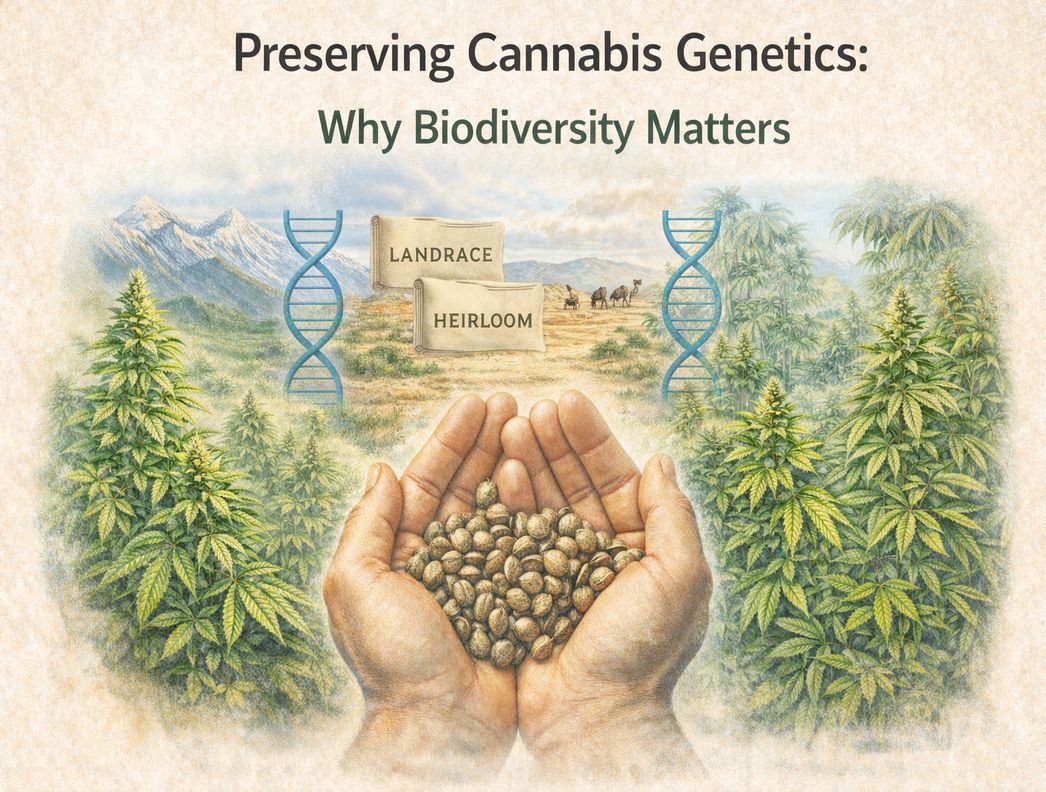
Why Biodiversity Matters
Preserving Cannabis Genetics:
Cannabis is one of the most genetically diverse plants cultivated by humans. Over thousands of years, it has adapted to a wide range of climates, soils, and cultural uses. Today, however, much of that natural diversity is at risk. As modern breeding narrows focus toward a limited number of popular traits, the importance of preserving cannabis genetics has never been greater.
Understanding why biodiversity matters in cannabis genetics helps explain not only where today’s strains come from, but why protecting genetic variation is essential for the plant’s future.
What Is Cannabis Genetic Biodiversity?
Genetic biodiversity refers to the range of genetic traits found within a species. In cannabis, this includes differences in plant structure, flowering time, resilience, terpene expression, and cannabinoid production. These traits developed naturally as cannabis spread across continents and adapted to local environments.
Landrace strains, naturally occurring regional varieties, are the foundation of this diversity. Each landrace evolved unique characteristics based on climate, altitude, soil conditions, and human cultivation practices. Together, they form the genetic library from which all modern cannabis strains originate.
How Modern Breeding Reduced Diversity
Modern cannabis breeding has achieved remarkable advancements in consistency and refinement. However, widespread hybridization and selective breeding have also led to genetic bottlenecks: situations where a small number of genetic lines dominate the market.
When breeders repeatedly cross the same parent strains to meet demand for specific traits, less common genetics can be lost over time. This reduces the overall resilience of cannabis as a species and limits future breeding potential. While modern strains may appear diverse in name, many share closely related genetic lineages beneath the surface.
Why Genetic Diversity Is Important
Preserving cannabis biodiversity matters for several key reasons:
1. Resilience and Adaptability
Genetically
diverse plants are better equipped to adapt to environmental changes,
pests, and disease. A broader genetic pool increases the chances that
cannabis can thrive in changing climates and cultivation conditions.
2. Long-Term Breeding Potential
Future
innovation depends on access to diverse genetics. Traits that may not
seem valuable today, such as climate tolerance or unique growth
patterns, could become essential tomorrow.
3. Stability and Consistency
Strong
genetic foundations help breeders create stable strains with
predictable characteristics. Without biodiversity, consistency becomes
harder to achieve over time.
4. Cultural and Agricultural Heritage
Landrace
and heirloom genetics represent centuries of human cultivation and
agricultural knowledge. Preserving them respects cannabis’s historical
and cultural roots.
The Role of Seed Banks in Preservation
Seed banks play a critical role in safeguarding cannabis biodiversity. By maintaining, cataloging, and protecting genetic lines, seed banks help ensure that rare and foundational genetics are not lost. Responsible seed preservation includes:
Maintaining genetic purity
Avoiding excessive inbreeding
Documenting lineage and origin
Protecting viable seed stock over time
For seed banks, preservation is not only about commerce, it is about stewardship of a living genetic resource.
Global Efforts to Protect Cannabis Genetics
Around the world, researchers, breeders, and conservationists are working to protect cannabis biodiversity. These efforts include collecting landrace genetics, studying plant DNA, and storing seeds in controlled environments for future research and cultivation. As cannabis research expands, genetic preservation is becoming increasingly important; not only for cultivation, but also for agriculture, sustainability, and scientific understanding.
Looking Ahead: A Genetic Responsibility
The future of cannabis depends on decisions made today. Preserving genetic diversity ensures that cannabis remains adaptable, resilient, and innovative for generations to come. While modern breeding continues to advance the plant, maintaining a strong connection to its genetic origins is essential. By valuing biodiversity, the cannabis community protects more than just strains -- it protects the plant’s past, present, and future.
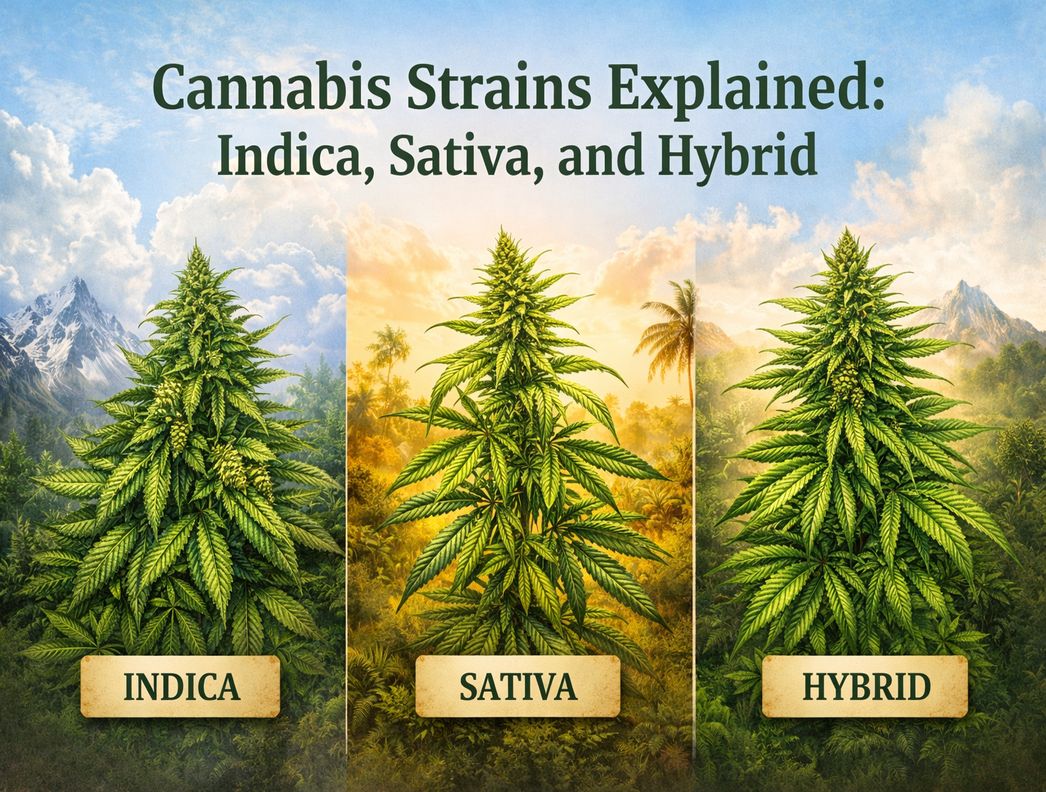
Cannabis Strains Explained
Indica, Sativa, and Hybrid
Understanding cannabis strains is
one of the first steps for anyone exploring the plant. While modern
cannabis genetics are far more complex than simple labels, the terms Indica, Sativa, and Hybrid
remain useful for describing a plant’s historical origins, physical
characteristics, and typical consumer preferences.
This guide breaks
down each strain type in a clear, beginner-friendly way.
Indica Strains: Compact and Resilient
Indica strains are believed to have originated in the mountainous regions of Central Asia, including areas such as Afghanistan, Pakistan, and northern India. These regions have harsh climates, which influenced the plant’s physical structure.
Growth Characteristics:
Indica plants tend to be short, bushy, and sturdy, with broad leaves and
dense foliage. They typically have a shorter flowering time, making
them popular among cultivators in cooler climates or with limited
growing space.
Historical Use:
Historically, Indica varieties were valued for their resin production
and durability. Many traditional hash-producing regions relied heavily
on Indica genetics due to their high resin output.
Common Consumer Preferences:
Indica strains are often associated with evening or nighttime use and
are commonly chosen by consumers looking for relaxing or calming
experiences. Their compact growth structure also makes them popular
among indoor growers.
Sativa Strains: Tall and Energetic
Sativa strains trace their origins to equatorial regions such as Southeast Asia, Central America, South America, and parts of Africa. These regions experience long growing seasons and abundant sunlight.
Growth Characteristics:
Sativa plants are typically tall and slender, with narrow leaves and
longer flowering cycles. Because of their height and extended growth
period, they are often better suited for outdoor cultivation in warm
climates.
Historical Use:
In many cultures, Sativa varieties were traditionally used during the
daytime for social, creative, or ceremonial purposes. Their growth
patterns evolved to thrive in open environments with consistent
sunlight.
Common Consumer Preferences:
Sativa strains are frequently associated with uplifting or energizing
experiences and are often preferred for daytime use. Due to their size,
they are more commonly grown outdoors or in larger cultivation spaces.
Hybrid Strains: The Best of Both Worlds
Hybrid strains are the result of selectively breeding Indica and Sativa genetics. As cannabis cultivation advanced, breeders began combining traits from both types to create plants with specific characteristics.
Growth Characteristics:
Hybrids can vary widely in size, flowering time, and structure depending
on their genetic makeup. Some lean Indica-dominant, others
Sativa-dominant, while balanced hybrids aim to blend traits evenly.
Why Hybrids Exist:
Hybridization allows breeders to improve consistency, resilience, yield,
and adaptability. Most modern cannabis strains available today fall
into the hybrid category.
Common Consumer Preferences:
Hybrids appeal to a broad audience because they offer flexibility.
Consumers can choose strains based on genetic dominance, growth traits,
or intended use rather than being limited to one category.
Understanding Strain Labels Today
While Indica, Sativa, and Hybrid remain helpful classifications, modern cannabis genetics are highly refined. Factors such as cannabinoid content, terpene profiles, and cultivation methods play a significant role in the final characteristics of a plant. For beginners, these strain categories provide a reliable starting point for understanding cannabis and exploring different genetic options.
A Foundation for Exploration
Whether you’re learning about cannabis for the first time or deepening your knowledge, understanding Indica, Sativa, and Hybrid strains builds a strong foundation. As research and breeding continue to evolve, these classifications remain an important part of cannabis education and history.
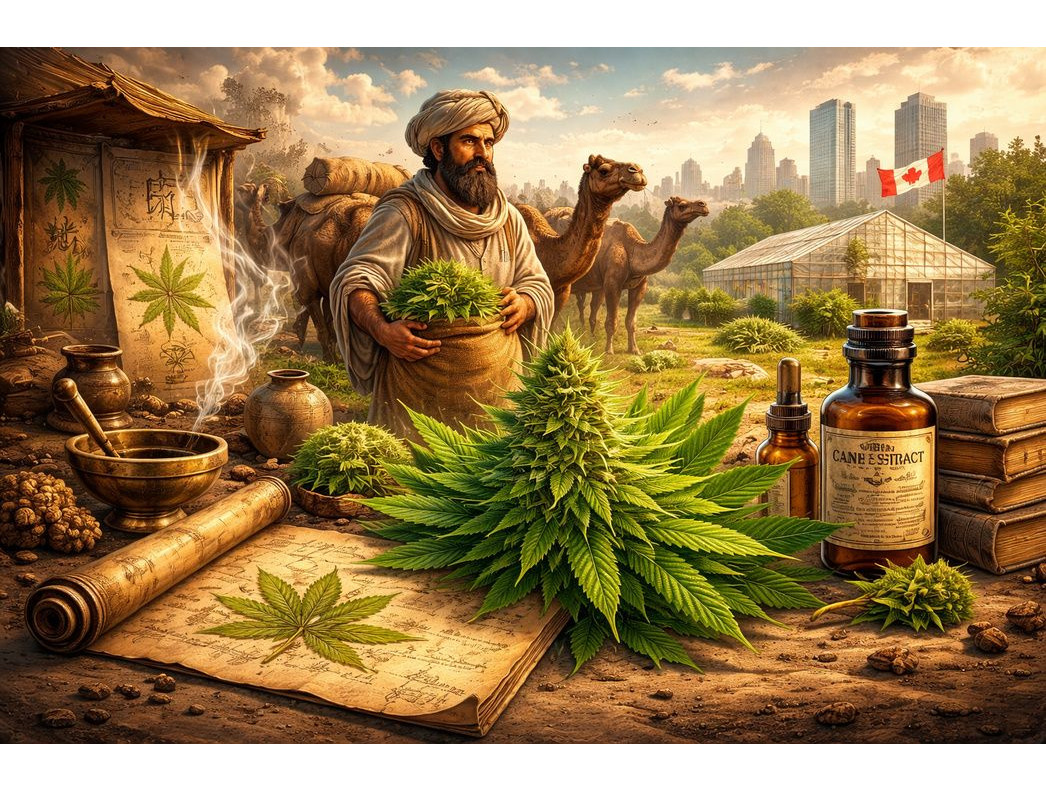
The History of Cannabis
From Ancient Medicine to Modern Industry
Cannabis is one of the oldest cultivated plants in human history, with a story that spans thousands of years, multiple civilizations, and a wide range of uses. Long before modern debates around legalization and regulation, cannabis played an essential role in medicine, agriculture, spirituality, and trade across the world.
Ancient Origins
The earliest recorded use of cannabis dates back over 5,000 years to ancient China. Archaeological evidence suggests cannabis was cultivated as early as 3000 BCE for its strong fibers, which were used to make rope, textiles, and paper. Ancient Chinese texts, including the writings attributed to Emperor Shen Nong, describe cannabis as a medicinal plant used to treat pain, inflammation, and various ailments.
From China, cannabis spread throughout Central Asia, India, and the Middle East. In ancient India, cannabis held both medicinal and spiritual significance. It was mentioned in sacred texts such as the Atharva Veda and used in traditional Ayurvedic medicine for digestive issues, pain relief, and relaxation. Cannabis preparations were also used in religious ceremonies, highlighting the plant’s deep cultural roots.
Expansion Through Trade and Empires
As trade routes expanded, cannabis traveled with merchants, explorers, and empires. The plant became a staple crop across Asia, Africa, and Europe. Hemp, a non-psychoactive variety of cannabis, was particularly valued for its durability and versatility. It was used to make sails, ropes, clothing, and even early forms of currency paper.
By the Middle Ages, cannabis cultivation was widespread throughout Europe. Hemp was so important that in some regions, farmers were legally required to grow it to support naval and industrial needs. During the Age of Exploration, cannabis seeds were brought to the Americas, where hemp became an essential crop in early colonial economies.
Cannabis in Western Medicine
In the 19th century, cannabis gained recognition in Western medicine. Extracts and tinctures were commonly prescribed for pain, insomnia, migraines, and muscle spasms. Cannabis was listed in medical pharmacopeias in Europe and North America and was widely accepted as a legitimate therapeutic substance.
However, attitudes toward cannabis began to shift in the early 20th century. Political, social, and economic factors, rather than scientific evidence, played a major role in its prohibition. By the 1930s, cannabis was increasingly regulated and criminalized in many parts of the world, leading to decades of restricted research and widespread stigma.
Modern Rediscovery and Legalization
In recent decades, scientific research and changing public perception have sparked a renewed interest in cannabis. Advances in genetics, cultivation techniques, and medical research have transformed the plant into a highly specialized and regulated industry. Researchers have identified hundreds of cannabinoids and terpenes, deepening our understanding of how cannabis interacts with the human body.
Countries such as Canada have taken a global leadership role in cannabis legalization, creating frameworks that support consumer safety, responsible use, and scientific study. Today, cannabis is recognized not only for its recreational and medicinal potential but also for its historical importance and agricultural versatility.
A Plant with a Long Legacy
The history of cannabis is a story of resilience, adaptation, and rediscovery. From ancient medicine to modern innovation, cannabis has continuously evolved alongside human civilization. As research expands and regulations modernize, the plant’s long and complex history provides valuable context for its place in today’s world, and its potential for the future.

10 Beginner-Friendly Strains to Grow at Home
10 Beginner-Friendly Strains to Grow at Home
Starting your cannabis growing journey can be exciting, but choosing the right genetics makes a huge difference. Some strains are far more forgiving than others, offering strong germination, resilient plant structure, and dependable yields.
For beginner growers, the best strains are those that tolerate minor mistakes, adapt well to different environments, and produce reliable results with basic care. Below are 10 beginner-friendly cannabis strains that are known for their stability and ease of cultivation.
1. White Widow
One of the most legendary cannabis strains ever bred, White Widow is known for its vigorous growth and strong resistance to common cultivation issues. It grows well both indoors and outdoors and produces thick, resin-coated buds.
This strain is popular with beginners because it germinates reliably and maintains strong plant structure throughout the grow cycle.
➡️ https://canadianseedbank.ca/index.php?product_id=75&route=product/product
2. Big Bud
Big Bud is famous for producing extremely large, dense flowers with minimal effort. The plant grows strong branches that support heavy bud production, making it one of the most productive strains available.
For new growers who want impressive yields without complicated growing techniques, Big Bud is an excellent choice.
➡️ https://canadianseedbank.ca/index.php?product_id=53&route=product/product
3. Early Mist
For growers in cooler climates, Early Mist is an excellent strain to start with. It was bred to mature earlier in the season, which makes it ideal for outdoor cultivation in regions with shorter summers.
The plants are hardy and adapt well to outdoor conditions while still producing solid yields.
➡️ https://canadianseedbank.ca/index.php?product_id=83&route=product/product
4. Swiss Miss
Swiss Miss is a resilient and adaptable strain that performs well in a variety of growing environments. It develops sturdy plants that handle small fluctuations in temperature or nutrients better than many other varieties.
This makes it a great option for growers who are still learning the fundamentals of cannabis cultivation.
➡️ https://canadianseedbank.ca/index.php?product_id=96&route=product/product
5. AK-47
Despite its intense name, AK-47 is actually a very manageable strain for beginners. It is a balanced hybrid known for stable genetics, vigorous growth, and strong aromatic buds.
AK-47 grows well indoors and outdoors and is known for producing high-quality results even with basic care.
➡️ https://canadianseedbank.ca/index.php?product_id=55&route=product/product
6. Northern Lights
A classic strain that has been trusted by growers for decades, Northern Lights is famous for its resilience and fast flowering cycle. It performs especially well in indoor grow environments.
Its predictable growth patterns make it one of the easiest strains for beginners to manage.
➡️ https://canadianseedbank.ca/index.php?product_id=71&route=product/product
7. Blueberry
Blueberry is a well-known strain that produces beautiful, aromatic buds with a sweet terpene profile. It tends to grow at a manageable height and adapts well to many indoor setups.
For beginners looking for a flavorful and visually appealing strain, Blueberry is a fantastic option.
➡️ https://canadianseedbank.ca/index.php?product_id=94&route=product/product
8. BC Skunk
BC Skunk is known for its strong growth and natural resistance to environmental stress. Skunk genetics are famous for their vigor, making this strain particularly forgiving for beginner growers.
It grows quickly and produces dense, aromatic buds.
➡️ https://canadianseedbank.ca/index.php?product_id=30&route=product/product
9. B-52
B-52 is a dependable hybrid strain that produces thick buds and strong yields. It develops sturdy plants that handle common beginner mistakes better than many more delicate strains.
This makes it a great strain for growers who want reliable results.
➡️ https://canadianseedbank.ca/index.php?product_id=62&route=product/product
10. Durban Poison
A legendary sativa strain, Durban Poison grows vigorously and thrives outdoors in sunny climates. Its strong natural growth patterns make it easier for beginners to maintain healthy plants.
The strain also produces energetic and uplifting effects that have made it popular worldwide.
➡️ https://canadianseedbank.ca/index.php?product_id=76&route=product/product
Final Thoughts
Starting with beginner-friendly genetics can dramatically increase your chances of a successful grow. Strains like White Widow, Big Bud, Early Mist, Swiss Miss, and AK-47 are known for their reliability, resilience, and strong performance in a wide range of growing conditions.
With the right seeds and a little patience, even first-time growers can produce healthy plants and satisfying harvests.

Cannabis in Pop Culture
How the Plant Shaped Music, Film, and Fashion
Cannabis has long existed at the intersection of culture, creativity, and social change. While today the plant is widely discussed in scientific, agricultural, and legal contexts, its influence on popular culture stretches back decades. From underground art movements to global music scenes and fashion trends, cannabis has played a unique role in shaping how generations express identity, creativity, and rebellion. Understanding cannabis in pop culture is not just about entertainment. It also reveals how attitudes toward the plant have evolved over time.
Early Cultural Influence
Cannabis began appearing in artistic circles long before it entered mainstream conversations. In the early twentieth century, jazz musicians in North America were among the first public figures linked to cannabis culture. Jazz clubs became spaces where experimentation, improvisation, and artistic freedom flourished. Within those environments, cannabis developed a reputation as a symbol of creative independence.
Although social attitudes toward the plant were far more restrictive during that period, its connection to music and artistic communities continued to grow quietly in the background. By the 1950s and 1960s, cannabis had become increasingly associated with broader counterculture movements. Writers, musicians, and filmmakers often referenced the plant as part of a cultural shift that challenged traditional norms. For many young people at the time, cannabis symbolized a break from conventional expectations and a move toward personal expression.
The Rise of Cannabis in Music
Music has arguably been the most influential driver of cannabis in pop culture. Over the decades, artists from multiple genres have referenced the plant in their work. From reggae and rock to hip hop and electronic music, cannabis references have appeared in lyrics, album artwork, and stage performances. Reggae music, in particular, helped bring cannabis symbolism to an international audience. Artists used it as a representation of spirituality, reflection, and cultural identity. As reggae spread globally, so did the imagery and language associated with cannabis.
Hip hop culture later amplified this influence. In the 1990s and early 2000s, cannabis became part of the visual and lyrical language of the genre. Artists often used it as a symbol of lifestyle and authenticity. At the same time, independent music scenes across the world continued to incorporate cannabis references in their creative expression. Today, cannabis appears across nearly every musical genre. However, the tone has shifted. Instead of being framed as rebellious or taboo, it is often treated as a normalized part of artistic culture.
Cannabis in Film and Television
Film and television have also played a significant role in shaping public perception of cannabis. Early portrayals tended to exaggerate the plant’s effects, sometimes using it as a tool for dramatic or comedic storytelling.
By the late twentieth century, cannabis had become a recurring element in comedy films. Certain characters were written specifically to represent relaxed or unconventional personalities associated with cannabis culture. These portrayals helped cement a recognizable stereotype that persisted for many years.
In more recent decades, however, film and television have evolved. Cannabis now appears in storylines with greater nuance. Characters who use it are often portrayed as ordinary individuals rather than exaggerated caricatures. This shift reflects changing social attitudes and a broader understanding of the plant. Streaming platforms and modern television series have further expanded this representation, presenting cannabis in everyday settings rather than framing it solely as a comedic element.
The Cannabis Aesthetic in Fashion
Beyond music and film, cannabis has also influenced fashion and visual culture. The iconic leaf shape became one of the most recognizable symbols in modern design. Initially used in underground or niche clothing brands, it eventually appeared in mainstream streetwear and festival fashion.
During the late twentieth century, wearing cannabis themed clothing often served as a subtle cultural signal. It indicated alignment with music scenes, artistic communities, or counterculture movements. As legalization expanded in places such as Canada, the symbolism began to evolve. Designers started incorporating botanical patterns, earthy color palettes, and plant inspired graphics into broader fashion collections. Cannabis imagery moved from controversial symbol to design inspiration. Today, fashion references to cannabis are often more subtle and artistic, reflecting a broader shift in cultural perception.
Celebrity Influence and Modern Branding
In the modern era, celebrities have played a significant role in shaping cannabis culture. Public figures from the worlds of music, sports, and entertainment have openly discussed their perspectives on the plant. Some have even launched brands centered around cannabis related lifestyle products or advocacy initiatives. These developments have helped transform cannabis from a cultural symbol into a legitimate global industry conversation. Instead of existing only within underground movements, cannabis now appears in discussions about agriculture, genetics, entrepreneurship, and innovation. Canada’s legalization framework has also positioned the country as an international example of regulated cannabis integration. This has contributed to a more mature and informed cultural dialogue.
The Digital Age and Cannabis Culture
The rise of social media has further transformed how cannabis is represented in pop culture. Online communities now share plant photography, genetic discussions, and educational content with audiences around the world. Digital platforms have allowed cannabis culture to move beyond stereotypes and toward deeper conversations about plant science and horticulture. Enthusiasts, researchers, and cultivators frequently discuss genetics, seed preservation, and breeding techniques online. This shift reflects a growing appreciation for the plant as both a cultural icon and a complex agricultural species.
A Cultural Symbol That Continues to Evolve
Cannabis has traveled an extraordinary path through modern history. What began as a misunderstood and often hidden plant has gradually become part of global cultural expression. Music, film, fashion, and digital media have all contributed to shaping its image. In Canada and around the world, the conversation continues to evolve. Cannabis is increasingly viewed through the lenses of science, agriculture, and responsible regulation. Yet its cultural influence remains undeniable.
From jazz clubs and reggae stages to modern streaming platforms and fashion runways, cannabis has left a lasting imprint on pop culture. As social attitudes continue to shift and knowledge expands, the plant’s cultural story is still being written.

Polyploidy in Plants
What Happens When Chromosome Counts Multiply
When most people think about plant genetics, they imagine chromosomes neatly paired in predictable sets. In many species, that is true. However, the plant kingdom is far more complex than simple pairs of chromosomes. Some plants carry extra sets of genetic material, a phenomenon known as polyploidy.
Polyploidy occurs when a plant has more than two complete sets of chromosomes. Instead of the typical diploid structure, written as 2n, polyploid plants may be triploid, tetraploid, or even higher. This genetic multiplication can significantly influence plant vigor, structure, and long term adaptability.
Understanding Chromosome Sets
In diploid plants, each chromosome has one matching partner. One set is inherited from each parent. This pairing allows for predictable inheritance patterns and stable reproduction. Polyploid plants, on the other hand, carry additional copies of every chromosome. A tetraploid plant, for example, has four complete sets instead of two. This means each gene may exist in multiple copies, creating a different genetic dynamic inside the cell. These additional chromosome sets can arise naturally through errors in cell division or through evolutionary processes over time. In fact, polyploidy is remarkably common in the plant world. Many agricultural crops, including wheat and certain fruits, are polyploid species.
How Polyploidy Affects Plant Structure
When chromosome counts multiply, the effects often become visible at the structural level. Extra genetic material can influence cell size, metabolic activity, and tissue development. Polyploid plants frequently exhibit thicker leaves, larger stems, and more robust structural characteristics. Cells themselves may be larger due to increased DNA content. This enlargement can translate into visible differences in leaf width, overall plant density, and even growth pattern. Because genes exist in multiple copies, expression can become amplified or buffered. Some traits may appear stronger, while others may stabilize due to genetic redundancy. This balance can contribute to increased structural resilience.
Genetic Redundancy and Stability
One of the most interesting aspects of polyploidy is genetic redundancy. With multiple copies of each gene, plants may gain a form of biological insurance. If one gene copy experiences mutation or reduced function, other copies may compensate. This redundancy can support stress tolerance and adaptability. In evolutionary terms, polyploid plants may have greater flexibility when facing environmental change. The presence of extra genetic material can provide a broader range of responses to temperature shifts, moisture variation, or nutrient differences. From a genetics perspective, this expanded DNA content increases the complexity of inheritance patterns. Traits may interact in more nuanced ways compared to diploid plants.
Polyploidy and Vigor
Plant vigor often improves when chromosome sets multiply. Increased vigor refers to strong growth, structural density, and metabolic efficiency. This enhanced performance may result from amplified gene expression or from the synergistic interaction of multiple gene copies. When genes responsible for growth hormones, photosynthesis, or structural proteins are present in higher quantities, the overall system can operate differently.
However, vigor is not guaranteed. Polyploidy introduces complexity, and outcomes depend on how gene networks interact. In some cases, increased chromosome numbers may disrupt balance rather than enhance it. The results are influenced by which genes are duplicated and how they coordinate inside the cell.
Reproductive Implications
Polyploidy can also influence reproductive biology. In some plants, additional chromosome sets affect pollen formation and seed development. Triploid plants, for example, often experience reduced fertility because chromosome pairing during reproduction becomes more complicated. Tetraploid plants, with evenly doubled chromosome sets, may reproduce more consistently than triploids. The structure of chromosome pairing plays a central role in determining fertility outcomes. From a breeding perspective, understanding chromosome number is critical. Changes in ploidy level alter inheritance patterns and can shift how traits are passed to future generations.
Evolutionary Significance
Polyploidy has played a major role in plant evolution. Many modern plant species originated through ancient chromosome doubling events. Over time, duplicated genes can evolve new functions, increasing biological diversity. This genetic expansion allows plants to explore new trait combinations while maintaining core stability. It is one of the reasons the plant kingdom displays such extraordinary variation in structure, size, and adaptability.
Why This Topic Matters
For those interested in advanced plant genetics, polyploidy represents a fascinating layer of biological complexity. It challenges the assumption that more DNA simply means duplication. Instead, it reveals how chromosome multiplication can reshape structure, influence vigor, and alter reproductive pathways. In cannabis and other plant species, chromosome dynamics form part of the broader discussion about genetic stability, trait expression, and evolutionary potential. While diploid structures remain the norm, understanding polyploid mechanisms deepens appreciation for how plants adapt and evolve.
Ultimately, polyploidy highlights a powerful truth in plant biology. Genetic systems are not static. They are dynamic, flexible, and capable of expanding beyond simple pairings. When chromosome counts multiply, plants gain new layers of possibility, complexity, and structural potential.

Growing Cannabis in Canada
Understanding Regional Climate Differences
Canada spans nearly ten million square kilometers, stretching from the Pacific coastline to the Atlantic provinces and north toward the Arctic Circle. With that geographic diversity comes a wide range of climate conditions that influence plant development.
For cannabis cultivation, understanding regional climate differences is essential for predicting growth patterns, flowering timelines, and overall plant performance. Whether grown indoors or outdoors, cannabis plants respond directly to temperature, humidity, daylight hours, and seasonal shifts. In Canada, those variables can change dramatically from province to province.
The West Coast: Mild and Moderate Conditions
British Columbia is often associated with cannabis culture, and for good reason. Coastal regions benefit from relatively mild temperatures and longer growing seasons compared to other parts of the country. Warmer summers and moderate humidity levels create favorable conditions for strong vegetative growth. However, coastal moisture can also present challenges. Higher humidity in late summer and early autumn may influence plant health and structural resilience. Understanding how moisture interacts with plant metabolism becomes especially important in regions where rainfall increases toward harvest season. Overall, western coastal climates tend to support longer outdoor growing windows compared to more northern or central provinces.
The Prairies: Temperature Swings and Shorter Seasons
Alberta, Saskatchewan, and Manitoba experience continental climates marked by hot summers and cold winters. One defining feature of the Prairies is rapid temperature fluctuation. Daytime heat can be significant during peak summer months, while evenings cool quickly. Outdoor cultivation in these regions requires awareness of shorter frost free periods. The growing season is typically more condensed, meaning plants must develop efficiently within a limited timeframe. Long daylight hours during midsummer can support strong vegetative growth. However, early autumn frosts can arrive quickly, influencing flowering duration. Selecting genetics suited to shorter outdoor seasons becomes particularly relevant in these provinces.
Ontario and Quebec: Humidity and Seasonal Balance
Central Canada presents a mix of humid summers and cold winters. Ontario and Quebec often experience high humidity during peak summer growth periods, which can influence transpiration rates and metabolic activity. Warm temperatures combined with moisture can accelerate vegetative expansion. At the same time, careful environmental monitoring becomes important in both outdoor and greenhouse settings. Autumn in central Canada brings cooler temperatures and reduced daylight hours, naturally triggering flowering cycles in photoperiod sensitive plants. The seasonal rhythm in these provinces closely aligns with the biological timing systems that regulate plant development.
Atlantic Canada: Maritime Influence
Atlantic provinces such as Nova Scotia and New Brunswick are influenced by surrounding ocean currents. Summers tend to be milder than in central Canada, while humidity remains relatively high. Wind exposure and variable rainfall patterns are additional factors to consider. Cannabis plants grown in maritime regions may experience slower seasonal transitions compared to inland climates. While the growing window can be slightly shorter than in parts of British Columbia, stable summer daylight hours still support healthy development when environmental conditions are balanced.
Northern Canada: Limited Outdoor Windows
Northern regions experience dramatic differences in daylight hours between seasons. Summers bring extended daylight, while winters are defined by long periods of darkness and cold temperatures. Outdoor cultivation in these areas is limited by short frost free periods. However, extended summer daylight can accelerate vegetative growth during peak months. Controlled indoor environments are often favored in northern communities to create stable temperature and light conditions year round.
Why Climate Matters for Cannabis Growth
Cannabis plants are highly responsive to environmental cues. Temperature influences enzyme activity and metabolic speed. Humidity affects transpiration and nutrient movement. Daylight duration regulates circadian rhythms and flowering transitions. In Canada, these variables shift significantly depending on geography. A plant grown on the Pacific coast may experience a longer, milder season than one cultivated in the Prairies or northern territories. Understanding regional climate differences allows cultivators to anticipate how plants will respond to seasonal changes. It also highlights the importance of genetic selection suited to specific environmental conditions.
The Intersection of Genetics and Environment
Seeds contain genetic instructions, but environment shapes how those instructions are expressed. In diverse climates like Canada, regional conditions influence structural development, flowering timing, and overall plant behavior. By recognizing how temperature, humidity, and daylight vary across provinces, growers gain deeper insight into cultivation biology. Climate is not simply a backdrop. It is an active factor that interacts with plant genetics every day.
Canada’s geographic diversity makes it one of the most unique cultivation landscapes in the world. From coastal moderation to prairie extremes and northern daylight shifts, understanding regional climate differences is key to appreciating how cannabis plants grow and adapt within this vast country.

What Determines Germination Success
The Science of Cannabis Seed Viability:
Every healthy cannabis plant begins with a single seed. Inside that small outer shell is a living, breathing biological system waiting for the right conditions to activate. Yet not all seeds germinate equally. Some sprout quickly and vigorously, while others struggle or fail to develop.
The difference comes down to one essential concept in plant biology: seed viability.
Understanding cannabis seed viability is critical for anyone interested in genetics, plant development, and long term preservation. When we look deeper into the science, we discover that germination success is not random. It is the result of embryo health, environmental conditions, and proper storage practices working together.
What Is Seed Viability
Seed viability refers to a seed’s ability to germinate and develop into a healthy plant under appropriate conditions. A viable cannabis seed contains a living embryo that remains metabolically intact and capable of growth once activated by moisture and warmth.
Inside the seed coat is the embryo, which includes the radicle that becomes the root, the embryonic shoot, and stored nutrients known as endosperm or cotyledons. These stored reserves fuel the plant during its earliest stage before it can produce its own energy through photosynthesis. If the embryo becomes damaged or its cellular structure deteriorates over time, the seed may lose viability. Even if it appears intact on the outside, the internal biological processes may no longer function properly.
The Role of Dormancy
Cannabis seeds are naturally programmed for dormancy. Dormancy is a protective mechanism that prevents premature germination. In nature, this ensures that seeds do not sprout during unfavorable environmental conditions.
Dormancy ends when moisture penetrates the seed coat and activates internal enzymes. Water absorption triggers metabolic pathways that restart cellular activity. Enzymes break down stored nutrients into usable energy, and the embryo begins to expand.
The first visible sign of successful germination is the emergence of the radicle. This root anchors the plant and begins nutrient and water uptake. However, if the seed has lost viability, these metabolic reactions may fail to initiate or complete.
Factors That Affect Cannabis Seed Viability
Several key factors determine whether a cannabis seed remains viable over time.
Genetic integrity plays a foundational role. Seeds produced from stable, well developed parent plants are more likely to contain strong, resilient embryos. Healthy genetics contribute to robust cellular structure and improved longevity.
Moisture levels are equally critical. Excess humidity during storage can prematurely activate metabolic processes, leading to degradation. On the other hand, extremely dry conditions maintained within safe limits help preserve internal stability.
Temperature significantly influences seed lifespan. Warmer storage environments accelerate cellular aging. Cooler, stable temperatures slow metabolic breakdown and help maintain long term viability.
Light exposure can also impact seed preservation. Seeds are naturally adapted to dark soil conditions. Extended exposure to direct light may contribute to internal stress over time.
The Science of Storage
Proper storage is essential for protecting cannabis seed viability. From a botanical perspective, seeds are living organisms in a state of suspended animation. While dormant, they continue to undergo slow metabolic activity. The goal of storage is to minimize that activity without damaging cellular structure.
Maintaining a cool, dry, and dark environment reduces the rate of internal deterioration. When these conditions are stable, seeds can retain viability for extended periods. This is why professional seed preservation focuses heavily on environmental control. Small fluctuations in temperature or humidity may seem insignificant, but over months or years they can affect germination rates.
Why Seed Age Matters
Time naturally impacts viability. Even under ideal storage conditions, cellular components gradually break down. Membranes lose integrity. Enzymes become less efficient. Energy reserves slowly diminish.
However, high quality cannabis seeds with strong genetic foundations and proper storage conditions can maintain impressive longevity. Age alone does not determine viability. It is the interaction between genetics and storage environment that truly matters.
Germination Success Begins Before Planting
Many people assume germination success depends only on the planting stage. In reality, success begins long before moisture is introduced. It starts at the moment the seed is formed and continues through how it is preserved. Seed viability is the foundation of healthy plant development. A strong, viable seed carries not only the genetic blueprint of the cultivar but also the metabolic strength required to begin life.
When we understand the science behind cannabis seed viability, we gain a deeper appreciation for plant biology and genetic preservation. Germination is not simply a matter of chance. It is the result of careful genetic selection, proper storage, and the remarkable resilience of a living embryo waiting for the right moment to grow.
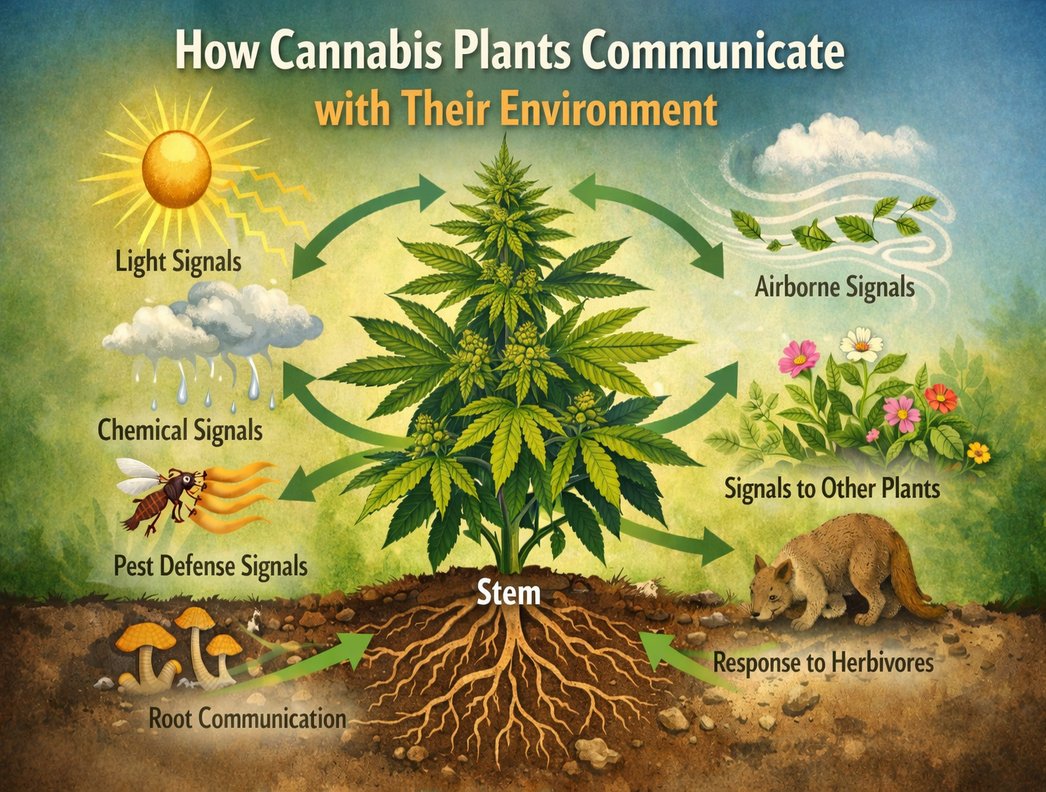
How Cannabis Plants Communicate
How Cannabis Plants Communicate with Their Environment
Plants may appear passive, but they are constantly sensing and responding to the world around them. Cannabis is no exception. Through complex biological systems, cannabis plants “communicate” with their environment -- adapting to light, soil conditions, temperature changes, and even nearby organisms. Understanding this natural interaction reveals how cannabis genetics and environmental factors work together to shape plant development.
Plants as Responsive Organisms
Cannabis plants do not have nervous systems, but they do possess sophisticated biochemical signaling pathways. These systems allow them to detect:
-
Light intensity and duration
-
Temperature fluctuations
-
Moisture levels
-
Soil composition
-
Physical stress
-
Nearby plant activity
When environmental conditions shift, internal chemical signals trigger adjustments in growth patterns and compound production. This dynamic relationship between genetics and environment is central to cannabis development.
Light as a Biological Signal
Light is one of the most powerful environmental signals influencing cannabis growth. The plant detects changes in daylight length and intensity through specialized photoreceptors. These receptors regulate:
-
Growth direction
-
Leaf expansion
-
Stem elongation
-
Transition into flowering
Over thousands of years, cannabis evolved to respond precisely to seasonal light cycles. This adaptation allowed landrace strains in different regions to thrive under specific daylight patterns.
Stress Responses and Adaptive Chemistry
When cannabis encounters environmental stress, such as wind, heat, or pests, it may alter its chemical production. Plants naturally produce protective compounds in response to stress. In cannabis, this includes shifts in resin and terpene expression. These compounds evolved primarily as defense mechanisms, helping the plant deter herbivores and protect reproductive structures. This evolutionary adaptation explains why environmental conditions can influence aromatic and structural traits, even within the same genetic line.
Root Communication and Soil Interaction
Much of a cannabis plant’s communication happens underground. Roots interact with soil microorganisms through chemical signaling. These interactions influence nutrient uptake and overall plant stability. Beneficial microbial networks in soil ecosystems can support stronger root systems and improved plant resilience. The root system acts as both anchor and sensor, constantly monitoring moisture levels and nutrient availability.
Plant-to-Plant Signaling
Research in plant biology shows that plants can release chemical signals when under stress, effectively “warning” nearby plants. While cannabis-specific research continues to develop, this phenomenon has been observed in many plant species. This type of environmental awareness highlights the complexity of plant ecosystems and reinforces the importance of genetic resilience.
Genetics vs Environment: A Balanced Relationship
Cannabis genetics determine a plant’s potential; structure, growth speed, terpene capacity, and adaptability. However, the environment influences how that potential is expressed. This interaction is often described as:
Genotype (genetics) + Environment = Phenotype (observable traits)
Two plants from identical seeds may express slightly different characteristics depending on environmental variables. This natural variation is part of the plant’s adaptive design.
Evolution Through Environmental Pressure
Over centuries, cannabis adapted to different climates and ecosystems:
-
Mountainous regions encouraged compact, resilient structures.
-
Tropical climates supported taller growth and longer flowering cycles.
-
Arid regions selected for drought tolerance.
These adaptations shaped the genetic diversity seen in modern cannabis strains.
Environmental pressure, over time, became a driving force in cannabis evolution.
A Living, Adaptive Organism
Cannabis is not a static plant, it is a responsive organism shaped by its surroundings. Its ability to sense, adjust, and adapt is deeply embedded in its genetics. For seed banks and breeders, understanding this interaction between plant biology and environment reinforces the importance of preserving diverse genetic lines. Adaptability depends on genetic strength, and genetic strength depends on biodiversity.
By appreciating how cannabis communicates with its environment, we gain a deeper respect for the science behind cultivation, and the evolutionary history that brought the plant to where it is today.
How to Plant Cannabis Seeds Indoors
A Beginner-Friendly Overview
Growing cannabis indoors can be an engaging and rewarding project for those interested in plant cultivation. Many people choose indoor growing due to unpredictable weather, limited outdoor space, or the desire for greater environmental control.
While indoor cultivation requires attention and patience, understanding the overall process helps set realistic expectations from the start.
This article provides a general overview of how indoor cannabis growing typically works, along with best-practice considerations. For readers seeking detailed, step-by-step instructions, we recommend consulting established third-party resources.
Why Grow Cannabis Indoors?
Indoor cultivation allows growers to better manage factors such as light exposure, temperature, and humidity. This level of control can help plants develop more consistently, regardless of outdoor climate conditions. Indoor growing is also appealing to those living in urban areas or regions with short growing seasons. That said, indoor growing is still gardening: it requires care, observation, and a basic understanding of plant needs.
Understanding the Indoor Growing Process
At a high level, indoor cannabis cultivation generally follows three core stages:
1. Seed Preparation
Before planting, seeds are typically prepared to encourage successful sprouting. This stage focuses on creating the right conditions for a seed to begin its growth cycle.
2. Planting Medium
Seeds are then placed into a suitable growing medium, such as soil or a starter material designed to support early root development. The choice of medium plays a role in moisture retention, airflow, and nutrient availability.
3. Ongoing Care
Once planted, young plants require consistent care. Light, water, airflow, and cleanliness all contribute to healthy development. As with any plant, observation is key, small changes in environment can impact growth. This general framework applies to most indoor growing methods, regardless of setup size or experience level.
A Note on Seed Soaking Practices
Many guides discuss soaking seeds as part of early preparation. While this technique is widely referenced, long soak times are not always necessary. Extended exposure to water may increase the risk of seed damage if not carefully monitored.
As a general best practice, shorter soaking periods are often sufficient to support seed viability while reducing potential stress to the seed. Growers are encouraged to research multiple sources and choose methods that prioritize seed health and care.
Recommended External Resource
For readers looking for a detailed, illustrated walkthrough, WikiHow provides a comprehensive guide that covers indoor planting methods in depth:
https://www.wikihow.com/Plant-Cannabis-Seeds-Indoors
This resource offers visuals and expanded explanations that may be helpful for beginners.
Grow with Knowledge and Patience
Indoor cannabis growing is ultimately about understanding plants and respecting the process. Learning the fundamentals, using reputable resources, and making informed decisions helps create a more enjoyable and educational experience. As with all cultivation activities, be sure to understand and comply with applicable local laws and age requirements.
Happy Growing From The CanadianSeedBank Team!
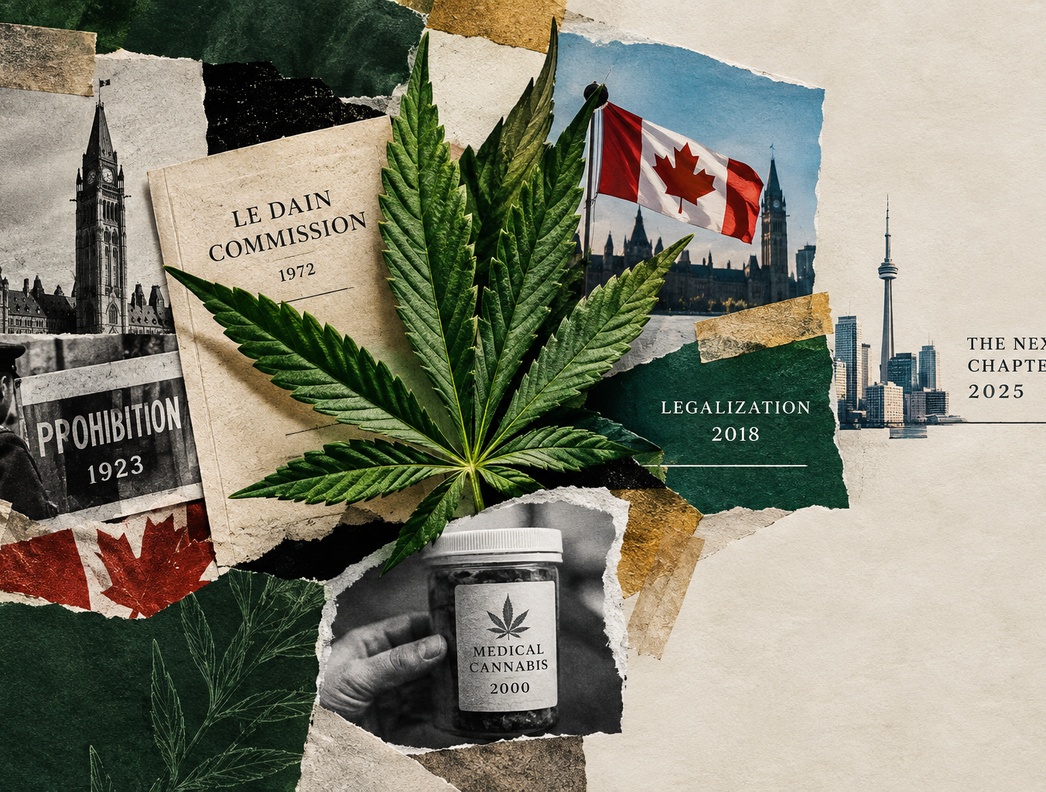
Canada’s Cannabis Plot Twist
How a Plant Became a National Debate
The journey from prohibition to legalisation was never a straight line. In 2025, its most revealing questions remain unfinished.
Canada’s cannabis story contains a peculiar reversal. A plant once treated as a matter for the criminal courts now appears in conversations about retail competition, product labels and public company balance sheets. The substance did not undergo a sudden botanical transformation in October 2018. The country changed the rules around it.
That distinction is easy to lose in the familiar before and after picture. Prohibition occupies one side; legalisation occupies the other. Between them sits a date, apparently explaining everything.
The actual story is more revealing. It involves obscure legislative decisions, commissions whose recommendations outpaced political action, patients who challenged the law and a national experiment that exchanged one set of difficult questions for another. By 2025, the most useful way to understand Canadian cannabis is to examine those turning points without pretending the ending has already been written.
Legalisation was a major decision. It was never a declaration that the work was finished.
A prohibition with an uncertain origin story
Cannabis entered Canada’s prohibited drug framework in 1923. A later Senate examination described how Health Minister Henri Séverin Béland referred to a new drug being added to the schedule, while noting that the circumstances behind the decision remained obscure. The record does not support the tidy impression of a comprehensive national debate followed by a clearly documented verdict. Senate Special Committee on Illegal Drugs, historical review (https://sencanada.ca/en/content/sen/committee/371/ille/rep/repfinalvol2-e)
That uncertainty matters. When a policy lasts for decades, longevity can begin to look like justification. People inherit the existence of the rule and assume that someone, somewhere, must have settled the argument before making it.
Historical investigation asks a less comfortable question: what if the confidence attached to the rule exceeds the surviving explanation for it?
This does not mean every later concern about cannabis was invented. It means the origin of a prohibition and the evidence relevant to present policy are separate subjects. Neither should be allowed to substitute for the other.
The point is especially important when discussing a substance with both real risks and a long history of exaggerated claims. A useful account must leave room to criticise the law without romanticising the product. Otherwise, history becomes another instrument in an argument it was supposed to illuminate.
The report that arrived before the politics
By the early 1970s, the country had produced a remarkably searching reconsideration of its approach. The Le Dain Commission’s 1972 cannabis report examined harm, criminal penalties and the limits of available evidence. Its majority recommendations supported repealing the prohibition on simple possession and cultivation for personal use, while retaining controls over commercial distribution. Le Dain Commission majority conclusions, 1972 (https://www.druglibrary.org/schaffer/Library/studies/ledain/ldc6a.htm)
The reasoning was significant because it separated concern about a substance from support for every punishment imposed on its users. A government could recognise health and social risks while also asking whether criminal penalties created additional damage.
That is a more demanding position than either unconditional approval or blanket condemnation. It requires comparing imperfect options. It asks whether a policy works, what it costs and who bears those costs.
The majority’s recommendations did not immediately become the country’s operating model. Cannabis prohibition persisted for decades. The gap between the report and the eventual change is a reminder that producing an argument and building the political conditions for action are different achievements.
There is something recognisably Canadian about a major policy debate arriving with a substantial report and then spending years waiting for the next meeting. Yet the delay was not merely bureaucratic theatre. During those years, the law continued to affect real people.
The commission’s enduring contribution was a framework for asking better questions. It treated the response to cannabis as a subject of evidence and judgement, rather than an automatic consequence of the plant’s reputation.
Patients changed the terms of the conversation
Medical access brought another challenge to the established framework. In 2000, the Ontario Court of Appeal’s decision in R. v. Parker addressed the constitutional problems created by prohibiting possession without an adequate medical exemption. The case concerned Terry Parker, who used cannabis to manage severe epilepsy. The judgment became a pivotal part of the legal history of medical access. R. v. Parker, Ontario Court of Appeal, 2000 (https://www.canlii.org/en/on/onca/doc/2000/2000canlii5762/2000canlii5762.html)
The importance of that development extends beyond one patient or one condition. Medical access disputes forced institutions to engage with particular circumstances that broad slogans could overlook. A general prohibition had to be considered alongside a person’s liberty, security and health needs.
None of this established that cannabis was an effective treatment for every illness, or that patient testimony could replace clinical research. Those would be different conclusions. The constitutional question concerned the defensibility of the legal framework, not a universal medical endorsement of the plant.
That distinction still matters in 2025. Medical access, evidence of therapeutic benefit and the commercial availability of cannabis overlap, but they are not interchangeable. A court can identify a rights problem without settling every scientific question. A retail market can expand without resolving every patient’s difficulty obtaining appropriate care.
The history becomes clearer when these developments are allowed to retain their separate meanings. Patients were not simply a prelude to a consumer market. Their needs helped expose limits in the existing system and remain a policy subject in their own right.
What changed in 2018
The Cannabis Act came into force on October 17, 2018. The federal framework established legal, regulated adult access while retaining restrictions. Its stated objectives included protecting young people, reducing criminal involvement and protecting public health and safety. Responsibilities were divided across levels of government, producing a national framework with provincial and territorial differences. Department of Justice, cannabis legalisation and regulation (https://www.justice.gc.ca/eng/cj-jp/cannabis/)
That was a major departure from prohibition, but it was not the absence of regulation. The country moved from broadly prohibiting a market to defining how a legal market could operate.
It also moved beyond decriminalisation, a term often used loosely in public debate. Removing criminal penalties for a particular act does not by itself create a regulated supply system. Legalisation requires decisions about what activity is permitted and under which conditions. The difference helps explain why reform proposals that sound similar can produce very different institutions. One may change what happens after a person is found in possession. Another must decide who may produce, distribute and sell, and how those activities will be supervised. Canada’s eventual framework had to address the second set of questions as well as the first.
This distinction helps explain why legalisation could generate apparently contradictory complaints. A business might find the rules burdensome. A public health advocate might worry about commercial incentives. A consumer might want more convenient access. Each could be responding to a different objective within the same framework.
Those tensions are built into the task. A policy intended to displace illegal supply must offer an alternative that people will use. A policy intended to reduce harm cannot treat every increase in sales as an uncomplicated success. A functioning market and a successful public health strategy are related, but their scorecards are not identical.
The harder question is how to balance them openly. Arguments become less useful when a commercial concern is presented as the whole public interest, or when every practical obstacle is dismissed as evidence that regulation itself has failed.
The past did not disappear from the record
Legalisation also raised an obvious question about people who already had criminal records for simple possession. In 2019, Canada introduced an expedited process for eligible cannabis record suspensions, removing the application fee and waiting period associated with that process. A record suspension is distinct from erasing the historical existence of a conviction. Parole Board of Canada, cannabis record suspensions (https://www.canada.ca/en/parole-board/corporate/publications-and-forms/applying-for-a-cannabis-record-suspension.html)
The distinction reveals something larger about policy transitions. Changing the rule for tomorrow does not automatically repair the consequences of yesterday’s rule. A society can redefine an activity while leaving people to navigate the administrative remains of its earlier position.
For that reason, the history of legalisation cannot be written entirely through store openings and sales figures. It also concerns whose burdens were reduced, whose circumstances remained complicated and how a new system acknowledged the old one.
This is not an argument for a single simple remedy. It is an argument for keeping the question visible. A national success story should be capable of examining the people who do not fit neatly inside its celebratory photograph.
The view from 2025
Canada’s 2024 expert review reported substantial progress, including a sharp reduction in possession charges and movement towards legal supply. It also identified continuing concerns about youth, potent products, medical access and the treatment of Indigenous communities within the framework. These were the panel’s findings and recommendations, not proof that every proposed reform had been implemented. Cannabis Act expert panel, 2024 (https://www.canada.ca/en/health-canada/services/publications/drugs-medication/legislative-review-cannabis-act-final-report-expert-panel.html)
That mixed assessment is more informative than declaring the experiment either a triumph or a disaster. A policy can improve one outcome while struggling with another. It can deserve credit and revision at the same time.
The Canadian story therefore resists the clean ending that political storytelling prefers. Prohibition did not begin with all the clarity later attached to it. Reform did not arrive as soon as serious arguments supported it. Legalisation did not eliminate the need for judgement.
What changed was the range of questions the country could ask in public. The debate could move beyond whether cannabis existed outside the law to how a regulated system should function, whom it should serve and how its results should be measured.
That is substantial progress. It is also a continuing obligation. In 2025, the most interesting chapter in Canada’s cannabis history is the one in which the country learns to evaluate its own decisions without defending them as permanent monuments.
A law can change on a particular morning. Learning what to do with that change takes considerably longer.
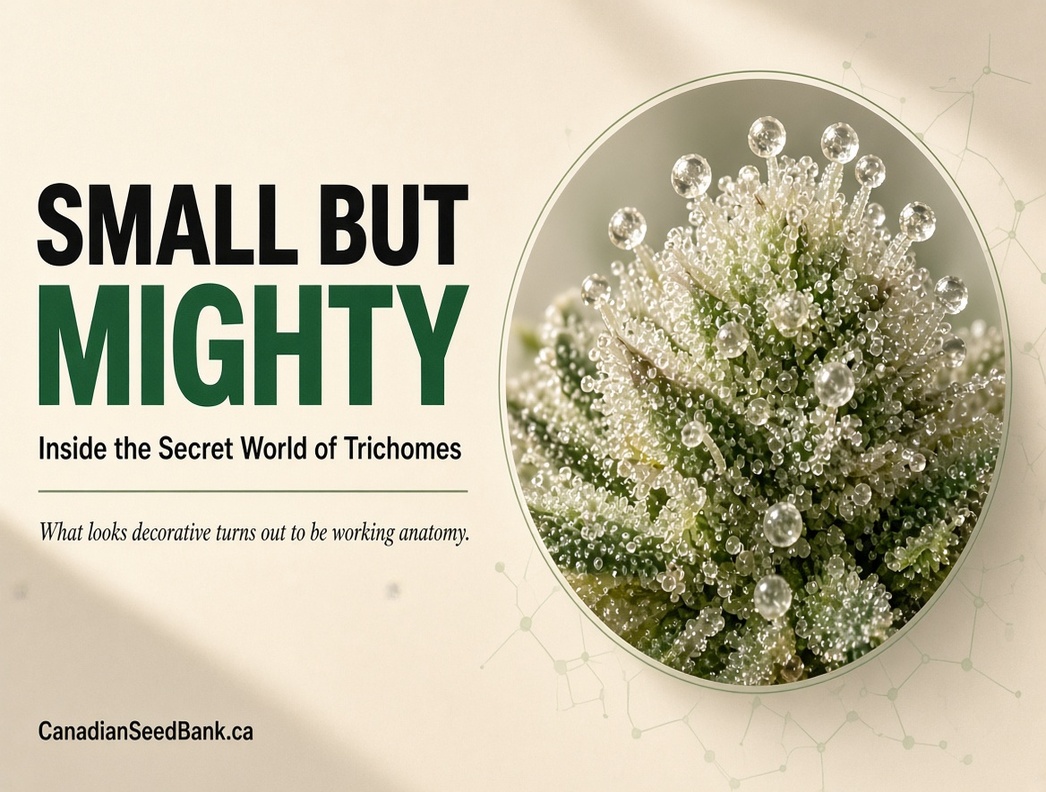
Small but Mighty
Inside the Secret World of Trichomes
Beneath cannabis’s frosted surface lies a microscopic system of extraordinary chemical organisation.
From a distance, a resinous cannabis flower can look dusted with sugar. Under magnification, that impression gives way to something stranger: a landscape of stalks and rounded heads, crowded together like a forest designed on a scale the eye was never meant to navigate. These structures are trichomes. Some are closely involved in producing and storing the compounds that make cannabis chemically distinctive. What looks decorative in a photograph turns out to be working anatomy.
The familiar cannabis leaf gets most of the public recognition. It appears on signs, packaging and an improbable number of socks. Yet some of the plant’s most consequential biology occurs in structures so small that their internal organisation remained poorly understood long after the leaf became an international symbol.
By 2025, microscopy and molecular research have begun to bring that hidden world into sharper focus. The findings reveal a plant doing more than accumulating resin. It is organising cells, directing chemical pathways and managing storage in specialised compartments. The surface sparkle is merely the part we can see without asking too many questions.
More than one kind of hair
In botany, a trichome is an outgrowth of the plant’s outer surface. The term covers a variety of structures across the plant kingdom. Some are glandular, meaning they produce or secrete substances; others have different physical roles.
Cannabis glandular trichomes are commonly described in three broad forms: bulbous, sessile and stalked. Their names point towards visible differences in size and shape. The stalked form, with its rounded glandular head raised above the surface, is the one most likely to resemble a tiny lollipop in a close photograph. A 2021 review explains these categories while emphasising that development can complicate identification. Tanney and colleagues, 2021
This is a useful warning against trusting the silhouette too quickly. A structure’s appearance at one stage does not always tell us its eventual identity. Biology moves; a photograph freezes it.
The distinction matters because trichomes are often discussed as if they were identical containers, differing only in how many appear on a flower. A more accurate picture begins with variety. Their anatomy and chemistry can differ, and understanding those differences requires more than counting visible points of light.
A Canadian team looks inside
Research led by Samuel Livingston and colleagues at the University of British Columbia, published online in 2019 and in The Plant Journal in 2020, examined cannabis trichomes using microscopy, chemical analysis and gene expression data. The team found differences in secretory cell numbers and chemical profiles between stalked and sessile glands. The evidence also supported a developmental relationship in which some apparently sessile structures become stalked trichomes. Livingston and colleagues, 2020
The study used the structures’ own fluorescence under specialised imaging conditions to help distinguish them. That is not the same thing as judging flower colour in ordinary light. It is an analytical technique that turns otherwise difficult differences into measurable information.
The larger lesson is that a gland’s outward shape and its internal work belong in the same investigation. Anatomy can help explain chemistry, while chemistry can reveal distinctions anatomy alone might miss.
There is a practical scientific reason to care about these definitions. If two researchers use the same name for different developmental structures, their results may appear to disagree even when both sets of measurements are sound. Shared terminology helps make comparisons meaningful. The everyday word “frost” cannot do that work. It describes an impression rather than a precisely identified structure. Moving from that impression to a reproducible description is part of the unglamorous craft of research, and one reason the most valuable paper is not always the one with the most dramatic conclusion.
This is the kind of research that rarely produces a dramatic retail slogan. It produces something more durable: a better description of what the plant actually is. Once the categories improve, future experiments can ask better questions and make more meaningful comparisons.
The remarkable organisation of a gland
In 2022, Livingston and colleagues took the investigation further in Current Biology. Using rapid freezing methods and electron microscopy, they described metabolically active cells connected through extensive bridges, functioning as a coordinated “supercell.” They also examined the spatial arrangement of structures and enzymes involved in cannabinoid production. Livingston and colleagues, 2022
The term sounds borrowed from science fiction, but the interest is practical. Producing specialised compounds requires organisation. Materials must reach the right places, reactions must occur in a workable sequence and products must be accommodated without the whole system becoming chemically chaotic.
The finding helps move the discussion from a list of ingredients towards the machinery that makes them possible. A chemical profile tells researchers what is present. Cell biology asks how the plant manages to produce and arrange it. That shift matters well beyond cannabis. A plant cell is not a miniature beaker in which everything happens everywhere. Its compartments and connections influence what reactions can occur. Studying those relationships reveals a form of organisation that an ingredient list cannot capture.
For a reader, the reward is a different kind of appreciation. The small gland is interesting because it has an internal life, not merely because people place value on some of its contents.
Chemistry has a workforce
Terpenes offer another route into this hidden system. They contribute to the aromatic character of many plants, including cannabis. Their production depends on enzymes, including terpene synthases, that guide the formation of particular molecules.
In a 2017 paper, Judith Booth, Jonathan Page and Jörg Bohlmann identified and characterised cannabis terpene synthases. Their work connected genes and enzyme activity with the chemical diversity of cannabis resin. Booth and colleagues, 2017
This is a more informative explanation than imagining that a plant simply contains a flavour. A scent emerges from compounds, and compounds emerge from biochemical processes. The language of aroma is the human description of a result; enzymes are part of how the result is made.
A later study by Booth and colleagues, published in 2020, examined terpene variation and additional synthases across cannabis varieties. It added detail to the relationship between genetic machinery and diverse terpene profiles. Booth and colleagues, 2020
That research does not turn an aroma into a guaranteed effect on a person. It explains production and variation within the plant. Keeping those questions separate prevents a useful botanical discovery from being converted into an unsupported promise about mood or medicine.
The distinction is especially valuable in popular writing. “This enzyme contributes to making a compound” and “this compound produces a particular experience” are different claims, requiring different evidence. Moving casually from one to the other skips much of the science.
Why sparkle cannot replace analysis
A dense covering of visible glands is striking, and it is understandable that people associate the appearance with resin. But a photograph does not measure the exact contents of those glands. It cannot establish a complete cannabinoid profile, quantify every aromatic compound or demonstrate the absence of contaminants. The reason is simple: a visible structure and a measured substance are not the same object of enquiry. A glass bottle tells us something about packaging. It does not tell us everything about the liquid inside.
Research by Zamir Punja and colleagues in 2023 examined glandular trichome development across plant ages and genotypes. The study documented variation in morphology and maturation, reinforcing the importance of developmental context when comparing flowers. Punja and colleagues, 2023
For an ordinary reader, that finding should encourage restraint rather than a new visual scoring system. An image records a particular sample under particular conditions. It is evidence worth considering, but its limits remain even when the photograph is spectacular.
This is also why colour descriptions of gland heads should not be promoted into universal guarantees about a finished product’s effects. Observation can be meaningful without supplying every answer. Laboratory analysis and human research exist because appearance cannot resolve all the questions we ask.
The plant beyond the product
One of the subtler problems in cannabis writing is the tendency to explain every trait through its usefulness to people. A gland becomes a delivery device. An aroma becomes a selling point. A flower becomes a collection of specifications.
Those perspectives are understandable, but incomplete. The plant’s biology did not begin with a menu. To understand it properly, researchers must ask questions about development, function and variation that may have no immediate commercial answer.
That is where the trichome story becomes especially rewarding. It takes a familiar surface and restores its complexity. The structures have different forms. Their cells coordinate activity. Their chemical products depend on particular pathways. Their appearance changes with development. None of that requires a marketing superlative to be interesting. There is a lesson here for how cannabis research is communicated in 2025. Discovery does not always arrive as a newly named cannabinoid or a claim about a future treatment. Sometimes it arrives as a better image of a cell, a more accurate description of a gland or an enzyme whose role has finally been tested.
These advances may appear small because their subjects are small. Their value lies in the foundation they provide. Reliable explanations accumulate through details that can be checked, challenged and built upon.
The next time a cannabis photograph shows a frosted flower, the most interesting question may be what lies beneath that apparent dusting. There is architecture there, and coordinated labour, and a chemical history that no glamour shot can fully reveal.
The leaf may remain the celebrity. The trichomes are doing much of the work.

The THC Trap
When One Number Becomes the Whole Story
Walk into almost any legal cannabis shop in Canada and the ritual is the same. A customer points at a jar. The first question is not how it was grown, how it smells or how it made the last person feel. The first question is a number.
Twenty eight percent. Thirty two. Thirty five, if the label is feeling ambitious.
That single figure, total THC, has become the closest thing the legal market has to a grade. It sits on every package in a typeface large enough to read from the till. It sorts menus on provincial sites. It decides which bags move and which sit. In a category that spent decades talking in slang and strain folklore, THC percentage looks like science. It is measurable. It is official. It is printed under a Health Canada warning. It is also a poor way to describe a plant, and an even poorer way to describe an experience.
A number that looks precise and is not
THC, or delta 9 tetrahydrocannabinol, is the compound that most people mean when they say cannabis is strong. On a dried flower label in Canada, the figure that matters is usually total THC. That is not the amount of already active THC sitting in the jar. Most of the potency in raw flower exists as THCA, an acid form that converts to THC when it is heated. Labs estimate what the consumer will actually get after that conversion, then express it as a percentage of the flower’s dry weight.
The arithmetic is tidy. The plant is not.
Cannabinoids are not poured evenly through a crop like sugar into tea. Village Farms researchers, writing in Scientific Reports, sampled flower from the top, middle and bottom of the same plants and found that potency moved with the architecture of the plant. Tops and middles ran higher. A single label number, in other words, can be a snapshot of one sample from one part of one plant, then applied to an entire lot. That is a useful factory measurement. It is a blunt consumer guide.
Labs themselves do not always agree. A 2024 exercise in Colorado sent identical samples to multiple licensed laboratories and got THC readings that swung by more than a third on the same flower. Canadian lab operators have made a similar point at home. When eight testing firms split samples of legal dried flower and pre-rolls, they could land close to one another if they used the same methods. The larger gap was between those results and the numbers printed on packages. More than half of the 3.5 gram flower SKUs they checked came in more than 25 percent below the claim on the label. Two were more than 40 percent below. That is not a rounding error. That is a different product.
The inflation problem is no longer an industry rumour
For years, licensed producers and independent labs talked about “THC inflation” the way people talk about weather: everyone feels it, nobody owns it. Health Canada has now put a federal stamp on the complaint.
In the first published results of its Cannabis Data Gathering Program, the department tested 50 legal dried flower products and 50 illegal samples seized mainly in British Columbia and Ontario. Among the legal products, 48 percent contained less than 80 percent of the total THC declared on the label. Twenty percent contained less than 70 percent of what the package promised. Only about half of the legal samples cleared the 80 percent mark. Product age was not a convincing excuse. Levels of CBN, a marker that rises as THC breaks down, were low.
The same survey found illegal flower all over the map, from under 10 percent THC to more than 25 percent, with no labels at all. Legal cannabis is supposed to be the market that tells the truth. On the metric consumers trust most, it often does not.
The pattern is not uniquely Canadian. A University of Colorado Boulder team that sent a blinded shopper into 52 dispensaries across 19 counties found that 44 percent of flower products missed the state’s 15 percent accuracy threshold. Most of the misses ran in one direction: the label was higher than the lab. Concentrates, which are more uniform chemically, were far more accurate. Flower, the product that built the culture and still dominates many retail floors, was the problem child.
An earlier Colorado study in PLOS One was blunter. Across 23 retail samples, measured THC sat 23 percent below the low end of the label range and 36 percent below the high end. About 70 percent of the samples were more than 15 percent weaker than advertised. Three contained roughly half the maximum potency on the package. None of this requires a conspiracy theory. It requires incentives.
Retail software and store staff still sort the world by potency. Consumers who learned cannabis in the illegal market learned to ask for “the strongest.” Producers noticed that jars labelled 30 percent left the shelf faster than jars labelled 22 percent, even when the second jar was the better smoke. Labs that returned conservative numbers lost contracts to labs that returned flattering ones. High North Labs in Vaughan once reported that of some 350,000 samples it had run, only a handful cleared 32 percent. Meanwhile, store menus filled with figures that would have sounded like science fiction a decade earlier.
Beena Goldenberg, then running a major Canadian producer, put the contradiction in plain language. Companies that had been selling flower in the 21 to 22 percent range were suddenly showing 28 to 32 percent. “This is not something that even the most advanced cultivation techniques could make happen,” she said. The plant can be bred stronger. It cannot be bred into a cartoon.
Why the number won the argument
Potency worship did not start in a boardroom. It started in a culture that had no labels.
Before legalization, quality was a story you heard from a friend. After 2018, Canada built a regulated market that had to put something on a package besides a strain name. THC was already famous. It was the compound police and public health officials talked about. It was the compound that made people high. Putting it in large type felt like transparency. It also flattened a complicated product into something a spreadsheet could rank.
Ontario’s legal market shows where that logic leads. Dried flower remains a sales giant, even as pre-rolls and vapes take share. Listings on the Ontario Cannabis Store routinely advertise ranges in the high twenties and thirties. A 2025 analysis of products in the province found that 97 percent of dried flower SKUs were “very strong,” meaning 20 percent THC or more. Average high end potency on dried flower moved from about 24.7 percent in 2022 to 29.4 percent in 2024. Prices fell. The numbers on the bag went up.
Public health researchers have watched that climb with less enthusiasm than buyers. THC content in typical illicit flower in the 1980s often sat near 8 percent. Today’s legal shelf is a different pharmacological object. Higher exposure is associated, in a growing literature, with higher rates of cannabis use disorder and with mental health risks that were easier to shrug off when the average joint was milder. The label arms race does not only distort shopping. It moves the entire category toward a narrower, stronger product, then tells the public that this is what cannabis is.
There is a second distortion, quieter and more commercial. If the number is the product, everything that is not the number becomes decoration. Aroma becomes a nice extra. Burn quality becomes a complaint for forums. How the flower was dried and cured becomes a craft footnote. The plant is reduced to a stimulant with a percentage attached. Wine did this to itself for a while with alcohol by volume. Whisky did it with proof. Both categories grew up. Cannabis, eight years into adult use legality in Canada, is still in the phase where the loudest number wins.
What a percentage cannot say
A THC figure cannot tell you whether the flower was harvested too early or dried too fast. It cannot tell you whether the terpene fraction is two percent or half a percent. It cannot tell you whether the smoke will feel bright, heavy, anxious or simply dull.
Terpenes are the fragrant oils that make one cultivar smell like lemon peel and another like diesel and black pepper. For years they were treated as flavouring. That was lazy chemistry. A 2022 sensory study found that the best predictor of a positive cannabis experience was not THC content and not even the measured terpene concentrations. It was whether the person liked the smell. In blind tests of commercial cultivars, aroma preference tracked mood and enjoyment. Higher THC did not.
Neurologist Ethan Russo has spent two decades arguing that cannabis pharmacology is a conversation among compounds, not a monologue by THC. In 2024 he co-authored a controlled trial in which occasional consumers vaporized THC with and without d-limonene, the citrus terpene. Limonene did not cancel the high. It did reduce the anxiety and paranoia that a strong THC dose can bring, and the effect grew as the limonene dose grew. Limonene alone did little. Together, the two compounds produced a different experience than THC by itself. That is the “entourage effect” stated without mysticism: some constituents change the character of others.
Newer laboratory work from Israel has pushed the point further. Sixteen common cannabis terpenes were tested for activity at CB1 and CB2 receptors, the same receptors THC uses. Several acted as partial agonists. They were weaker than THC, but they were not inert. Some reached what the authors called a clinically relevant level at concentrations comparable to THC, especially at CB2. The finding does not turn a pine smelling jar into medicine by itself. It does make the old habit of ignoring everything but THC look scientifically out of date.
A practical rule has followed the research into buying guides, if not yet onto most Canadian labels. Flower at 22 percent THC with a rich terpene fraction often feels more complete than flower at 30 percent with a thin one. The second product hits hard and then falls away. The first has a shape. Consumers already know this in their bodies. They just have not been given a shelf language for it.
The things quality actually is
Ask a grower what quality means and the answer is rarely a percentage. It is density without foam. It is a cure that leaves the flower springy rather than brittle or wet. It is a grind that is not dust. It is an ash that does not fight you. It is a nose that is still alive after the bag has been open for a minute.
Those are not romantic extras. They are evidence that the plant was finished, not just tested.
Moisture and water activity decide whether flower burns or stews. A sloppy trim leaves chlorophyll in the smoke. A rushed dry drives off the volatile fraction that makes one batch of the same cultivar memorable and the next batch a generic “loud.” None of that appears in the giant THC box. Some licensed producers now print terpene totals on the package for that reason. Village Farms has argued, in public, that listing terpenes is closer to how wine talks about a vintage than how a gas station talks about octane.
Canada’s legal market already collects the data. Every lot that reaches a provincial wholesaler has been through a lab. The certificate of analysis behind the package usually includes a longer cannabinoid panel and, increasingly, a terpene panel. Almost none of that reaches the customer in a form they can use at a glance. The interface of the industry, the menu and the sticker, still behaves as if one column matters.
That is a design choice. It can be changed.
A market that trained its customers badly
Ontario consumer research keeps stumbling over the same contradiction. A large share of shoppers say they want higher potency so they can “feel it.” A large share also say they want subtle effects. Higher potency is not the same thing as a stronger desired effect. The first is chemistry. The second is taste. The legal market has spent years teaching people to confuse them.
The illegal market is happy to exploit the confusion. Among people who still buy outside the legal system, “potency is too low” sits near the top of complaints about licensed shops, just behind price. If the legal shelf is racing to print bigger numbers, and those numbers are often optimistic, the illicit seller can always claim to be stronger. There is no Health Canada auditor at the kitchen table.
The cost of that race is paid in trust. When nearly half of legal samples miss 80 percent of their claim, every accurate producer is dragged toward the same suspicion. Lab operators who refuse to play have said they lose work. Retail staff who try to talk about flavour get talked over by the percentage. New consumers learn a vocabulary that will disappoint them the first time a 32 percent bag tastes like lawn clippings and anxiety.
Health Canada has begun to treat the problem as more than a trade gripe. The department has issued fresh guidance on validating analytical methods for cannabis testing and has used targeted inspections to look at high potency claims. The Data Gathering Program exists because the regulator needed its own measurements, not just the ones companies paid for. That is progress. It is not yet a standard that a shopper can feel.
Other regulated pleasures solved a version of this. Coffee moved from “dark roast” as a proxy for strength to origin, process and sensory notes. Chocolate moved from a cacao percentage that meant little by itself to talk about fermentation and roast. Alcohol still prints ABV, but nobody buys a bottle of Burgundy because it is 13.5 instead of 13. Cannabis is stuck in the cacao percentage phase, except the number is easier to game and harder for a civilian to verify.
What should be on the bag
A better label would not hide THC. People have a right to know how much of a psychoactive drug they are buying. Dose still matters for edibles, oils and anyone who is new. The mistake is letting that figure colonize the whole conversation.
A grown up package would treat total THC as one line among several. It would give a terpene total and the two or three dominant terpenes, because those predict character better than the words indica and sativa, which have been marketing categories for years. It would say when the lot was packaged, because THC and terpenes both fade in light, heat and air, a point Health Canada itself has made. It would leave room for the sensory facts a good retailer already knows: how the flower smells when the bag opens, how it burns, whether the cultivar actually tastes like what the name promises.
Stores can do this before the regulations catch up. Some already do. They keep flower in glass, they open a sample, they talk about gas and citrus instead of a leaderboard. The ones that still greet every customer with “how high do you want the THC” are not being helpful. They are running the old script because it is fast.
Consumers can do it too, without becoming amateur chemists. If two bags are close in price, the one with a louder, cleaner nose is usually the better bet. If a brand’s numbers jump five points in a season while the plant looks and smells the same, believe the plant. If a 24 percent flower knocks out a 31 percent flower in a side by side, trust the result. Your nervous system is a more sensitive instrument than a sticker.
The trap
The THC trap is not that potency is fake. Plenty of modern flower is genuinely strong, and some people want exactly that. The trap is the belief that the number is the product. A percentage is a tool. Used honestly, it tells you the ceiling of how hard a dose can hit. Used as a substitute for quality, it trains a market to breed for a test, to shop for a test and to argue about a test, while the things that make cannabis worth buying, aroma, balance, cleanliness, pleasure, slide off the page.
Canada built a legal system so people would not have to take a dealer’s word for what was in the bag. That was the right instinct. The system then put one figure in the largest font and wondered why everyone stared at it. The way out is not a war on strong cannabis. It is a refusal to let one measurement do the talking for a plant that never agreed to be that simple.
Sources Health Canada, Cannabis Data Gathering Program; StratCann reporting on Canadian multi lab testing and Health Canada method guidance; The Globe and Mail on label claims; University of Colorado Boulder and MedPharm retail label study; Schwabe et al., PLOS One (2023); Village Farms / Scientific Reports on within plant potency; Journal of Cannabis Research on Ontario product potency after legalization; Russo et al. on vaporized d-limonene and THC; Biochemical Pharmacology work on terpene activity at cannabinoid receptors; OCS consumer and sales reporting.
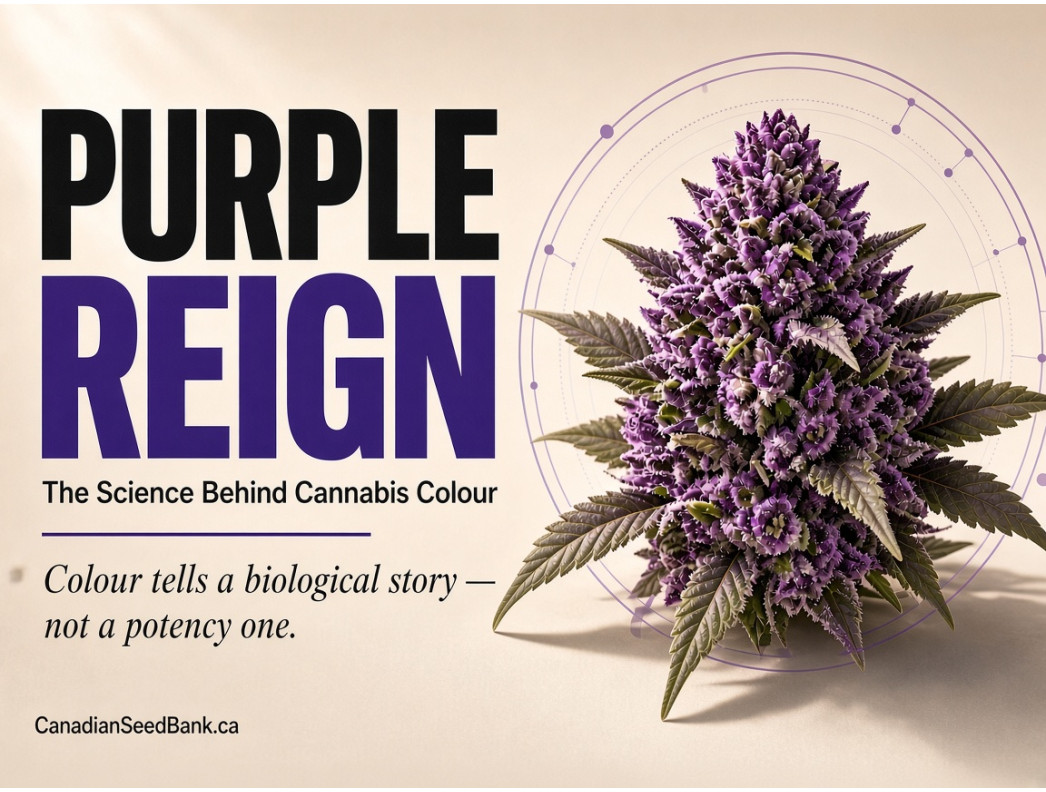
Purple Reign
The Science Behind Cannabis Colour
The plant’s most photogenic trait tells a fascinating biological story. It is less forthcoming about potency.
A purple cannabis flower makes its entrance before anyone reads the label. Against a background of green, its colour suggests something unusual, perhaps rare, perhaps luxurious. It is an impressive amount of public relations for a pigment.
The visual appeal is real. The conclusions attached to it are another matter. A flower can look like a small velvet sculpture without offering any dependable clue about how strong it is, what it smells like or how a person will respond to it. Colour is evidence of colour. Everything beyond that requires another question.
That does not make the subject superficial. The science behind cannabis pigmentation connects genetics, cellular chemistry and plant development. By 2025, researchers are beginning to describe those connections in greater detail, moving the conversation beyond the convenient idea that purple is simply what happens when green becomes more interesting.
Look closely and the flower becomes a collection of overlapping stories. Its green tissues, darker patches, pale resin glands and fine hairs belong to different biological systems. The eye blends them into an impression. Science has the less glamorous job of separating them again.
Meet the pigments behind the performance
The main characters in purple plant colour are anthocyanins, a group of pigments within the wider flavonoid family. Their familiar territory includes the reds, blues and purples seen across many fruits and flowers. They are stored in cellular compartments called vacuoles, where their chemical surroundings help influence their appearance. The pigment molecule is part of the explanation; its setting matters too. Chemistry of anthocyanin colour
This helps explain why “purple” is an imprecise chemical description. Two tissues can look broadly similar while containing different mixtures or amounts of pigments. Conversely, a related pigment system can contribute to different shades depending on its environment. A colour name is a useful piece of ordinary language, not an inventory of molecules.
The distinction is familiar outside cannabis. We do not expect every red apple to have identical flavour or every dark grape to make the same wine. Yet cannabis colour can acquire an unusual burden of expectation, as though the plant were publishing its entire character in a visible code.
It is not. Purple gives us a reason to investigate the pigment system. It does not give us permission to skip the investigation.
A genetic story comes into focus
In a 2024 paper in Plant Direct, Kristina Gagalova and colleagues examined anthocyanin biology in four cannabis varieties with different pigmentation. The researchers compared chemical profiles and gene activity, identifying associations between anthocyanin accumulation in leaves and the expression of several genes involved in the pigment pathway. Gagalova and colleagues, 2024
The emphasis on leaves is worth retaining. A study of one tissue does not automatically explain every coloured feature of every flower. Nor does a correlation between gene activity and pigment accumulation prove that a single gene controls the entire visible result. What the research offers is a more detailed view of a coordinated biological process.
For readers accustomed to a simple “purple gene” explanation, that complexity is useful. Plants do not generally manufacture elaborate traits through a single switch labelled dramatic. They rely on biochemical pathways, regulation and interactions among processes.
The result also changes how a photograph should be read. A striking image captures an expression of biology at a particular moment. It is not a guarantee that every individual sharing a commercial name will reproduce every detail in the frame. A name, an image and a measured characteristic provide different kinds of information.
Botanists distinguish a genotype, the genetic constitution of an organism, from its phenotype, the characteristics it expresses. The vocabulary can sound academic until a visual promise depends on it. A description of inherited potential and a description of an observed specimen are not interchangeable. Keeping them separate allows a reader to appreciate variation without treating every difference as a contradiction. It also encourages better documentation: photographs of more than one specimen, clear descriptions of the tissue shown and honest language about how consistently a characteristic has been observed.
For a seed business, this is an opportunity to communicate with more precision. There is a meaningful difference between describing a tendency associated with a lineage and promising an identical appearance in every plant. The first respects biological variation. The second asks a catalogue photograph to perform a laboratory’s job.
Green deserves some credit
Purple attracts attention partly because green is doing so much of the background work. Chlorophyll is central to the familiar green appearance of plant tissues and to the light absorbing machinery of photosynthesis. Carotenoids contribute additional pigment chemistry, including yellow and orange tones. Their visual prominence depends on the tissue and the surrounding mixture of pigments.
These are basic features of plant biology, but they are easy to forget when colour is discussed as if it were an optional cosmetic upgrade. A cannabis flower does not begin as a neutral object awaiting decoration. Its appearance emerges from living structures with different jobs.
That distinction also prevents a common interpretive mistake: assuming every visible colour change has the same cause. A darker patch, a pale surface and a reddish hair may look like parts of one palette, yet they need not share a mechanism. Identifying the structure comes before explaining its colour.
The fine threads protruding from female cannabis flowers, for example, are associated with reproductive anatomy. They are distinct from the glandular trichomes that give many flowers a sparkling appearance. Botanical research on female cannabis architecture describes these structures as parts of a complex flowering system, rather than interchangeable decorations. Spitzer Rimon and colleagues, 2019
That may sound like a distinction reserved for microscopes and examination papers. In practice, it changes the quality of everyday descriptions. Saying precisely what is purple, pale or orange is more informative than treating the entire flower as one coloured object.
The flower is not wearing a potency label
Anthocyanin colour and cannabinoid concentration are different measurements. Seeing abundant purple tissue does not quantify THC, just as seeing green tissue does not quantify chlorophyll without an appropriate analytical method. A camera can document appearance. It cannot replace chemical testing.
Nor can visual drama establish a predictable effect. The route from a plant’s composition to a person’s experience involves questions that pigmentation alone does not address. A claim that purple necessarily means stronger, more relaxing or more medicinal therefore needs evidence beyond photographs and repeated anecdotes.
This is a question of inference, not an insult to colourful plants. Purple cannabis may have characteristics someone values. The issue is whether the colour establishes those characteristics. A product can be both beautiful and accurately described without claiming a scientific connection that has not been demonstrated.
The same restraint applies to health language. Research on anthocyanins in foods or experimental preparations does not establish that consuming purple cannabis produces an equivalent benefit. The material, amount, preparation and route of exposure would all need consideration. A pigment’s presence cannot carry an entire medical argument.
There is a temptation to make beauty useful by giving it an additional function. Perhaps a flower cannot simply be attractive; it must also be exceptionally potent or unusually beneficial. But aesthetic interest does not need a therapeutic excuse. Admiring a colour is perfectly reasonable. Turning admiration into a health claim is a different activity.
What a photograph leaves out
Even the visible evidence arrives through a filter. Lighting changes the balance of colour in a photograph. Exposure, camera settings and editing influence what a viewer sees. A close photograph can also emphasise a small region that is less prominent when the whole specimen is considered. None of that makes photography inherently misleading. It makes context valuable. A useful image shows the feature clearly and represents it fairly. A useful caption identifies what is being shown. If an illustration exaggerates colour for artistic effect, it should not be confused with a documentary record of a particular plant. The distinction is especially relevant in a market where the image may be the reader’s first encounter with the product.
Science photography asks related questions. Which tissue was sampled? Was it examined under ordinary light or a specialised imaging method? Is the colour natural, enhanced or assigned to make otherwise invisible information understandable? An image can be accurate while requiring explanation.
That is why a laboratory image and a product photograph should not be expected to answer the same questions. One may reveal anatomy; the other may communicate appearance. Both can be valuable without becoming substitutes for the rest of the evidence.The deeper fascination of purple cannabis lies in this movement between scales. From across a room, there is a colour. Closer in, there are tissues. Closer still, there are cells, pigments and patterns of gene activity. Each view reveals something the previous one concealed.
It is a richer story than a ranking of the darkest flowers. It also provides a better vocabulary for appreciating variation. Burgundy, violet and near black impressions can invite curiosity about the plant without being promoted into claims about superiority.For readers in 2025, the most useful shift is from asking what purple promises to asking what purple reveals. That question leads towards botany, evidence and careful observation. It makes room for wonder without requiring credulity.
The flower has already done something remarkable: it has made a complex piece of cellular chemistry visible. There is no need to improve the story by inventing a hidden potency certificate.
Purple can keep the crown for making an entrance. The rest of its reputation should still have to earn an explanation.

Beyond the Buzz
The Future of Cannabis Will Be Built on Better Questions
The future of cannabis is frequently presented as a forecast with a suspicious amount of confidence. Every new product is a breakthrough, every emerging compound is the next big thing, and every market projection seems to have been calculated during an unusually optimistic lunch.
The more interesting future is less theatrical. It concerns whether researchers can develop better medicines, whether consumers receive clearer information, whether businesses can support their claims, and whether an industry associated with a green plant can account honestly for its environmental footprint.
Those questions are already visible in published research and policy reviews. Their eventual answers are not guaranteed. This article draws a distinction between documented developments and the directions they suggest. The forecasts are editorial judgements, not promises about discoveries, investment returns, or changes in the law.
For Canadian Seed Bank, that distinction is the starting point for a useful conversation. We can be interested in what comes next without pretending that a crystal ball belongs beside the laboratory equipment.
Medicine will need more precision
One credible direction is increasingly specific medical research. Asking whether cannabis is medicine is too broad to resolve every clinical question. Researchers need to know which substance or preparation is being studied, for which condition, in which patients, and against what comparison.
There is already a concrete example of that specificity. The United States Food and Drug Administration has approved Epidiolex, a purified cannabidiol medicine, for seizures associated with particular conditions. That approval concerns a defined prescription product and specified uses. It does not establish equivalent benefits for every product labelled CBD. FDA information on cannabis and approved medicines.
The likely opportunity is not an endless expansion of sweeping wellness claims. It is the slower process of identifying where particular products provide meaningful benefits, what risks accompany them, and how confidently those results apply beyond a study.
That may produce less dramatic advertising. It would produce much more useful medicine. A patient needs an answer relevant to their condition, not a reminder that a plant contains interesting chemistry. Scientific ambition becomes valuable when it survives contact with a carefully framed question.
The unglamorous breakthrough is consistency
Reliable research depends on knowing what is being tested. If the material changes substantially between studies, apparently conflicting results can become difficult to interpret. Quality controls are therefore part of the scientific story rather than administrative decoration.
The FDA’s guidance for clinical research involving cannabis and compounds derived from it addresses issues including material sources and product quality. It treats these as essential considerations in the development of investigational medicines. The guidance is an existing framework, not evidence that any particular future treatment will succeed. FDA guidance on quality considerations for clinical research.
A reasonable forecast is that the ability to document consistency will become a stronger mark of credibility. Not every important advance will involve discovering a new molecule. Some will involve demonstrating, convincingly, that the material described is the material supplied.
It is difficult to build a thrilling launch campaign around reproducibility. Nevertheless, reproducibility is what allows one result to become a body of knowledge. Without it, an industry can accumulate a mountain of claims while remaining surprisingly short of dependable answers.
Cannabis identity will become harder to fake with a name
As scientific descriptions improve, familiar commercial categories deserve closer examination. A 2021 Nature Plants study found that the indica and sativa labels in its sample set did not correspond to distinct groups across the genome. Associations were instead found with a more limited set of chemical and genetic differences. The original cannabis labelling study.
This does not mean every existing name must disappear. Names help people communicate. It suggests an opportunity for information that extends beyond them: clearer attribution, more precise descriptions, and honest explanations of what a category can actually tell us.
For a seed focused audience, the promising future is one in which identity comes with a stronger explanation. A memorable name can remain memorable while the information supporting it becomes more rigorous. Romance and documentation do not have to fight over the same paragraph. The challenge will be making better information understandable. Replacing a vague label with an incomprehensible page of technical language is not much of an improvement. The most effective communicators will help readers see which details matter and why.
Imagine an article that tells you where a claim originated, whether it concerns a particular sample, and what remains uncertain. That may sound modest beside a dazzling prediction about personalised products. Yet it would already represent a useful advance over descriptions that offer certainty without showing the reader what supports it.
More compounds will mean more questions
Cannabis research is also widening beyond the few compounds that dominate public conversation. Aroma offers a useful example. A 2023 study in ACS Omega highlighted the contribution of compounds beyond terpenes to distinctive cannabis scents, including certain volatile sulfur compounds. The original aroma research.
The important implication is not that another set of chemical names should immediately become a set of medical promises. It is that familiar explanations can be incomplete. Better analytical work may reveal differences that older descriptions overlooked.My expectation is that the gap between discovery and marketing will remain one of the industry’s central tensions. Finding a compound, understanding its role, and demonstrating a benefit in people are different achievements. A press release can cross those distances in a sentence. Research cannot.
Readers will benefit from writers who keep the stages visible. An interesting laboratory finding deserves attention on its own terms. It does not need to become a cure, a guarantee, or the answer to every problem before it earns a place in the conversation.
Green will need to mean something measurable
A plant’s colour tells us very little about the environmental impact of the industry surrounding it. In a 2021 study, researchers modelled the greenhouse gas emissions associated with indoor cannabis production across the United States. They found substantial variation by location, with energy use and environmental controls among the major contributors. These were modelled results for specified production scenarios, not a universal footprint for every cannabis product. The original environmental assessment.
The likely direction is greater pressure for environmental claims that can be examined. What activities are included in an assessment? Which energy sources are involved? Are comparisons being made on the same basis? A leaf printed on recyclable packaging cannot answer those questions by itself.
This is an area where progress may look surprisingly ordinary. Better reporting, transparent assumptions, and evidence that a change actually reduces an impact can matter more than a dramatic sustainability slogan. The challenge is to reward meaningful improvements without treating the word natural as a completed environmental audit.
For Canadian readers, local circumstances also matter. Findings from an American model are informative, but they should not automatically be presented as measurements of every Canadian business. Serious discussion makes room for those differences.
Canada’s next chapter is a question of quality
Canada’s 2024 expert panel review of the Cannabis Act offers a useful picture of the issues still requiring attention. In its discussion of medical cannabis, the panel called for better research and attention to obstacles affecting that work. It argued for maintaining established evidentiary standards rather than lowering them specifically for cannabis. Those were the panel’s recommendations, not proof that every recommended change has since occurred. The expert panel’s final report.
That distinction points towards a more mature definition of progress. Expansion alone is not enough. A larger market can still leave unanswered questions about products, health claims, and the information available to the public.
A constructive future would make it easier to conduct good research and easier for readers to distinguish strong evidence from persuasive packaging. It would also leave room for results that disappoint commercial expectations. A study finding little benefit is still useful if it prevents people from relying on an unsupported claim.
That kind of maturity does not require abandoning enthusiasm. It requires directing enthusiasm towards things that can survive scrutiny. Curiosity becomes stronger when it is willing to hear an inconvenient answer.
The future worth paying attention to
The next important cannabis development may arrive with a striking headline. It may also arrive as a careful paper, an improved measurement, or a clearer explanation of something previously misunderstood. We should leave enough room in the conversation to recognise all of them.
At Canadian Seed Bank, the most compelling future is one with more knowledge behind the names and better evidence behind the claims. There will still be stories to tell, history to explore, and unusual chemistry to understand. None of that requires pretending the uncertainty has disappeared.
Cannabis has never lacked attention. What will matter next is what that attention produces. Better questions, asked with patience and answered honestly, may prove more valuable than the loudest prediction in the room.
Hemp, Hype and Hard Facts
Can Cannabis Help Build a Greener World?
The plant has serious industrial potential. Its environmental credentials depend on what happens after the harvest. The most persuasive argument for hemp may eventually be a wall. Not a slogan painted on one, but the material inside it: plant matter turned into part of a building, expected to perform quietly for years while nobody thinks about cannabis at all.
It is an appealing reversal for a plant that so often arrives accompanied by an argument. Hemp promises something refreshingly practical. A useful fibre. An insulating material. A component in a product that might require fewer fossil resources.
By 2025, those possibilities are substantial enough to deserve serious attention. They are also surrounded by a familiar enthusiasm in which a versatile crop becomes the answer to almost every environmental problem at once. The vocabulary moves quickly from renewable to sustainable to climate saving, sometimes without pausing to explain the journey.
The more interesting story begins where the adjectives stop. What product is being made? What does it replace? How much energy does processing require? How long will it last? And what happens when someone no longer wants it?
Hemp can make a strong case. It should not need an exemption from the questions asked of every other material.
A plant with several possible careers
Hemp’s industrial versatility comes partly from its anatomy. The stem contains useful outer fibres and a woody inner core. These fractions offer different material properties and therefore different possible applications. Seeds provide another stream of products. A 2016 scientific review describes the plant’s broad potential as a source of fibres, biomass and specialised compounds. Andre and colleagues, 2016 (https://pmc.ncbi.nlm.nih.gov/articles/PMC4740396/)
That variety creates opportunities, but also a communication problem. “Made from hemp” can refer to very different things. A textile, an insulating block and a composite panel do not share an environmental footprint simply because part of their raw material came from the same species.
The useful comparison is between finished products performing equivalent jobs. A material that is excellent in one role may be unsuitable in another. Industrial promise becomes credible when it is specific enough to test. This is why the question “Can hemp replace plastic?” is usually too broad to be helpful. Which plastic? In what product? With what requirements for strength, moisture resistance, lifetime and disposal? A plant cannot answer a question that the product designer has not yet defined.
The wall with an unfortunate nickname
Hempcrete has become one of the most visible examples of industrial hemp’s possibilities. The name suggests a direct substitute for conventional concrete, which can create the wrong expectation. Typical hemp and lime materials are used for insulation and enclosure within a building system, rather than simply replacing structural concrete wherever concrete appears.
Their appeal involves a combination of material properties. Research by Florence Collet and Sylvie Prétot measured how the thermal conductivity of hemp concretes varied with formulation, density and moisture content. The results underline that performance depends on the material actually produced, not merely on the presence of hemp. Collet and Prétot, 2014 (https://arxiv.org/abs/1406.3310)
For a prospective building material, this is a strength rather than a disappointment. Reliable performance can be measured, specified and incorporated into design. Vague enthusiasm cannot tell a builder how a wall will behave.
The distinction also improves environmental comparisons. If a material primarily supplies insulation, its performance should be considered alongside other ways of providing that function. Comparing equal weights of unlike products can produce a striking number without producing a useful answer. A kilogram is a unit of mass. It is not a unit of shelter.
A fair assessment would ask how much material is needed to deliver a defined level of performance over a defined period. It would also consider the rest of the assembly. If one option needs additional components to perform the same job, those components belong in the comparison. This is where an environmental headline becomes an engineering question, and where a credible advantage can be distinguished from a favourable choice of units. The details are not obstacles to the case for hemp. They are how the case becomes persuasive.
Carbon accounting begins after the headline
Plants absorb carbon dioxide as they grow, incorporating carbon into their tissues. Using plant material in a durable product can retain some of that carbon for a period of time. This is an important part of hemp’s appeal, but it is only the beginning of the accounting.
In a 2017 study of hempcrete blocks, Alessandro Arrigoni and colleagues examined the influence of carbonation, mixture components and transport on environmental impacts. Their work demonstrates why the binder and the supply chain belong in the same conversation as the plant. Arrigoni and colleagues, 2017 (https://www.sciencedirect.com/science/article/pii/S0959652617303876)
A 2020 study by Jay Arehart and colleagues modelled the theoretical carbon storage and sequestration potential of hempcrete. It considered both carbon held in the plant material and carbon associated with binder carbonation. The word “theoretical” is significant: a model clarifies possibilities under stated assumptions; it does not certify every commercial product that uses the name. Arehart and colleagues, 2020 (https://par.nsf.gov/servlets/purl/10174020)
The practical lesson is that a carbon claim needs boundaries. Does it cover production alone, or the full life of the product? Does it include transport? What happens at demolition? How is carbon uptake counted, and when might stored carbon return to the atmosphere?
Without those details, two apparently contradictory claims may simply be counting different things. One assessment might stop when a block leaves a factory. Another might include decades of use and its eventual disposal. Neither can be interpreted properly without knowing the scope. Temporary carbon storage can still be valuable. It should simply be described as temporary where that is what the evidence supports. The atmosphere has little interest in whether a promotional paragraph preferred a more permanent sounding word.
The factory matters as much as the field
The environmental character of an industrial crop is shaped by everything required to turn it into a useful material. Separating fibres, refining them and manufacturing a finished product involve processes with their own demands. The source of energy, the use of chemicals and the distance between stages can influence the result.
An assessment of industrial hemp fibre production by Carlo Ingrao and colleagues illustrates this need to examine production systems rather than assume that a natural fibre carries a fixed environmental advantage. Ingrao and colleagues, 2015 (https://www.sciencedirect.com/science/article/abs/pii/S1364032115005729)
For Canada, the business implication is straightforward even without a market forecast. A promising crop requires processing capacity, consistent specifications and buyers willing to use the output. Growing a raw material does not automatically establish the infrastructure that makes it competitive.
Consider a hypothetical manufacturer choosing between a familiar component and one containing hemp fibre. The new option must arrive reliably, perform as required and fit the production process. A favourable environmental assessment may strengthen the case, but it cannot compensate for a part that fails its intended function.
That is not resistance to innovation. It is the ordinary discipline through which an experimental material becomes an industrial one. The same principle applies to textiles. An attractive story about fibre origin does not answer questions about processing, durability, finishing or how often a garment will be worn. A product’s environmental value depends partly on the service it provides over its lifetime.
Renewable does not mean consequence free
A crop can be renewed while still requiring land, labour and resources. Those demands should be compared with realistic alternatives rather than with an imaginary industrial process that has no footprint at all. This is where the strongest hemp arguments can become more persuasive by becoming less absolute. It is entirely possible for a particular hemp product to offer an environmental advantage in a particular setting. It does not follow that every expansion of hemp production is automatically beneficial, or that the same advantage will appear in every region.
The material’s eventual destination matters too. Adding plant fibre to a plastic composite does not, by logic alone, make the complete product biodegradable. The other ingredients and the conditions of disposal still need examination. “Contains a renewable ingredient” and “will harmlessly disappear” are different statements.
Consumers should not need specialist training to recognise the distinction. Clear product information can explain what the material contains, how it should be used and what realistic disposal options exist. If an environmental benefit depends on access to a particular industrial process, that condition belongs in the explanation.
The alternative is a familiar kind of disappointment: a promising technology loses credibility because its advertising promised more than its engineering could deliver.
A more useful ambition for 2025
The strongest case for hemp is not that it will replace every incumbent material. It is that it can earn a place in applications where its properties, cost and environmental performance make sense together. That is a demanding ambition. It requires independent testing, transparent accounting and products that work outside a demonstration project. It also creates a clearer route to progress than declaring the crop a universal solution and leaving manufacturers to supply the missing details.
For businesses, credibility may depend on learning to state a narrower claim well. A company that can explain the measured benefit of one product gives a customer something to evaluate. A company that promises to save the planet with a fibre gives the customer a much larger claim and far less guidance.
For readers, the best question is therefore not whether hemp is green. It is whether a particular use of hemp improves a particular outcome compared with a realistic alternative. That question makes room for success, failure and improvement, which is exactly what a developing industry needs. The future may include more walls, textiles and everyday objects containing hemp. Their achievement will be practical: meeting a need with a defensible use of resources.
If hemp helps build a greener world, the evidence will eventually be in the buildings, the products and the accounting. The plant has potential. The paperwork should be able to keep up.

Before the Dispensary
Cannabis in the Medicine Cabinet from the 1700s to the 1900s
Long before cannabis became a subject for modern dispensaries, it occupied a very different setting: the medical text, the physician’s casebook, and eventually the pharmacy bottle. Its history includes serious inquiry, ambitious claims, practical frustrations, and political decisions. There were promising observations. There were also conclusions that travelled much further than the evidence carrying them.
This makes the story more interesting than either of its popular shortcuts. Cannabis was neither an unknown plant suddenly discovered by modern medicine nor a perfectly understood remedy that history simply misplaced. Between the 1700s and the end of the 1900s, the ways people described, investigated, and regulated it changed profoundly.
Following those changes reveals something larger about medicine itself. A substance can be familiar long before its chemistry is understood. A physician can recognise a possible effect without knowing its mechanism. And a treatment can appear in a respectable publication without having survived the kinds of trials we would expect today.
The dates matter, but so does the vocabulary surrounding them. When a historical author calls something a remedy, the word tells us what that author believed or observed. It does not automatically carry the meaning of an approved medicine today. Reading the past carefully means resisting the urge to lend it our present assumptions.
The 1700s inherited a much older story
Beginning in the eighteenth century requires looking beyond Europe. Cannabis already belonged to medical traditions with histories extending much further back. Indalecio Lozano’s research on Arabic medical writings examines therapeutic uses recorded between the eighth and eighteenth centuries, including uses associated with pain, nausea, fever, and convulsive conditions. These are records of historical medical practice, not modern confirmation of every claimed benefit. Lozano’s historical study.
That wider perspective matters. Accounts that begin with a European doctor discovering cannabis accidentally erase the people whose knowledge made his investigation possible. Discovery is often an untidy word for the movement of information between communities with unequal access to publication and authority.
The eighteenth century was also an era of botanical classification. Kew’s nomenclatural record traces Lamarck’s Cannabis indica name to a publication in the 1780s. Naming the plant and understanding its medicinal effects were separate projects, but both influenced the vocabulary later physicians encountered. Kew’s record for Cannabis indica.
For a modern reader, this is a useful warning against treating an old plant name as though it were a contemporary product specification. Historical terms belonged to the knowledge and assumptions of their period. Their apparent familiarity can conceal considerable differences in meaning.
A physician in India changed the conversation
William Brooke O’Shaughnessy became an important figure in the nineteenth century history of cannabis medicine through his work in India. His investigations drew on existing knowledge of local preparations and included observations of their effects. His report circulated in British medical literature in 1843, giving physicians a detailed account of a substance many of them had little experience using. O’Shaughnessy’s original publication.
The paper’s title alone reveals the period’s medical priorities. It discusses the effects of Indian hemp and its possible usefulness in tetanus and other convulsive diseases. It belongs to a world in which physicians faced desperate illnesses with limited tools and often learned through individual cases.
That context helps explain the interest without requiring us to endorse the conclusions. A reported change in a patient was a reason to investigate, not proof that a disease had been cured. Symptom relief, recovery, and elimination of an underlying cause are different outcomes. Historical writing needs to keep them separate.
O’Shaughnessy’s importance lies partly in making observations available for others to examine. His work should be read as a chapter in the development of medical inquiry, with both its curiosity and its limitations intact.
Cannabis entered the professional literature
The discussion did not end with one famous report. In 1843, John Clendinning published his own observations on the medicinal properties of Indian cannabis in Medico Chirurgical Transactions. The surviving paper runs across more than twenty pages, a reminder that nineteenth century medical interest was more substantial than a handful of colourful quotations. Clendinning’s original paper.
Reading such publications as historical objects changes the experience. Their importance is not simply whether a modern reader finds a claim persuasive. They show what physicians thought worth recording, which questions they asked, and how they attempted to communicate observations to their peers.
The casebook format also reveals the distance between clinical experience and controlled evidence. Without a suitable comparison group, improvement can be difficult to attribute. Illnesses fluctuate. Other treatments may be involved. A memorable case can become influential precisely because it is memorable, rather than because it represents the usual outcome.
None of this makes the early accounts worthless. It places them in the correct category. They are evidence about medical history and possible starting points for later questions. They are not a prescription waiting to be copied out of an antique journal.
The pharmacy bottle had a consistency problem
By the later nineteenth century, cannabis extracts and tinctures had become part of Western medical practice. Historical research by Antonio Waldo Zuardi describes a period of growing use followed by decline during the opening decades of the twentieth century. One major difficulty was obtaining consistent effects from plant preparations that differed in potency. Zuardi’s history of cannabis as medicine.
For a physician, inconsistency was a practical obstacle. An apparently familiar preparation did not necessarily provide the same experience as the previous one. Before the relevant chemistry could be characterised reliably, the relationship between a product’s identity and its effects remained difficult to pin down. The problem sounds surprisingly modern. Medicine depends on knowing what a patient receives and being able to relate that material to evidence. An attractive label cannot perform that job. Neither can a reputation built around a plant name alone.
The old pharmacy bottle is therefore more than a charming artefact. It represents a central scientific challenge: turning variable biological material into something sufficiently understood and reproducible for clinical use. That challenge did not disappear merely because the bottle looked authoritative on a shelf.
The twentieth century complicated the story
Cannabis medicine did not decline for a single neat reason. Zuardi’s review describes problems with preparations alongside the growing influence of restrictions, including the American Marihuana Tax Act of 1937. Pharmaceutical practice and legal policy were changing together. A story that attributes everything to either scientific failure or prohibition alone leaves out important context.
It is tempting to arrange the history as a morality play, complete with enlightened doctors, foolish officials, and a final triumphant return. The actual record is less accommodating. Some medical questions were legitimate. So were concerns about variability and unwanted effects. Restrictions also shaped what could be supplied and investigated.
For readers today, the useful lesson is to keep different questions separate. Legal status does not establish clinical effectiveness. Historical popularity does not establish safety. Equally, a period of prohibition does not answer every scientific question about a substance. Politics and pharmacology interact, but they are not interchangeable forms of evidence.
Chemistry opened another door
In 1964, Yechiel Gaoni and Raphael Mechoulam published work identifying the structure of the principal intoxicating constituent now known as delta 9 THC. The achievement helped move cannabis research towards defined molecules whose properties could be investigated with greater precision. The original chemistry paper.
The implications extended beyond giving a familiar effect a chemical name. Researchers could ask more specific questions about a particular compound rather than treating every preparation as the same mysterious substance. Precision made disagreement more useful: investigators could begin to establish whether they were even studying comparable material.
Later discoveries shifted attention from the plant towards the body. In 1988, William Devane and colleagues reported evidence characterising a cannabinoid receptor in rat brain. In 1992, researchers identified anandamide, a compound produced in the body that binds to cannabinoid receptors. The receptor study and the anandamide study helped establish a new biological framework for investigation.
By the close of the twentieth century, the scientific conversation had changed. The question was no longer simply what an extract appeared to do. It included the molecules involved, their targets, and the signalling systems researchers were beginning to understand.
What the old medicine cabinet teaches us
For Canadian Seed Bank Blog readers, the value of this history lies in its depth. Cannabis connects traditional knowledge, botanical study, clinical observation, chemistry, and public policy. None of those chapters should be asked to stand in for the entire book.
The strongest conclusion is also the least theatrical. Historical use can justify curiosity. Careful experiments must establish what that curiosity eventually permits us to claim. The medicine cabinet of the past offers a fascinating record of questions being asked. Our responsibility is to keep improving the quality of the answers.
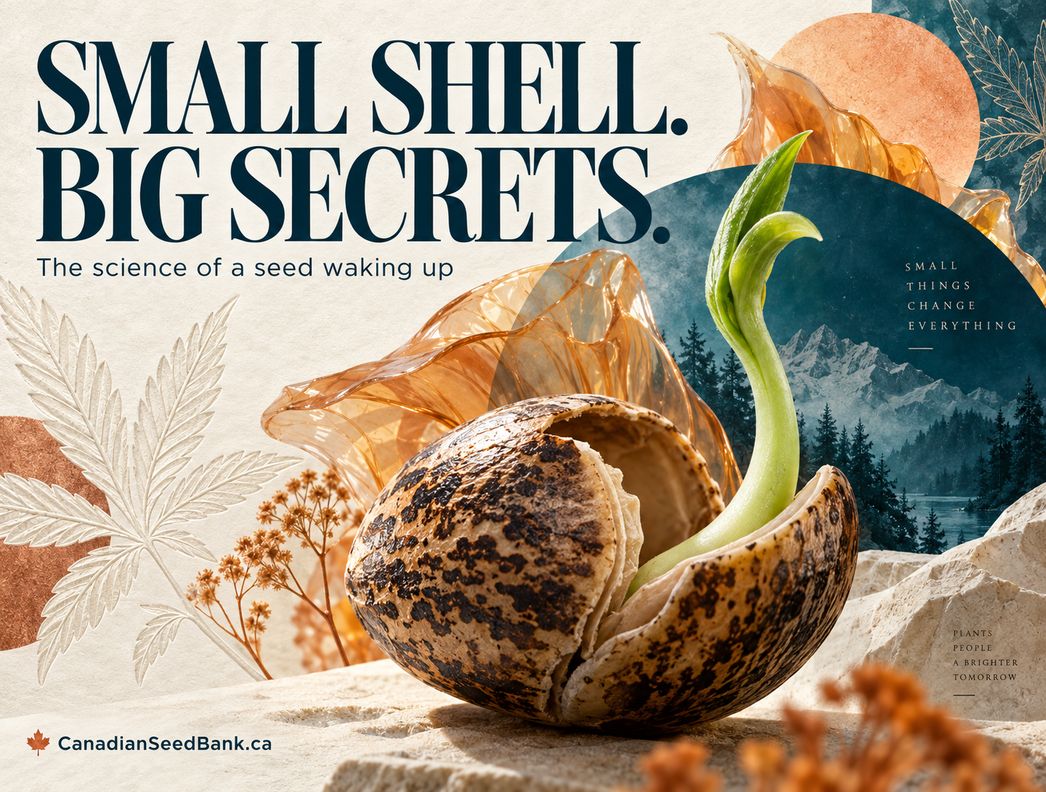
Small Shell, Big Secrets
What Really Happens When a Seed Wakes Up
A seed is very good at looking unimpressive. It sits there, apparently doing nothing, while people project entire futures onto it. We imagine leaves, branches, flowers, forests. The seed offers no comment. For something carrying so much expectation, it has an admirably restrained public relations department.
Its ordinary appearance conceals an extraordinary biological arrangement. A seed allows a plant’s next generation to exist before it begins living independently. Growth can pause. Development can resume. Between those states lies germination, one of the most consequential transitions in the plant world.
For readers interested in cannabis, understanding that wider botanical story provides useful perspective. Seeds belong to biology before they belong to a catalogue. Their behaviour reflects inherited characteristics, developmental history, and processes that cannot be reduced to a reassuring slogan. The science is more interesting than the shortcuts, and considerably better at explaining why nature rarely operates like an appliance.
The plant is already in there
A seed does not manufacture a plant from nothing when it germinates. It contains an embryo, the young plant formed during seed development. Protective tissues surround it, and stored resources support its early development. The details differ across plant groups, but the basic achievement is remarkable: living tissue packaged for a period between generations.
Germination describes the resumption of development leading to the emergence of the embryonic root, or radicle. That is distinct from the later process of becoming an established seedling. The first visible breakthrough matters, but it is a beginning rather than a completed transformation. These distinctions are central to J. Derek Bewley’s influential review of seed germination, published while he was at the University of Guelph. Seed Germination and Dormancy.
The distinction is easy to appreciate outside botany. Opening a restaurant and running a successful restaurant are related achievements, but nobody would sensibly confuse the two. Biology also has milestones. Treating the first milestone as the entire story makes later developments harder to understand.
Waiting can be a survival strategy
We tend to interpret delay as a problem. Seeds complicate that assumption. In seed science, dormancy describes a condition in which a viable seed does not germinate even when the external conditions would otherwise permit it. Dormancy is therefore different from simply being unable to proceed because the surrounding environment is unsuitable.
Researchers distinguish several kinds of dormancy, involving features such as physical barriers, embryo development, and physiological regulation. These are not interchangeable explanations. The influential work of William Finch Savage and Gerhard Leubner Metzger describes dormancy as part of the plant’s relationship with its environment, helping determine when germination occurs. Seed dormancy and the control of germination.
The broader idea changes the way we read a landscape. A patch of apparently empty ground need not represent an absence of plant life. Some of its biological future may simply be out of sight. The visible season is only one part of the story.
It also challenges our fondness for speed. Human deadlines are excellent tools for arranging meetings and rather poor explanations of evolution. A process can be slow for reasons that make sense to a plant, even when they are inconvenient to an observer.
A chemical conversation beneath the surface
Seeds do not make conscious decisions, although the language of waking and waiting makes it tempting to imagine otherwise. Their developmental changes involve chemical signalling and the regulation of genes. Behind an apparently simple event sits an intricate system of controls.
Two important groups of plant hormones are abscisic acid and gibberellins. Broadly, abscisic acid is associated with the establishment and maintenance of dormancy, while gibberellins help promote the transition towards germination. Their activities interact with other signals rather than operating as isolated switches. Researchers studying these relationships describe a network, not a single master button. Research on hormonal regulation of dormancy and germination.
That difference matters when science reaches popular culture. A complicated biological relationship can become a cartoon remarkably quickly: this chemical means stop, that one means go, and the rest apparently takes care of itself. Useful introductions simplify. Good explanations also tell us where the simplification ends.
The more closely researchers examine a seed, the less it resembles a tiny machine with one instruction. It looks instead like a living system negotiating several demands at once. That is a more demanding explanation, but also a far more satisfying one.
Before growth comes repair
One of the most surprising parts of seed science concerns maintenance. The ability to remain alive does not mean that a seed escapes deterioration. Biological molecules can accumulate damage, and the transition towards active growth brings a need to address it.
In a 2022 study of Arabidopsis thaliana, researchers examined how seeds respond to DNA damage. They found that genome maintenance mechanisms, including DNA repair and controls on the cell cycle, help protect the developing plant. The study also showed that seeds and seedlings respond differently to damage. This was research on a model plant, not a test of cannabis germination methods. The original study in PNAS.
The finding gives an apparently quiet interval a different meaning. A lack of visible movement does not necessarily imply a lack of biological activity. Some of the important work is happening below the scale at which our eyes can follow it.
It is a useful antidote to dramatic photography. A picture can capture a root emerging through a seed covering. It cannot, by itself, show the molecular work that made that moment possible. The most photogenic part of the event is not necessarily the most complicated.
The ancient seeds that interrupted the calendar
Some seeds have demonstrated a capacity for survival that sounds almost fictional. In a 2020 study, Sarah Sallon and colleagues reported the germination of ancient date palm seeds recovered from archaeological sites in the Judean desert. Radiocarbon evidence placed the material roughly two millennia in the past. Genetic analysis offered information about the historical date palms and their relationships with other populations. The original date palm research.
This is the sort of result that deserves an astonished pause. A living connection had crossed an interval longer than the history of many modern countries. Archaeology and plant biology had met inside something small enough to hold between two fingers.
Yet the achievement is an exceptional finding about particular material. It does not establish a universal lifespan for seeds, and it should not be converted into a promise about unrelated species. The distinction preserves the wonder rather than diminishing it. An extraordinary exception becomes less interesting when it is carelessly presented as an ordinary expectation.
Why a seed bank is more than a vault
The phrase seed bank invites an image of shelves, containers, and a satisfyingly heavy door. Those things may be involved, but the scientific work extends well beyond keeping a collection in one place.
Kew’s description of its seed collection highlights identification, collection records, viability, longevity, and the biological difficulties associated with different species. It also identifies exceptional species that cannot be conserved through conventional seed banking, including those whose seeds do not tolerate drying. Preserving plant diversity therefore requires knowledge of the material, not simply space for it. Kew’s seed collection programme.
This is an important distinction between possessing an object and understanding what it represents. A museum collection loses much of its value when its labels disappear. A scientific collection also depends on the information attached to it: identity, origin, history, and the limits of what is known.
For a publication such as Canadian Seed Bank Blog, that is an especially useful perspective. The fascination lies in the relationship between living material and reliable information. A seed can be small without the responsibility of describing it being small as well.
A better kind of curiosity
Perhaps the most valuable change is to replace the search for one universal secret with an interest in better questions. What process is being described? Which species was studied? What did researchers actually measure? Does a striking photograph show the same thing as the claim attached to it?
Those questions make seed science accessible without pretending it is simple. They also protect the difference between a finding, an interpretation, and a sales pitch. All three can be written confidently. Only one necessarily comes with an experiment behind it.
Even the word success deserves a second look. An account might be discussing the first visible root, the later survival of a seedling, or the preservation of an entire collection. Those are different stories. Recognising which story a researcher is telling makes the result easier to appreciate and much harder to accidentally exaggerate.
A seed’s first visible root is a modest sight. No fanfare, no announcement, no attempt to go viral. Yet behind it sits a remarkable story of development, signalling, survival, and repair. The closer we look, the more impressive that small beginning becomes.

Cannabis Has A Memory
Cannabis Has a Memory, and the Future Depends on Keeping It
The newest thing in cannabis usually arrives with a very loud introduction. There is a fresh name, a confident description, and the suggestion that everything before it was merely rehearsing. Somewhere behind the announcement sits a quieter question: what had to exist for this new thing to become possible?
That question leads away from the launch and towards the archive. It leads to earlier plant material, records, observations, places, and people whose contributions may be less visible than the latest branding. It also changes how we think about seeds. They become part of a continuing story rather than simply the beginning of a new product description.
At Canadian Seed Bank, we find that perspective especially compelling. The future of cannabis deserves imagination, but it also deserves a memory. A culture that celebrates every arrival while forgetting its predecessors eventually runs out of context. Novelty is more interesting when we understand what made it possible.
The story began long before the catalogue
Cannabis history is much older than the language of modern retail. A 2021 study published in Science Advances used genomic data from 110 accessions to investigate the plant’s domestication. The researchers concluded that cannabis was first domesticated in East Asia during the early Neolithic period and identified evidence of later differentiation associated with human selection. Their work places modern cannabis within a much longer relationship between people and plants. Read the original domestication study.
The scale of that relationship is worth pausing over. A modern name may occupy a few words on a screen, but the plant behind it belongs to a history that cannot be compressed into a catchy paragraph. Scientific research gives us ways to examine that history without pretending every part of it is already settled.
This should encourage humility. When we speak about discovering something new, we are often entering a story with many earlier chapters. Acknowledging those chapters does not diminish present achievements. It gives them proportion and makes the achievements easier to understand.
Heritage is more than an attractive adjective
Heritage sounds reassuring. It suggests continuity, character, and a connection to something that survived because it mattered. The word can be useful, but only when we ask what it means in a particular account.
Does it refer to a documented history? A longstanding association with a place? A remembered name? A claim passed between several sellers? These possibilities are not interchangeable. A description becomes more credible when it explains the connection rather than relying on the emotional warmth of the word itself.
The same care belongs around terms such as rare and original. Rarity alone does not establish importance, and an origin story does not become accurate because it is appealing. A compelling history should be able to withstand a few ordinary questions about its sources.
Think of an antique shop. The chair is more interesting when someone can explain where it came from, how they know, and which details remain uncertain. “Very old, extremely special” may fit on a tag, but it is not much of a conversation. Cannabis heritage deserves better than the botanical equivalent of that tag.
Diversity is an idea worth defending
There is a useful distinction between having many names and having meaningful diversity. A catalogue can look wonderfully varied while leaving the reader unsure how different its entries actually are. Visual abundance is easy to create. Explaining the substance behind it takes more care.
This is an editorial argument for valuing difference beyond novelty. An unfamiliar history, a less fashionable characteristic, or a thoroughly documented background can deserve attention even when it does not fit the current aesthetic. The most interesting collection is not necessarily the one with the most dramatic titles.
Other parts of culture already understand this. We preserve films that will never become blockbusters and books that will never dominate a bestseller list. Their value is not exhausted by their immediate popularity. They hold perspectives, techniques, and possibilities that a narrower collection would lose.
Cannabis discussion can benefit from a similar outlook. We need not declare every older variety superior or every new development shallow. We can simply recognise that the fashionable present is an incomplete guide to what may matter later. Keeping a broader conversation alive is an investment in curiosity.
People belong in the history
Plant stories can become strangely impersonal. A place is mentioned, a famous name appears, and the people who sustained the connection disappear between the two. The result is a history with plenty of atmosphere and very little acknowledgement.
A more thoughtful account asks whose knowledge is being described. Who made the observations? Who maintained the records? Whose language and experience shaped the story before it entered a modern catalogue? Where those answers are known, including them gives readers a richer understanding.
Where they are not known, the absence should remain visible. Inventing a colourful character or a romantic journey does not repair an incomplete history. It merely replaces the gap with fiction. Good storytelling can be vivid without pretending to possess evidence it does not have.
This matters for a Canadian publication discussing a plant with connections far beyond Canada. Our perspective can be local without treating the rest of the world as decorative background. Respect begins with recognising that a place name represents more than an appealing word on a package.
Documentation has its own quiet drama
Records rarely receive the applause given to a new release. A dated account, a carefully attributed description, or an explanation of uncertainty will not usually produce the most spectacular headline. Yet these are the things that let a story remain useful after the initial excitement fades.
Imagine trying to reconstruct a family history from nicknames alone. You would have plenty of personality and very little confidence about who was related to whom. Dates, sources, and clear distinctions turn the collection of anecdotes into something that can be examined.
The same principle improves cannabis writing. A claim becomes more valuable when its source is named. An old account becomes more useful when its date is clear. A disputed detail becomes more understandable when the disagreement is acknowledged instead of quietly edited out.
Even a small historical feature can make these distinctions gracefully. Picture an article that opens with a remembered variety, then places an early catalogue description beside a later recollection. The writer can explain where the accounts agree and where they diverge. Readers get a story with texture, including the uncertainty that makes historical work interesting. There is no need to force a verdict where the evidence cannot support one. Sometimes the most revealing detail is how a story changed as it moved between people. Following that change can tell us something about the culture surrounding the plant, even when a precise botanical identity remains unresolved. That is a richer result than repeating the most colourful version as fact.
Documentation also allows a story to change responsibly. New information can refine an earlier interpretation without making the entire history collapse. That is one advantage of treating knowledge as a developing record rather than a flawless legend. Legends tend to resent corrections. Good records make room for them.
Progress does not require amnesia
It is tempting to frame heritage and innovation as opponents. One side supposedly protects the past while the other invents the future. The argument makes a tidy headline, but it creates an unnecessary choice.
Understanding what came before can make new work easier to appreciate. It allows us to ask what is distinctive, what has been carried forward, and what claims genuinely deserve the word new. Without that context, innovation risks becoming whatever received the latest packaging.
Equally, respect for history should not harden into automatic resistance to change. An older story can be meaningful without making every modern development suspect. The goal is an informed relationship between past and present, with enough curiosity to recognise value in both.
That relationship gives a seed focused publication something useful to contribute. We can make room for careful histories, clear explanations, and questions that are more interesting than which name is attracting attention this week. We can also resist the temptation to turn every account into a sales pitch.
For Canadian Seed Bank, the strongest cannabis stories connect enthusiasm with understanding. They remember that behind a name sits a body of information, and behind that information sit people, places, and a great deal we are still learning.
The future will bring plenty of new names. Some will endure, and others will eventually sound like a fashion choice we would rather not discuss. What should last is our willingness to keep the record clear and the conversation broad. A plant with this much history deserves a future that remembers where to look.

What's in a Name?
What Is Really in a Cannabis Strain Name?
A cannabis catalogue can sound like three businesses sharing one address: a bakery, a travel agency, and a comic book shop. There are desserts, distant places, mysterious initials, and names with enough dramatic confidence to headline an action film. It is memorable branding. It is not always a complete explanation.
Names matter because they are usually our first point of contact with a variety. Before we read a description or ask where the information came from, the name has already suggested a personality. It can evoke familiarity, novelty, heritage, or a particularly ambitious pudding.
The challenge is learning how much weight that first impression should carry. A name can be useful, but it should begin the conversation rather than finish it. At Canadian Seed Bank, we believe the most interesting question is often the one immediately after “What is it called?” That question is “What do we actually know about it?”
A name is a doorway
Good names are economical. They make something easier to recognise, discuss, and remember. Without them, every conversation would require an awkward paragraph of explanation before anyone could identify the subject. There is nothing inherently unserious about a memorable name.
Problems arise when recognition becomes a substitute for information. A familiar label can feel reassuring even when the description beneath it is vague. A dramatic new name can create excitement before there is much substance to examine. In both cases, the reader risks lending the name more authority than it has earned.
Consider a restaurant dish called Grandmother’s Special. It may be excellent. It may even involve a grandmother. But you would still want to know what is on the plate. A cannabis name deserves the same mixture of interest and sensible curiosity.
That does not require cynicism. You can enjoy the storytelling while asking for clearer details. In fact, the story often becomes more compelling when it has something solid beneath it. Specificity gives character a foundation. Otherwise, we are simply collecting adjectives with interesting fonts.
The familiar categories are less tidy than they look
Indica and sativa are among the most recognisable words in cannabis. Their familiarity can make them feel like complete explanations, particularly when they appear beside confident descriptions of what someone should expect. The scientific picture is more complicated.
A 2021 study in Nature Plants examined more than 100 cannabis samples using chemical measurements and genetic data. In that sample set, products labelled sativa and indica did not form distinct groups across the genome. The labels were instead associated with variation in a smaller number of terpenes and related genetic regions. The finding challenges the idea that these commercial categories neatly divide modern cannabis into two comprehensive biological groups. Read the original labelling study.
That does not make every use of the words meaningless. It means readers should resist asking them to carry more information than they can support. A broad label is not the same as a detailed account of identity, chemistry, ancestry, or personal response.
There is something liberating about that distinction. Once a category stops pretending to answer everything, better questions become possible. We can replace the demand for a tidy label with a more useful interest in the actual information available.
Family stories need a paper trail
Lineage is one of the most appealing parts of cannabis storytelling. It offers a sense of connection between a modern variety and the material that came before it. A description with named parents can feel more substantial than one built entirely from mood and metaphor.
Still, a lineage statement is a claim with a source. It is worth knowing whether that source is the originating breeder, a later seller, an independent record, or a description repeated so often that nobody remembers where it began. Repetition can make a claim familiar without making it better documented.
The distinction matters especially when the language becomes historical. Words such as original, authentic, and legendary carry considerable emotional weight. They should invite explanation. What does original mean in this particular description? Original to whom? What evidence connects the material to the history being presented?
These are reasonable editorial questions, not accusations. A thoughtful answer can acknowledge what is documented and where uncertainty remains. An honest gap is more useful than a seamless story held together by confidence alone. Readers should not need detective training to tell which parts of a description are established and which are inherited lore.
Take a fictional example called Midnight Orchard. The name suggests darkness, fruit, and perhaps a little mystery. One description might stop there, adding luxurious, legendary, and unforgettable until the paragraph resembles a perfume advertisement. Another might explain who introduced the name, identify the source of its reported ancestry, and describe the aroma as a reported impression. The second account gives the reader several different kinds of information without pretending they are all equally certain.
Now imagine that another listing uses the same name but provides a different background. The sensible response is to acknowledge the discrepancy and look for its explanation. Perhaps the listings refer to different material. Perhaps one contains an error. The name alone cannot resolve the issue. This is exactly where careful attribution earns its keep: it gives readers a way to follow the story instead of simply choosing whichever version sounds more confident.
Numbers need context too
A percentage printed beside a name can appear to settle the matter. It offers the comfort of something measurable in a field crowded with subjective descriptions. Yet a number becomes useful only when the reader understands what it refers to.
Was it measured in a particular sample? Is it presented as a typical range, a reported result, or an exceptional outcome? Is the description clear about the basis for the claim? Those are different kinds of information, even when the typography makes them look equally certain.
Imagine an automobile advertisement displaying a speed without saying whether it came from ordinary driving, a controlled test, or a particularly enthusiastic imagination. The missing context would matter. Cannabis descriptions deserve the same expectation of clarity.
A seed listing and a laboratory report also perform different jobs. The first describes the material being offered and the information associated with it. The second reports findings for material that was actually tested. Good editorial practice keeps those roles clear instead of allowing one to borrow certainty from the other.
The difference between detail and decoration
Not every long description is informative. Some simply spread a small amount of information across a very large amount of enthusiasm. Premium, exceptional, elite, and extraordinary can fill a paragraph without helping anyone understand the subject.
Useful detail does a different job. It identifies the source of a claim, explains a term, distinguishes a reported characteristic from a guarantee, or makes a comparison more precise. It leaves the reader better equipped to judge the description rather than merely more impressed by its tone.
This is why plain language often feels more professional than elaborate promotion. A sentence that admits a limitation may carry more value than a paragraph promising perfection. Confidence is most persuasive when it is proportionate to the evidence.
Humour has a place here too. Cannabis names can be wonderfully strange, and pretending otherwise would miss part of their charm. The trick is to enjoy that charm without confusing it with documentation. A variety can have an excellent name and still need an excellent explanation.
Read with curiosity, not suspicion
There is no need to approach every description as though it were an attempted escape from cross examination. Most readers want enough information to understand what they are looking at, not an academic defence delivered under fluorescent lighting.
A better habit is to notice the unanswered question. If a name suggests a place, does the description explain the connection? If it invokes a famous family, is that relationship explained? If it makes a specific claim, does it indicate where the claim came from?
Sometimes the answer will be straightforward. Sometimes the available history will be incomplete. What matters is whether the writing makes those differences visible. Transparency helps readers make sense of uncertainty instead of hiding it behind another layer of polished language.
For Canadian Seed Bank, this is an opportunity to make cannabis education more satisfying. We can treat readers as intelligent adults who appreciate an interesting story and can also handle an honest qualification. The two belong comfortably in the same article.
The most memorable name may still be the one that makes you smile. There is nothing wrong with that. Just give the description beneath it a chance to earn your attention as well. A clever title opens the door. Clear information is what makes the visit worthwhile.

The Nose Knows
The Nose Knows Something the Numbers Do Not
Some cannabis descriptions read like a grocery list written during a power outage. Lemon peel, diesel, black pepper, ripe mango, damp earth. It sounds improbable until you encounter an aroma that manages to suggest a fruit stand and a mechanic’s garage in the same breath. Then the vocabulary starts making sense. Almost.
That is part of what makes cannabis such an interesting plant to discuss. Its aromatic character can be familiar and peculiar at once. A description may point towards something you know, yet never quite capture it. There is always another detail hiding behind the obvious one.
At Canadian Seed Bank, we think that complexity deserves more attention. Numbers are convenient. They fit neatly into comparison charts and require very little imagination. Aroma asks something different of us. It asks us to pay attention, find the right words, and accept that a useful description may be more revealing than an impressive statistic.
The trouble with a single score
Imagine reviewing a restaurant by reporting the temperature of the oven. It is relevant information, certainly, but the chef might reasonably hope you would mention dinner. Cannabis conversations can fall into a similar habit whenever one measurement becomes the entire definition of quality.
A percentage feels authoritative because it appears precise. The difficulty begins when precision is mistaken for completeness. Even an accurate measurement can answer only the question it was designed to answer. It cannot automatically tell us whether something is distinctive, memorable, carefully described, or personally appealing.
This is where aroma adds another dimension. It gives us language for character rather than rank. Instead of asking which sample wins, we can ask what makes each one recognisable. That shift sounds small, but it changes the conversation from a leaderboard into an actual discussion.
There is also something refreshingly democratic about it. You do not need to possess an encyclopedic vocabulary to notice that one aroma reminds you of orange rind and another of a cedar chest. Clear observation is more useful than elaborate performance. Nobody needs to detect imaginary Himalayan marmalade to earn a place at the table.
Terpenes deserve attention, and some company
Terpenes often take centre stage in explanations of cannabis aroma. They are an important part of the picture, but the picture is larger than a short list of familiar names. Treating every scent as the work of one famous terpene can make a complicated subject sound tidier than the evidence allows.
A 2023 study published in ACS Omega examined aromatic differences among cannabis samples and highlighted the importance of compounds beyond terpenes. These included volatile sulfur compounds associated with certain distinctive scents. The research helps explain why similar terpene profiles do not necessarily translate into identical aromas. It also offers a useful reminder that compounds present in small quantities can make meaningful contributions to what we perceive. Read the original aroma study.
The editorial lesson is straightforward: leave room for complexity. A familiar chemical category can provide a helpful introduction without becoming the explanation for everything. Science becomes more interesting when we allow it to expand the story instead of squeezing it into the marketing copy we already have.
Think of a room full of musicians. Knowing which instruments are present tells you something, but it does not tell you exactly what the music sounds like. Composition matters. Relationships matter. A quiet contribution may change the character of the whole performance.
Why strange descriptions can be useful
Words such as earthy, floral, sharp, and sweet are useful because they create a starting point. More specific comparisons can help someone imagine the distinction between two descriptions. Lemon juice and lemon peel belong to the same fruit, but they suggest different things. So do fresh wood and an old wooden cupboard.
The purpose is communication. A good aroma description gives the reader a clearer impression than they had before. It does not need to be poetic, although a little personality rarely hurts. The best ones feel recognisable rather than theatrical.
One useful distinction is between intensity and character. “Strong” tells us how forcefully something announces itself, but very little about its personality. A quiet scent can still be distinctive, just as a person speaking softly can have something memorable to say. Describing both qualities gives the reader a fuller impression. “A gentle woody aroma” and “an assertive woody aroma” share a reference point while suggesting different encounters. Neither phrase needs to declare a winner. That is the advantage of descriptive language: it can make differences visible without forcing every observation into a contest. The vocabulary becomes more useful precisely because it becomes less competitive.
Consider the difference between “a spectacular explosion of premium flavour” and “a bright citrus impression followed by something dry and woody.” The first sentence congratulates itself. The second gives you something to work with. Professional cannabis writing should know the difference.
Unusual comparisons can be especially helpful when the aroma itself is unusual. A reference to fuel, rubber, or cheese does not necessarily express criticism. It may simply be the closest available description. Language borrowed from other familiar experiences helps us discuss a plant that refuses to stay within a polite floral vocabulary.
Your vocabulary belongs to you
People arrive at aroma with different collections of references. Someone who cooks frequently may reach for herbs and spices. Someone who spends time outdoors may think of resin, soil, or fallen leaves. Neither vocabulary needs to defeat the other.
The useful question is whether the description communicates an honest observation. If one person says grapefruit and another says orange peel, they may be noticing related qualities through different language. Agreement does not require everyone to use the same noun.
This is also a reason to be suspicious of descriptions that sound too perfect. When every variety supposedly delivers a flawless sequence of exotic fruit, expensive dessert, and spiritual fulfilment, the writing has probably wandered away from observation. A little uncertainty can make a description more credible.
Phrases such as “suggests,” “recalls,” and “has a hint of” are not weak writing when they reflect the nature of the subject. They establish an honest relationship between the thing being described and the comparison being offered. They leave space for the reader to have a different impression without being wrong.
An aroma is not a medical promise
There is an important boundary between describing a scent and promising an outcome. A reference to lavender is a sensory comparison. A promise that the same aroma will reliably solve someone’s sleep difficulties is a much larger claim. Elegant language should never be used to slip quietly across that boundary.
For the same reason, aroma should not be presented as a certificate of safety or a dependable forecast of an individual’s response. A pleasing description does not establish either. The language of appreciation works best when it remains clear about what is actually being appreciated.
This distinction allows us to be enthusiastic without becoming careless. We can find the plant fascinating, explore the vocabulary around it, and discuss emerging research while keeping observation separate from speculation. Readers deserve that clarity, particularly in a subject where confident claims are easy to find.
There is no need to drain the personality from cannabis writing to make it responsible. In fact, accuracy often improves the writing. It forces us to look more closely instead of reaching for another grand promise that sounds impressive and explains very little.
Better descriptions make better conversations
For a seed focused publication, aroma is also an invitation to discuss identity with greater care. What language is used to describe a variety? Where did that description come from? Is it a general impression, a breeder’s account, or an observation tied to particular material? Those distinctions help readers understand the limits of the information.
A useful description should be specific enough to mean something and modest enough to remain believable. It should not imply that a name alone guarantees an identical sensory result. Nor should it borrow the authority of a laboratory when it is simply expressing a human impression.
This creates room for a more mature kind of enthusiasm. We can value distinctiveness without declaring every new release revolutionary. We can enjoy an unusual comparison without mistaking it for chemistry. We can also admit when the available information does not support a more detailed answer.
That is the kind of conversation Canadian Seed Bank wants to encourage. Curious, informed, and comfortable with nuance. Cannabis has enough character of its own without needing every sentence to arrive wearing a gold medal.
The next time a description catches your attention, look beyond the biggest number and the loudest adjective. Notice whether the writer has helped you understand something particular. A little citrus, a little wood, an unexpectedly savoury edge. Sometimes the most interesting part of the story is the part that refuses to fit inside a score.
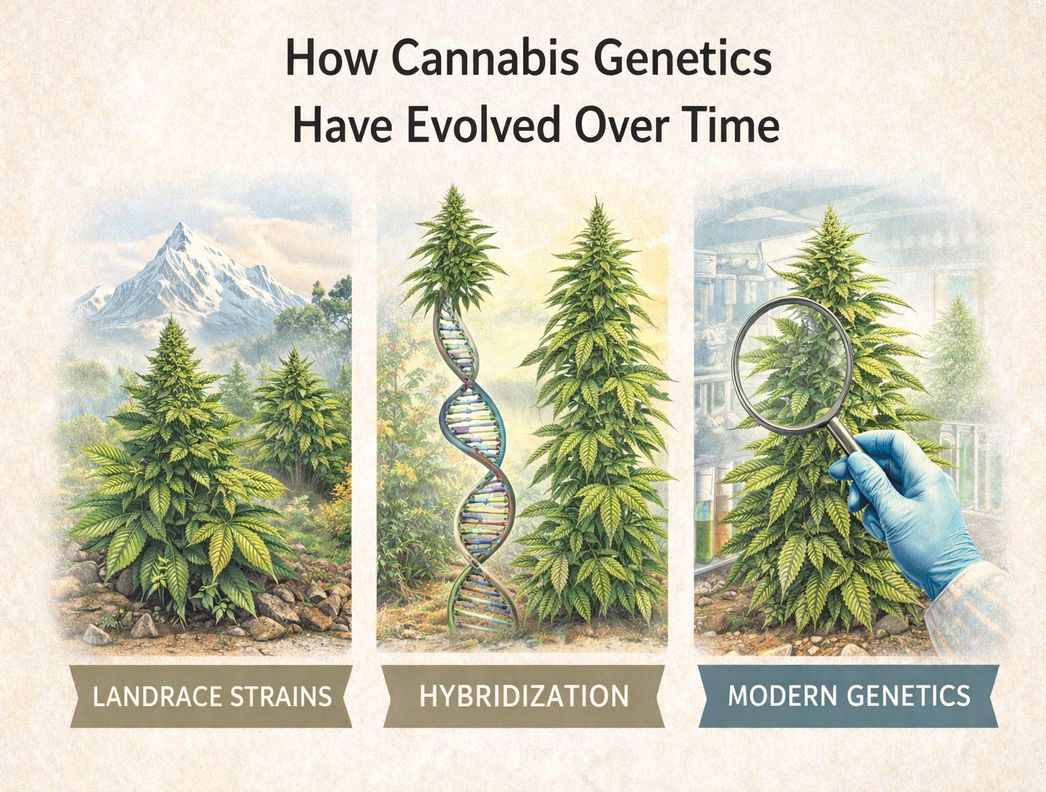
Cannabis Evolution 101
How Cannabis Genetics Have Evolved Over Time
The cannabis plant seen today is the result of thousands of years of natural adaptation, human cultivation, and scientific advancement. From ancient landrace strains to highly refined modern genetics, cannabis has evolved alongside civilization itself.
Understanding this evolution offers valuable insight into how today’s strains came to be, and why genetics matter so much in cannabis cultivation.
Landrace Strains: The Foundation of Cannabis Genetics
The earliest cannabis plants are known as landrace strains. These are naturally occurring varieties that developed over centuries in specific geographic regions without intentional crossbreeding. Landrace strains adapted to their local environments, shaping their structure, flowering cycles, and resilience.
Examples of traditional landrace regions include:
Central Asia (Afghanistan, Pakistan)
Southeast Asia (Thailand, Laos)
Africa (Durban region)
Central and South America
The Indian subcontinent
Because they evolved in isolation, landrace strains display consistent genetic traits. They form the genetic backbone of all modern cannabis varieties and are prized for their stability and historical significance.
Early Cultivation and Selective Breeding
As cannabis spread through trade routes and migration, humans began selective breeding -- by choosing plants with desirable characteristics such as yield, aroma, flowering time, or adaptability. This marked a turning point from purely natural evolution to intentional genetic refinement.
Farmers and cultivators selectively saved seeds from plants that performed best in their environment. Over time, this process enhanced specific traits and gradually diversified cannabis genetics beyond their original landrace forms. Selective breeding allowed cannabis to adapt to new climates, growing conditions, and cultivation goals, laying the groundwork for the vast diversity seen today.
The Rise of Hybrid Genetics
As global cannabis cultivation expanded, breeders began crossing landrace strains from different regions. This led to the creation of hybrid strains, combining traits from multiple genetic lineages. Hybridization allowed breeders to:
Improve consistency and predictability
Enhance resilience to environmental stress
Balance growth structure and flowering time
Preserve rare genetics through controlled breeding
By the late 20th century, most cannabis strains had become hybrids to some degree. Pure landrace strains became increasingly rare, often preserved only by dedicated genetic conservation efforts.
Modern Cannabis Genetics and Scientific Advances
In recent decades, cannabis genetics have advanced rapidly due to improved cultivation techniques and scientific understanding. Breeders now use detailed phenotyping, genetic analysis, and controlled environments to refine plant traits with greater precision.
Modern genetics focus on:
Stable seed production
Consistent plant structure
Predictable flowering cycles
Refined cannabinoid and terpene profiles
Rather than relying solely on appearance or region, today’s cannabis genetics are shaped by data-driven selection and careful breeding strategies. This has led to a diverse and highly specialized genetic landscape.
How Today’s Strains Came to Be
Most cannabis strains available today are the result of multiple generations of selective breeding and hybridization, tracing their lineage back to original landrace genetics. While strain names and categories continue to evolve, the genetic foundations remain rooted in those early regional varieties.
For seed banks and cultivators, genetics represent more than just a name, they define a plant’s potential, reliability, and adaptability. Preserving genetic diversity while advancing cultivation science remains a central focus of modern cannabis breeding.
The Ongoing Evolution of Cannabis
Cannabis genetics continue to evolve as research expands and cultivation methods advance. With growing interest in preservation, sustainability, and genetic integrity, the future of cannabis genetics balances innovation with respect for its origins. Understanding this evolution highlights why genetics matter, and why quality seed selection remains essential for the next generation of cannabis cultivation.
The Purple Mystery
Why Some Cannabis Turns Purple and What the Colour Really Means
Some cannabis plants seem determined to steal the spotlight. While their neighbours stay green, they show off shades of plum, burgundy and violet. A few become so dark they almost look black, with sparkling trichomes standing out against the colour like frost on a blackberry.
It is enough to make anyone pause for a closer look.
But what is happening inside that plant? Is purple cannabis stronger? Is the colour inherited? And why can two plants with similar backgrounds look so different?
The answers lead into a world of natural pigments, genetic instructions and microscopic chemistry. The same broad family of compounds that colours berries and flowers also helps create some of cannabis’s most striking appearances.
Once you understand the science, a purple flower becomes even more interesting. That beautiful exterior is showing you a small part of the plant’s inner workings.
Meet the Plant’s Colour Department
Much of the purple colouring in cannabis comes from anthocyanins, a group of pigments within the flavonoid family. Across the plant kingdom, anthocyanins contribute red, purple and blue shades to leaves, flowers and fruits.
If the name sounds unfamiliar, the colours certainly are not. You have encountered this pigment family in foods such as berries, grapes and red cabbage.
Inside plant cells, anthocyanins accumulate in compartments called vacuoles. Think of these as tiny storage spaces, although their chemistry is considerably more sophisticated than a cupboard full of paint.
The shade we see depends on the pigments’ molecular structure, their surroundings and interactions with other compounds. Producing pigment is only part of the job. Plants also have to transport and stabilise it, while breakdown can change how much remains.
In other words, a purple leaf is the finished appearance of several processes happening together. Research on anthocyanin storage and stability.
Scientists Have Put a Name to the Purple
It is one thing to say that a flower contains purple pigment. Identifying the actual compound is where the detective work begins.
In a 2023 study published in Antioxidants, researchers identified cyanidin 3 rutinoside, also known as keracyanin, as the major anthocyanin in the cannabis material they examined. Their work helped connect visible colour with specific chemistry. Bassolino and colleagues, 2023.
Keracyanin probably will not become a household word anytime soon. Still, finding it matters because it moves the explanation beyond appearance and into something scientists can identify and measure.
There is an important boundary here: the researchers examined particular plant material. Their findings do not mean every purple cannabis variety contains exactly the same pigment mixture or concentration.
That is what makes this subject worth following. A colour familiar to enthusiasts is still giving scientists new questions to investigate.
Why Does One Plant Go Purple While Another Stays Green?
Imagine a group photograph where everyone received the same invitation but arrived wearing something different. Cannabis pigmentation can create a similar impression.
The explanation involves genetics and how genetic instructions are expressed.
A 2024 study in Plant Direct investigated four differently pigmented cannabis varieties. Researchers examined anthocyanins and related compounds, along with genes associated with their production. Several genes showed strong relationships with anthocyanin accumulation in the leaves. Gagalova and colleagues, 2024.
Pigmentation involves a sequence of biological steps. Different enzymes help carry out those steps, while regulatory systems influence their activity.
The study also provides a useful reminder to read the details. It examined leaf pigmentation, which does not automatically explain every colour pattern in cannabis flowers.
A plant described simply as “purple” may have a much more specific story behind it. Where the colour appears, how it is distributed and how consistently it is documented all make that story more informative.
Is the Plant Just Showing Off?
As tempting as that explanation might be, plants have their own reasons for producing pigments.
Across many species, scientists have investigated anthocyanins for their roles in responses to environmental stress. One area of interest is protection from excessive light.
Depending on where they accumulate, these pigments can intercept some incoming light before it reaches sensitive photosynthetic structures. A 2025 review describes anthocyanins among the mechanisms involved in plant responses to light stress. Their contribution depends on the plant and the circumstances. Research on plant responses to light stress.
That gives a colourful leaf another dimension. Something we admire for its appearance may also participate in the plant’s response to its surroundings.
It does not follow that the darkest plant wins a prize for health or resilience. Biology rarely hands out answers that neatly.
Purple is an interesting trait to understand, rather than a universal score for how well a plant is doing.
Purple Does Not Come with a Potency Certificate
A dark flower covered in sparkling resin makes a powerful first impression. It is easy to look at it and assume everything about it must be intense.
But the colour and the resin tell different stories.
Cannabis glandular trichomes are specialised structures involved in producing and storing cannabinoids and terpenes. Research in The Plant Journal examined their structure and chemistry as flowers developed, revealing substantial differences beneath that familiar frosted appearance. Research on cannabis glandular trichomes.
Anthocyanin pigmentation is a separate feature. Looking at a purple surface does not reveal its THC concentration.
It cannot establish the aroma, either, or predict someone’s individual experience. Those questions require different information.
There is nothing wrong with appreciating an unusually beautiful specimen. The trick is to enjoy the appearance without quietly turning it into a laboratory report.
A plant can be visually spectacular while still leaving plenty of questions unanswered.
Your Camera Is Not a Chemistry Lab
Anyone who enjoys plant photography knows how captivating a close view can be. Veins, colour gradients and tiny surface structures suddenly become the main event.
Scientists are interested in those visual details too, but translating an image into a chemical measurement takes careful work.
A study published in Frontiers in Plant Science investigated using image analysis to estimate anthocyanin concentrations in lettuce. The researchers compared image information with measured pigment content to assess the relationship. Kim and colleagues, 2023.
The study concerns lettuce, so its findings are not a ready made cannabis test. What it illustrates is the gap between observing a colour and reliably measuring what creates it.
For an enthusiast, photographs remain wonderful records of appearance. They can reveal patterns worth discussing and details worth investigating.
They simply need supporting evidence before being asked to prove chemical composition or other qualities that are invisible to the camera.
The Details Worth Looking At
Once you know the basics, purple cannabis gives you much more to notice than a single dramatic shade.
Is the colour concentrated in the leaves or visible in floral tissues? Does it form a broad wash of violet, a burgundy edge or a patchwork against green? Does a variety description explain the pictured specimen, or make a broader claim about the variety?
These are useful questions because they turn a quick glance into a closer look.
They also make conversations about cannabis more enjoyable. “That looks amazing” can become “What part of the plant is actually coloured?” or “What evidence explains that pattern?”
There is no need to memorise a list of enzymes to take an interest in the answer. Curiosity is enough to get started.
And the subtle specimens deserve attention too. A faint purple margin can raise just as interesting a question as a flower that looks dipped in plum juice.
A Little Colour, a Much Bigger Story
Part of the fascination with cannabis is how much detail appears when you slow down and look. A plant that first seems simply green or purple gradually reveals textures, patterns and differences that a variety name cannot fully describe.
Pigmentation is a particularly inviting way into that world because the evidence is right there in front of you, even when the explanation requires a microscope or laboratory.
Scientists are steadily connecting visible colours with the compounds and genetic activity behind them. Each discovery adds detail without making the plant any less remarkable.
Next time a violet flower catches your attention, enjoy the spectacle. Then take another look.
Behind that beautiful colour is a plant quietly carrying out some very impressive chemistry.