
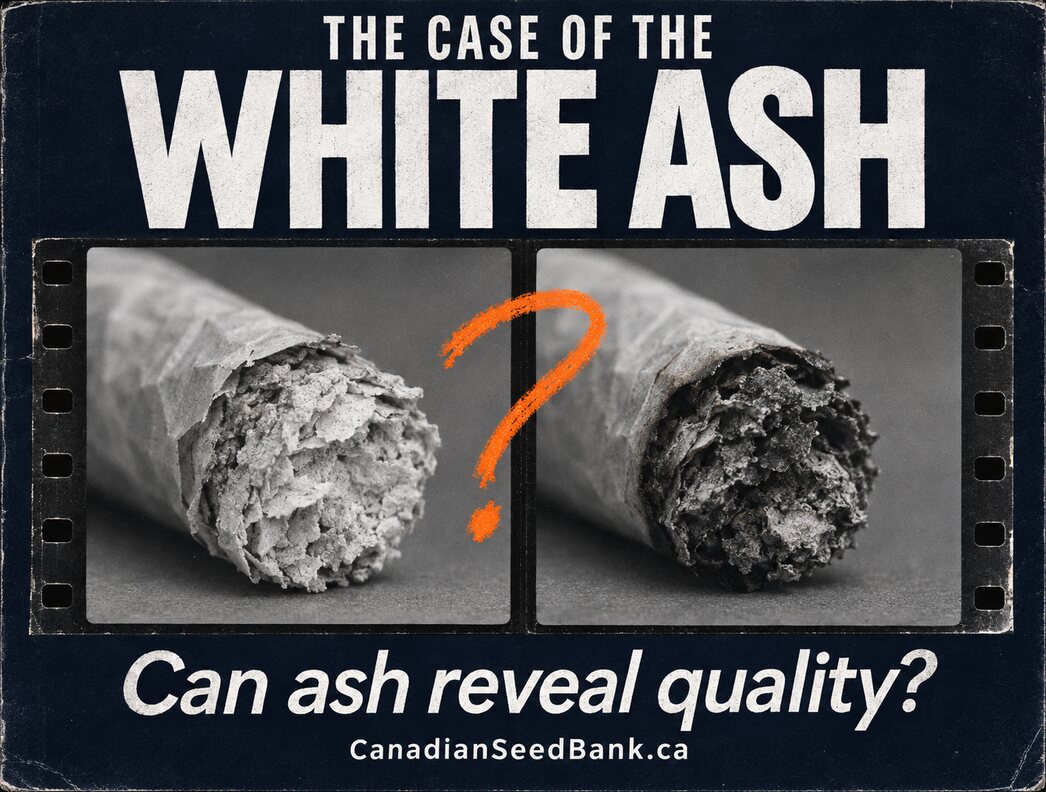
The Case of the White Ash
Can You Judge Cannabis by What Burns Away?
Imagine two photographs posted side by side. In the first, a neat column of pale ash clings to the end of a joint. In the second, the ash is dark and breaks unevenly. You know nothing about the flowers, the papers or the people who rolled them. Which grower did the better job?
If you picked the first, you know the rule. White ash means the cannabis was grown carefully, flushed properly and cured well. Black ash means somebody cut a corner. Versions of that advice have appeared in cannabis buying guides for years. It is an appealing test: free, immediate and available to anyone with eyes. Leafly
Now imagine finding out that both joints contained flower from the same jar. Would you still be comfortable judging the grower?
That is the problem with the white ash test. It asks a perfectly good observation, what colour is this ash?, to answer a much harder question: how was this plant treated months before it reached my hands? There are ways to investigate that second question. One of the most revealing experiments starts with something cannabis enthusiasts barely mention when they show off a beautiful burn: the paper.
The clue hiding in the rolling paper
In 1997, a researcher named V. Hampl presented an experiment on cigarette ash. The tobacco blend stayed the same. What changed was the paper wrapped around it. Hampl made papers containing different forms of calcium carbonate, a mineral filler, then compared the ash they produced. As the filler particles became smaller, the ash initially became whiter. Below a certain particle size, the trend reversed and the ash became greyer again. Same tobacco. Different paper. Visibly different result. CORESTA
This was a tobacco industry presentation, not a cannabis trial. It cannot tell us how much a particular hemp or rice paper changes the ash of a particular flower. Its value is simpler: it demonstrates a way for ash colour to change without a farmer doing anything differently. It also exposes an awkward wrinkle in the idea that pale ash means fewer minerals. In this experiment, a mineral in the wrapper helped determine how white the ash looked. CORESTA
Another tobacco study uncovered a detail especially relevant to photographs. With certain fillers, researchers observed lighter grey ash on the outside, where the paper had been, and darker ash inside, where the tobacco had been. A photograph of the intact tip and a photograph taken after breaking it open could therefore give different impressions of the same cigarette. Before anyone argues about what a colour means, it helps to agree on which part they are looking at. sciencedirect.com
Of course, paper cannot explain dark residue in a glass bowl. Nor does it have to. Finding one alternative explanation does not solve every burn. It does establish why an ash photograph, on its own, is a poor basis for reconstructing a plant’s history.
Does flushing leave a signature?
The strongest version of the white ash claim makes a specific prediction. If withholding added nutrients before harvest reliably produces paler ash, people who do not know which flower received which treatment should still see a difference afterward. Conveniently, somebody tried this.
In a trial by Rx Green Technologies, researchers divided 48 Cherry Diesel plants among four groups. One group continued receiving nutrients until harvest. For the others, the researchers stopped supplying nutrients 7, 10 or 14 days earlier. A blind panel later evaluated the cured flower for flavour, harshness and ash colour. The company reported no statistically significant effect of flush duration on any of those three outcomes.
Getting that result from a nutrient supplier deserves a raised eyebrow, and the scope deserves an equally close look. This was one company testing one cultivar in its own facility. A trial that fails to detect a difference cannot prove that no difference exists anywhere. What it can tell us is that even when the researchers knew precisely which plants had received which treatment, the familiar rule failed to deliver a reliable distinction in that trial. That is a substantial problem for anyone claiming to spot an unflushed crop from a picture. Rx Green
But the science gets more interesting than a tidy declaration that flushing does nothing. In a 2025 study published in HortScience, Clemson University researchers Michael Alden and James Faust examined two cannabis cultivars grown for CBD. As the period of nutrient restriction lengthened, concentrations of nitrogen, phosphorus and potassium in the flowers declined. So did the dry mass of the flowers. The researchers measured actual changes in the crop. They did not establish that a consumer could detect those changes by looking at ash. journals.ashs.org
Those findings can coexist. A grower can change the mineral composition of a flower without creating a visible signature that a stranger can reliably recognise. That missing link is where much of the argument happens. One person says, correctly, that plant nutrition matters. Another hears that claim as proof that black ash exposes poor nutrition. Between those two statements lies an experiment that still needs to be done.
What exactly does “clean” mean?
Ask three people what they mean by a clean burn. One might mean the joint stayed lit. Another might mean the smoke felt less harsh. The third might believe the flower was free of pesticide residues. They could spend an evening agreeing that white ash is desirable without realising they disagree about what it supposedly proves.
The first two people are describing experiences. Someone whose purchase repeatedly goes out or tastes unpleasant has every reason to be disappointed. They do not need a laboratory’s permission to dislike it. The leap comes when a disappointing experience becomes a confident explanation. “This batch kept going out” is useful feedback a producer can investigate. “Your grower left fertilizer in the flower” is a diagnosis for which the customer has supplied no independent evidence.
The third claim, about contaminants, raises a different question entirely. Health Canada’s pesticide testing requirements call for testing a representative sample from a lot or batch for specified active ingredients. That approach ties a result to a substance and an identifiable group of products. A photograph of ash identifies neither. If your concern is a particular residue, the relevant evidence is a test for that residue. White ash provides no such reassurance, and dark ash does not establish contamination.
Why experienced people can believe an unreliable rule
Suppose your favourite grower consistently produces flower you enjoy. You like its aroma, it burns the way you prefer, and the ash often looks pale. After a dozen purchases, white ash has become part of what a good experience looks like to you. There is nothing foolish about noticing that pattern. The mistake would be assuming you have discovered which part of the experience caused the others.
Consider how a disappointing purchase gets graded under the same rule. It tastes rough and leaves dark ash: another point for the theory. But what about flower that tastes excellent and leaves dark ash? Does that count as a point against the theory, or does the ash persuade you to revise your opinion of flower you enjoyed thirty seconds earlier?
That second possibility is worth sitting with. A quality test is supposed to help us decide whether something meets our standards. Once it starts persuading us to discount the very qualities we care about, the test has quietly become the standard. A grower could deliver the aroma and flavour you were looking for and lose the argument over the colour of what you were about to tap into an ashtray.
The experiment that would change the conversation
A convincing study would start by choosing one claim. “Good cannabis burns white” is too vague to test. “Observers can identify which samples received a particular nutrition treatment from the colour of their ash” is specific enough to get wrong. That is what makes it useful.
Researchers could begin with flower from the same batch, vary the paper alone and record how much the ash colour changes. Then they could reverse the comparison: hold the paper, flower moisture, packing and draw conditions steady while varying the growing treatment. Photograph the residue under fixed lighting, record whether the measurement comes from the surface or the interior, and ask observers who do not know the treatment to classify the samples. Finally, repeat the exercise with unfamiliar cultivars. A rule meant to guide customers should work on flower they have never seen before.
The most informative result would be the mistakes. How often would carefully documented flower produce dark ash and receive a failing grade? How often would pale ash earn praise for a cultivation practice the producer never used? It is easy to assemble a gallery of photographs that fit a rule. The photographs that look convincing and lead to the wrong answer tell you whether the rule is worth trusting.
So what should you make of a beautiful column of white ash? Enjoy it as one detail of the experience. If a flower smells distinctive, describe the aroma. If it burns unevenly, say what happened. If someone claims a particular growing practice made the difference, ask what they compared it with. Those observations give growers and other enthusiasts something more valuable than a verdict: information they can actually use.
Return to those two photographs. You can tell which ash is paler. You might even know which picture you prefer. But which grower did the better job?
The honest answer is still that you haven’t met the flower. You’ve only met the ash.