
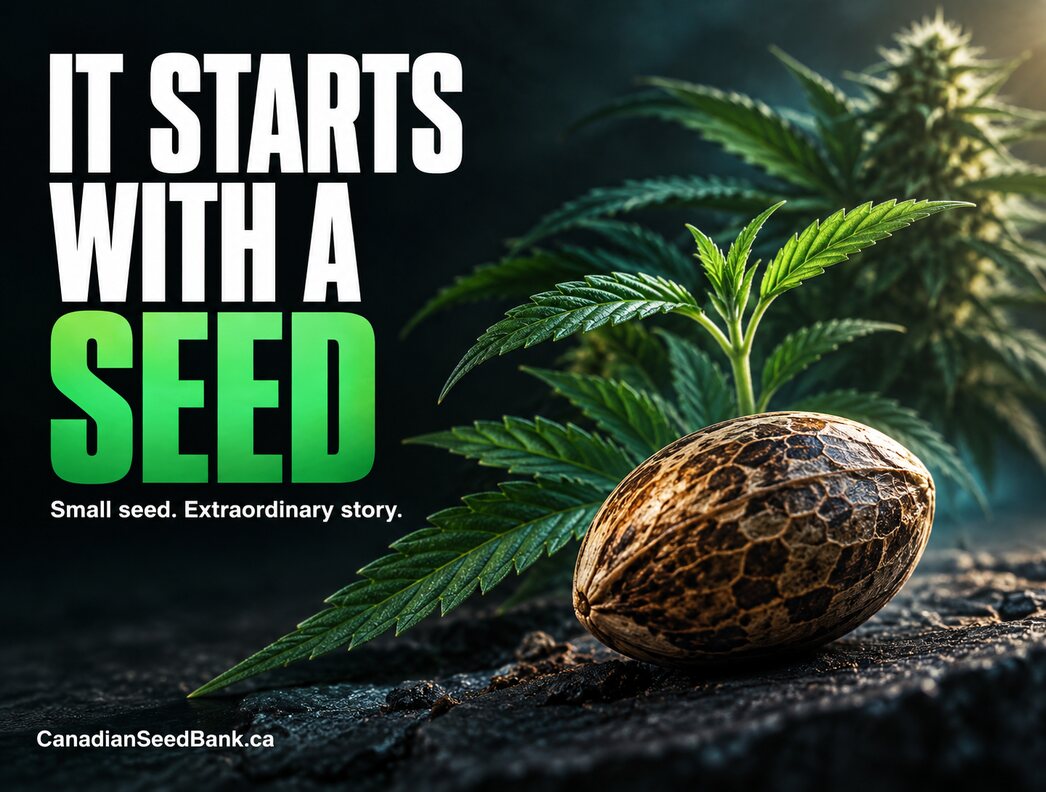
It Starts with a Seed
The Cannabis Journey Nobody Puts on the Packet
Picture a single cannabis seed resting in your palm.
It is smaller than you expected. Brown, patterned, almost ordinary. If you dropped it on the kitchen counter beside a few crumbs, you might have to look twice to find it.
Yet you have already imagined the plant.
You have pictured the leaves, the colours and the intricate flowers you have spent far too long admiring online. Somehow, all that possibility is connected to this tiny object.
Then another thought arrives.
What do I actually know about it?
You know a few variety names. You recognise the famous leaf. You have heard confident opinions from friends, strangers and at least one person whose entire explanation began with “trust me.”
Now you want something more satisfying.
You want to understand the plant for yourself.
The Adventure Begins with Too Many Open Tabs
At first, learning about cannabis seems straightforward.
You open a few articles. Then a few more. Before long, your browser looks like it is preparing a university dissertation.
One page says the most important thing is THC. Another talks about terpenes. Someone insists that purple flowers are superior. Someone else explains genetics using enough abbreviations to make you miss your original ignorance.
The photographs are gorgeous. The promises are enormous. The explanations do not always agree.
You start wondering whether everyone else received a handbook you somehow missed.
This is a familiar turning point in any new interest. The excitement is still there, but now it has company: the uncomfortable awareness of how much you do not know.
Fortunately, understanding cannabis does not begin with memorising everything.
It begins with asking a better question.
Look at What Is Actually in Your Hand
Set the claims aside for a moment and return to the seed.
Botanically, what people commonly call a cannabis seed is an achene, a small dry fruit containing a single seed. Inside is an embryo, including two embryonic leaves called cotyledons and a developing root structure called the radicle.
That little speck has architecture.
Researchers examining cannabis seed anatomy have documented these structures in detail. The protective exterior surrounds organised living tissue, rather than an empty shell waiting to become something. Research on cannabis seed anatomy.
You turn it slightly between your fingers.
Nothing about its appearance has changed, but it no longer seems quite so ordinary.
This is the first useful lesson: when the language gets overwhelming, return to something real. Look closely. Learn what it is. Build your understanding from there.
The Photograph Is a Possibility, Not a Promise
Your next challenge arrives in the form of a spectacular photograph.
The flower is impossibly handsome. Purple folds, amber hairs, sparkling resin. You catch yourself imagining an exact copy.
Here is where genetics adds a little humility to the adventure.
A seed carries inherited genetic information. In sexually produced offspring, that inheritance involves combinations of genetic material, rather than a simple photocopy of one parent.
The distinction is familiar outside the plant world. Human siblings can share parents without sharing the same face.
In plants, genotype refers to genetic makeup. Phenotype refers to observable characteristics, which arise through the interaction of that genetic makeup with development and environment.
Those words are useful because they separate what is inherited from what is expressed.
You do not need to memorise a textbook definition. Remember that a living organism has a range of biological possibilities. A photograph records one particular expression.
That makes the picture interesting evidence, while leaving room for variation.
The First Myth Falls Apart
Once you begin noticing those distinctions, some familiar claims start sounding different.
Take variety names.
They can carry history, identify breeding work and provide a shared vocabulary. But how reliably does a name identify the genetics or chemistry of every sample carrying it?
A 2021 study in Nature Plants examined cannabis samples and found that matching cultivar names did not consistently indicate matching genetic or chemical identities. The familiar indica and sativa labels also poorly captured the overall variation the researchers measured. Watts and colleagues, 2021.
You do not throw out every name you have learned.
Instead, you begin asking what supports it.
Who documented the ancestry? Does the description identify a particular source? Is the claim based on a measured sample, a breeder’s observations or a story repeated so often that nobody remembers where it started?
The questions feel small.
The change in your understanding is not.
You Meet the Temptation of the Easy Answer
Then someone gives you a shortcut.
“Just choose the strongest.”
It is appealing advice because it turns a complicated subject into a number. No uncertainty. No reading. Apparently, the whole mystery can be settled with a percentage.
But you have already started noticing more than numbers.
You are interested in appearance, ancestry and chemistry. You want to know why plants differ, not simply which description sounds most impressive.
Science rewards that curiosity.
In 2025, researchers published a cannabis pangenome assembled from 193 genomes representing 144 biological samples. A pangenome brings together genetic information from multiple individuals, helping researchers examine variation that a single reference cannot fully represent. Lynch and colleagues, 2025.
Even scientists studying cannabis at this scale are still uncovering its diversity.
Suddenly, expecting one number to explain the plant seems a little ambitious.
The Real Test Is Admitting What You Cannot Tell
There comes a moment when someone shows you another photograph.
“What do you think? Is that good?”
A few days earlier, you might have repeated something about colour, frost or a familiar name.
Now you pause.
You can describe what you see. You can appreciate the flower’s structure and appearance. You can explain why the image caught your attention.
You also know what you cannot establish from a photograph.
It cannot provide a laboratory measurement of cannabinoid concentration. It cannot verify a complete pedigree. It cannot tell you how someone will personally respond to the finished product.
So you answer honestly.
“It looks interesting. I would want to know more.”
That may sound less dramatic than an instant verdict, but it marks a genuine change.
You are beginning to separate observation from assumption.
Curiosity Starts Replacing the Pressure
The subject becomes more enjoyable after that.
You no longer feel obliged to have an opinion about every variety. You can encounter an unfamiliar term without pretending you already understand it.
A description becomes an invitation to investigate.
You notice whether a source explains its methods. You recognise the difference between a finding from one study and a claim about every cannabis plant. You start saving useful references instead of collecting confident slogans.
There is also more room for simple enjoyment.
You can admire an unusual leaf or the pattern on a seed without needing it to prove anything. You can appreciate a striking flower without declaring it superior to all the others.
The plant has become more interesting because you are allowing it to be complicated.
You Return to the Same Tiny Seed
Eventually, you find yourself looking at the seed again.
It has not grown larger. It has not acquired a label explaining its entire future. It still sits quietly in your palm.
But you see more now.
You recognise a protective structure surrounding an embryo. You understand that inheritance carries variation. You know that names and photographs provide pieces of information, and that useful questions help connect those pieces.
You have not become an expert overnight.
You have become something more valuable than an expert pretender: an interested person who knows how to keep learning.
The next conversation feels different. Someone repeats an impressive claim, and instead of accepting it immediately or dismissing it outright, you ask where it came from.
Someone admits they are confused, and you remember the browser full of tabs.
You know exactly where to begin.
“Let’s look at what we actually know.”
And there it is: the part of the journey nobody prints on the packet.
You started by wanting to know what a cannabis seed might become.
Along the way, you became a more thoughtful observer yourself.