
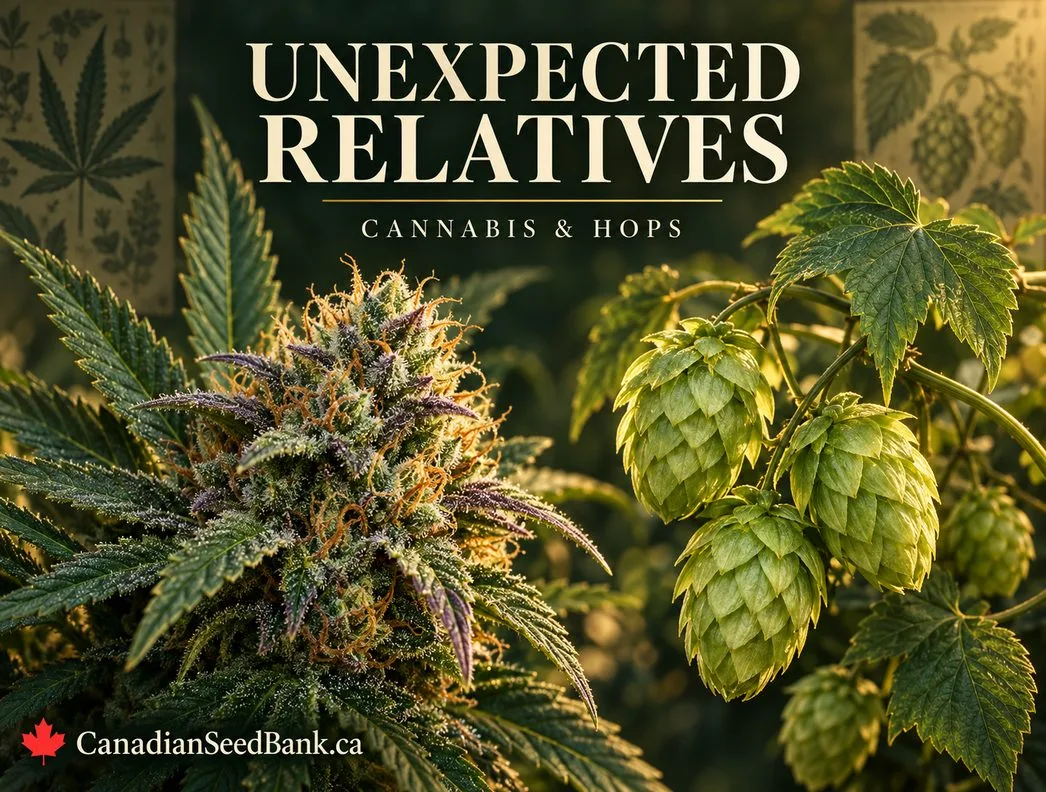
Unexpected Relatives
Cannabis, Hops and the Family Secret Millions of Years in the Making
Put a cannabis flower beside a hop cone and you might notice a certain family resemblance. Both have an intricate arrangement of small plant structures. Both have a reputation for distinctive aromas. Both have inspired people to spend extraordinary amounts of time discussing their favourite varieties.
The connection goes much deeper than enthusiastic conversation.
Cannabis and hops are close botanical relatives, sharing ancestry that stretches back millions of years. Their extended family even includes trees, making the family photograph considerably stranger than you might expect.
Following that relationship takes us from aromatic flowers to ancient pollen, then into DNA research that is changing our understanding of cannabis history.
It turns out the plant has a much longer backstory than any strain name could possibly contain.
Meet the Relatives
Cannabis belongs to the plant family Cannabaceae. So does Humulus, the genus that includes hops. Another member is Celtis, commonly known as hackberry.
At first glance, a tree, a hop plant and cannabis might seem like an unlikely group. Botanical relationships, however, are about ancestry. Relatives do not have to maintain the same appearance or lifestyle.
DNA evidence helped establish the broader family grouping, bringing together plants that older classification systems sometimes placed separately. Cannabis and hops occupy particularly close branches within that family. Research on cannabis classification and ancestry.
Think of a family reunion where one cousin became a brewer’s favourite, another became famous for cannabinoids and a more distant relative quietly became a tree.
Nature has never felt obliged to keep everyone on the same career path.
The Aromatic Family Resemblance
The connection becomes especially entertaining when you start looking at chemistry.
Hops contain aromatic compounds familiar to anyone who has explored cannabis terpenes, including myrcene, humulene and caryophyllene. Research published in BMC Plant Biology in 2023 examined hop genes and enzymes involved in terpene production, documenting considerable variation among the varieties studied. Chen and colleagues, 2023.
These compounds help explain why discussions of hops and cannabis sometimes sound surprisingly similar. Suddenly, conversations about plant aroma are sharing part of the same chemical vocabulary.
That does not mean the two plants smell identical or have interchangeable effects. A shared ingredient is only one part of a complex mixture.
Think about the difference between recognising a familiar musical instrument and hearing the same song. The instrument may be present in both performances, while everything around it changes the result.
Inside the Plant’s Perfume Workshop
Plants manufacture terpenes through biochemical processes involving enzymes called terpene synthases.
A 2017 study in PLOS One investigated these enzymes in cannabis, linking particular genes with the production of aromatic compounds. The researchers characterised enzymes associated with substances including myrcene, limonene and pinene. Booth and colleagues, 2017.
For an enthusiast, this adds a fascinating layer to a familiar experience. An aroma begins with biological instructions and chemical reactions long before anyone tries to describe it as citrusy, herbal or woody.
It also makes the relationship with hops more interesting. Scientists can investigate how related plants use their biochemical machinery to produce distinctive mixtures.
The scent is something you can notice immediately. The machinery behind it takes considerably more detective work.
That gap between an everyday observation and its hidden explanation is one reason plant science is so absorbing.
Ancient Pollen Has a Family Resemblance Too
Tracing cannabis into the distant past presents an unexpected problem: its pollen can be difficult to distinguish from hop pollen.
Some fossil pollen records therefore group the two together. Convenient for recording a discovery, perhaps, but less helpful when trying to work out which plant lived in a particular place.
In a 2019 study, researchers reviewed 155 fossil pollen studies from Asia. They used surrounding vegetation as an additional clue. Pollen associated with open steppe vegetation was interpreted as more consistent with cannabis, while woodland associations pointed towards hops.
Their analysis proposed the northeastern Tibetan Plateau as a possible centre of cannabis origin. It also drew on a molecular estimate placing the separation of cannabis and hops at approximately 28 million years ago. McPartland, Hegman and Long, 2019.
These are scientific reconstructions, with uncertainty attached. There was no conveniently labelled ancient flower waiting beside a date stamp.
The researchers had to assemble the story from surviving clues.
Origin and Domestication Are Different Chapters
Where a plant first evolved and where people began domesticating it are separate questions.
That distinction matters when reading headlines about the “birthplace” of cannabis. One article may concern events millions of years ago. Another may concern human activity thousands of years ago.
A 2021 study in Science Advances examined genomic data from 110 cannabis accessions collected from different parts of the world. Its analysis supported domestication in East Asia during the early Neolithic period.
The researchers also identified genetic signals associated with differences between hemp and drug varieties, including traits related to branching and the production of structural plant materials. Ren and colleagues, 2021.
The picture is of a plant whose history includes both natural evolution and human preferences.
People encountered biological variation, valued different characteristics and helped shape the plants that followed. Modern cannabis carries traces of that long relationship, even when its branding feels thoroughly contemporary.
The Family Album Just Got Much Bigger
Reading one cannabis genome gives scientists a detailed reference. Comparing many genomes reveals variation that a single reference cannot capture.
That broader collection is called a pangenome.
In 2025, research published in Nature presented a cannabis pangenome assembled from 193 genomes representing 144 biological samples. The collection included 181 newly generated genomes and 12 previously released ones. Lynch and colleagues, 2025.
The difference between the number of genomes and plants reflects how researchers can separately represent inherited chromosome sets. The project goes beyond treating one plant as a complete stand in for the species.
For enthusiasts, the idea is easy to appreciate. Imagine trying to understand an entire extended family using one person’s photograph. You would learn something, but you would miss a great deal.
A larger genetic collection helps scientists ask better questions about what cannabis plants share and where they differ.
What This Means When You Look at a Variety
A modern variety name usually points towards a relatively recent story: particular parents, a breeder’s work or a memorable characteristic.
The deeper family history supplies another perspective.
A citrus note, an unusual leaf or a distinctive flower belongs to a living organism with layers of ancestry. Some connections concern recent breeding. Others reach far beyond the existence of agriculture.
That makes clear documentation especially valuable. A stated pedigree, an observed characteristic and a genetic analysis each tell you something different.
You do not need to become a geneticist to enjoy the distinction. It simply makes browsing varieties more interesting. Instead of seeing a collection of names and photographs, you begin seeing questions about inheritance, variation and the evidence behind a description.
There is plenty to appreciate before anyone mentions a potency percentage.
A Familiar Plant with an Unfamiliar Past
The cannabis and hops connection is a good reminder that plants rarely fit neatly into the categories people build around them.
We discuss one through brewing, another through fibre, seeds, cannabinoids or gardening. Evolution tells a story that crosses those conversational boundaries.
The research also works at wonderfully different scales. A pollen grain can help reconstruct an ancient landscape. An enzyme can explain part of an aroma. A collection of genomes can reveal variation hidden behind familiar appearances.
Each gives us another way to understand the same plant.
The next time you look closely at a cannabis flower, imagine the family album behind it: aromatic relatives, ancient landscapes and countless generations that came before its modern name.
And somewhere on a neighbouring branch of that family tree, hops has been doing its own thing all along.