
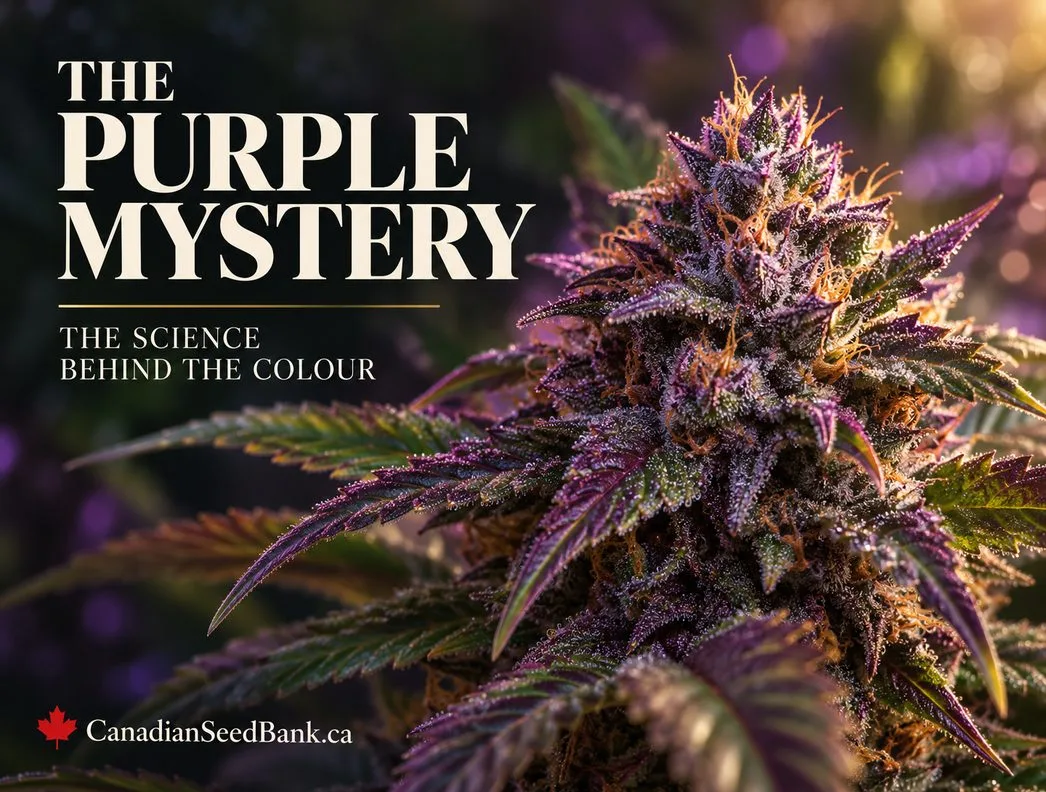
The Purple Mystery
Why Some Cannabis Turns Purple and What the Colour Really Means
Some cannabis plants seem determined to steal the spotlight. While their neighbours stay green, they show off shades of plum, burgundy and violet. A few become so dark they almost look black, with sparkling trichomes standing out against the colour like frost on a blackberry.
It is enough to make anyone pause for a closer look.
But what is happening inside that plant? Is purple cannabis stronger? Is the colour inherited? And why can two plants with similar backgrounds look so different?
The answers lead into a world of natural pigments, genetic instructions and microscopic chemistry. The same broad family of compounds that colours berries and flowers also helps create some of cannabis’s most striking appearances.
Once you understand the science, a purple flower becomes even more interesting. That beautiful exterior is showing you a small part of the plant’s inner workings.
Meet the Plant’s Colour Department
Much of the purple colouring in cannabis comes from anthocyanins, a group of pigments within the flavonoid family. Across the plant kingdom, anthocyanins contribute red, purple and blue shades to leaves, flowers and fruits.
If the name sounds unfamiliar, the colours certainly are not. You have encountered this pigment family in foods such as berries, grapes and red cabbage.
Inside plant cells, anthocyanins accumulate in compartments called vacuoles. Think of these as tiny storage spaces, although their chemistry is considerably more sophisticated than a cupboard full of paint.
The shade we see depends on the pigments’ molecular structure, their surroundings and interactions with other compounds. Producing pigment is only part of the job. Plants also have to transport and stabilise it, while breakdown can change how much remains.
In other words, a purple leaf is the finished appearance of several processes happening together. Research on anthocyanin storage and stability.
Scientists Have Put a Name to the Purple
It is one thing to say that a flower contains purple pigment. Identifying the actual compound is where the detective work begins.
In a 2023 study published in Antioxidants, researchers identified cyanidin 3 rutinoside, also known as keracyanin, as the major anthocyanin in the cannabis material they examined. Their work helped connect visible colour with specific chemistry. Bassolino and colleagues, 2023.
Keracyanin probably will not become a household word anytime soon. Still, finding it matters because it moves the explanation beyond appearance and into something scientists can identify and measure.
There is an important boundary here: the researchers examined particular plant material. Their findings do not mean every purple cannabis variety contains exactly the same pigment mixture or concentration.
That is what makes this subject worth following. A colour familiar to enthusiasts is still giving scientists new questions to investigate.
Why Does One Plant Go Purple While Another Stays Green?
Imagine a group photograph where everyone received the same invitation but arrived wearing something different. Cannabis pigmentation can create a similar impression.
The explanation involves genetics and how genetic instructions are expressed.
A 2024 study in Plant Direct investigated four differently pigmented cannabis varieties. Researchers examined anthocyanins and related compounds, along with genes associated with their production. Several genes showed strong relationships with anthocyanin accumulation in the leaves. Gagalova and colleagues, 2024.
Pigmentation involves a sequence of biological steps. Different enzymes help carry out those steps, while regulatory systems influence their activity.
The study also provides a useful reminder to read the details. It examined leaf pigmentation, which does not automatically explain every colour pattern in cannabis flowers.
A plant described simply as “purple” may have a much more specific story behind it. Where the colour appears, how it is distributed and how consistently it is documented all make that story more informative.
Is the Plant Just Showing Off?
As tempting as that explanation might be, plants have their own reasons for producing pigments.
Across many species, scientists have investigated anthocyanins for their roles in responses to environmental stress. One area of interest is protection from excessive light.
Depending on where they accumulate, these pigments can intercept some incoming light before it reaches sensitive photosynthetic structures. A 2025 review describes anthocyanins among the mechanisms involved in plant responses to light stress. Their contribution depends on the plant and the circumstances. Research on plant responses to light stress.
That gives a colourful leaf another dimension. Something we admire for its appearance may also participate in the plant’s response to its surroundings.
It does not follow that the darkest plant wins a prize for health or resilience. Biology rarely hands out answers that neatly.
Purple is an interesting trait to understand, rather than a universal score for how well a plant is doing.
Purple Does Not Come with a Potency Certificate
A dark flower covered in sparkling resin makes a powerful first impression. It is easy to look at it and assume everything about it must be intense.
But the colour and the resin tell different stories.
Cannabis glandular trichomes are specialised structures involved in producing and storing cannabinoids and terpenes. Research in The Plant Journal examined their structure and chemistry as flowers developed, revealing substantial differences beneath that familiar frosted appearance. Research on cannabis glandular trichomes.
Anthocyanin pigmentation is a separate feature. Looking at a purple surface does not reveal its THC concentration.
It cannot establish the aroma, either, or predict someone’s individual experience. Those questions require different information.
There is nothing wrong with appreciating an unusually beautiful specimen. The trick is to enjoy the appearance without quietly turning it into a laboratory report.
A plant can be visually spectacular while still leaving plenty of questions unanswered.
Your Camera Is Not a Chemistry Lab
Anyone who enjoys plant photography knows how captivating a close view can be. Veins, colour gradients and tiny surface structures suddenly become the main event.
Scientists are interested in those visual details too, but translating an image into a chemical measurement takes careful work.
A study published in Frontiers in Plant Science investigated using image analysis to estimate anthocyanin concentrations in lettuce. The researchers compared image information with measured pigment content to assess the relationship. Kim and colleagues, 2023.
The study concerns lettuce, so its findings are not a ready made cannabis test. What it illustrates is the gap between observing a colour and reliably measuring what creates it.
For an enthusiast, photographs remain wonderful records of appearance. They can reveal patterns worth discussing and details worth investigating.
They simply need supporting evidence before being asked to prove chemical composition or other qualities that are invisible to the camera.
The Details Worth Looking At
Once you know the basics, purple cannabis gives you much more to notice than a single dramatic shade.
Is the colour concentrated in the leaves or visible in floral tissues? Does it form a broad wash of violet, a burgundy edge or a patchwork against green? Does a variety description explain the pictured specimen, or make a broader claim about the variety?
These are useful questions because they turn a quick glance into a closer look.
They also make conversations about cannabis more enjoyable. “That looks amazing” can become “What part of the plant is actually coloured?” or “What evidence explains that pattern?”
There is no need to memorise a list of enzymes to take an interest in the answer. Curiosity is enough to get started.
And the subtle specimens deserve attention too. A faint purple margin can raise just as interesting a question as a flower that looks dipped in plum juice.
A Little Colour, a Much Bigger Story
Part of the fascination with cannabis is how much detail appears when you slow down and look. A plant that first seems simply green or purple gradually reveals textures, patterns and differences that a variety name cannot fully describe.
Pigmentation is a particularly inviting way into that world because the evidence is right there in front of you, even when the explanation requires a microscope or laboratory.
Scientists are steadily connecting visible colours with the compounds and genetic activity behind them. Each discovery adds detail without making the plant any less remarkable.
Next time a violet flower catches your attention, enjoy the spectacle. Then take another look.
Behind that beautiful colour is a plant quietly carrying out some very impressive chemistry.