
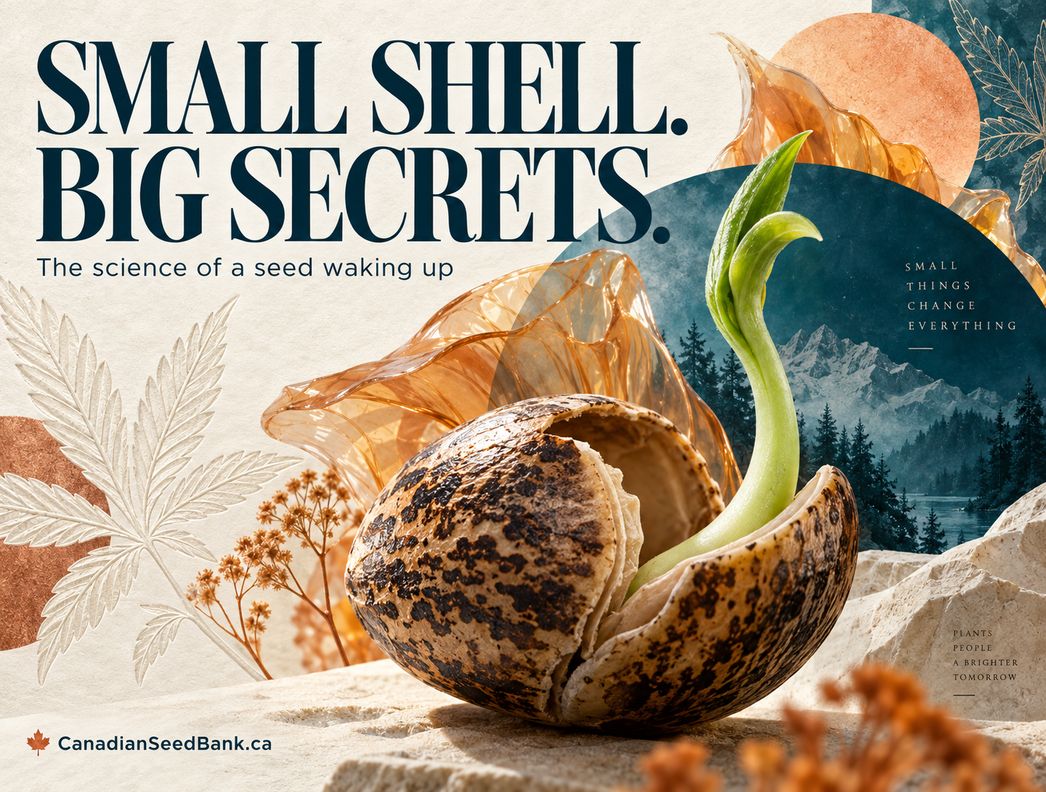
Small Shell, Big Secrets
What Really Happens When a Seed Wakes Up
A seed is very good at looking unimpressive. It sits there, apparently doing nothing, while people project entire futures onto it. We imagine leaves, branches, flowers, forests. The seed offers no comment. For something carrying so much expectation, it has an admirably restrained public relations department.
Its ordinary appearance conceals an extraordinary biological arrangement. A seed allows a plant’s next generation to exist before it begins living independently. Growth can pause. Development can resume. Between those states lies germination, one of the most consequential transitions in the plant world.
For readers interested in cannabis, understanding that wider botanical story provides useful perspective. Seeds belong to biology before they belong to a catalogue. Their behaviour reflects inherited characteristics, developmental history, and processes that cannot be reduced to a reassuring slogan. The science is more interesting than the shortcuts, and considerably better at explaining why nature rarely operates like an appliance.
The plant is already in there
A seed does not manufacture a plant from nothing when it germinates. It contains an embryo, the young plant formed during seed development. Protective tissues surround it, and stored resources support its early development. The details differ across plant groups, but the basic achievement is remarkable: living tissue packaged for a period between generations.
Germination describes the resumption of development leading to the emergence of the embryonic root, or radicle. That is distinct from the later process of becoming an established seedling. The first visible breakthrough matters, but it is a beginning rather than a completed transformation. These distinctions are central to J. Derek Bewley’s influential review of seed germination, published while he was at the University of Guelph. Seed Germination and Dormancy.
The distinction is easy to appreciate outside botany. Opening a restaurant and running a successful restaurant are related achievements, but nobody would sensibly confuse the two. Biology also has milestones. Treating the first milestone as the entire story makes later developments harder to understand.
Waiting can be a survival strategy
We tend to interpret delay as a problem. Seeds complicate that assumption. In seed science, dormancy describes a condition in which a viable seed does not germinate even when the external conditions would otherwise permit it. Dormancy is therefore different from simply being unable to proceed because the surrounding environment is unsuitable.
Researchers distinguish several kinds of dormancy, involving features such as physical barriers, embryo development, and physiological regulation. These are not interchangeable explanations. The influential work of William Finch Savage and Gerhard Leubner Metzger describes dormancy as part of the plant’s relationship with its environment, helping determine when germination occurs. Seed dormancy and the control of germination.
The broader idea changes the way we read a landscape. A patch of apparently empty ground need not represent an absence of plant life. Some of its biological future may simply be out of sight. The visible season is only one part of the story.
It also challenges our fondness for speed. Human deadlines are excellent tools for arranging meetings and rather poor explanations of evolution. A process can be slow for reasons that make sense to a plant, even when they are inconvenient to an observer.
A chemical conversation beneath the surface
Seeds do not make conscious decisions, although the language of waking and waiting makes it tempting to imagine otherwise. Their developmental changes involve chemical signalling and the regulation of genes. Behind an apparently simple event sits an intricate system of controls.
Two important groups of plant hormones are abscisic acid and gibberellins. Broadly, abscisic acid is associated with the establishment and maintenance of dormancy, while gibberellins help promote the transition towards germination. Their activities interact with other signals rather than operating as isolated switches. Researchers studying these relationships describe a network, not a single master button. Research on hormonal regulation of dormancy and germination.
That difference matters when science reaches popular culture. A complicated biological relationship can become a cartoon remarkably quickly: this chemical means stop, that one means go, and the rest apparently takes care of itself. Useful introductions simplify. Good explanations also tell us where the simplification ends.
The more closely researchers examine a seed, the less it resembles a tiny machine with one instruction. It looks instead like a living system negotiating several demands at once. That is a more demanding explanation, but also a far more satisfying one.
Before growth comes repair
One of the most surprising parts of seed science concerns maintenance. The ability to remain alive does not mean that a seed escapes deterioration. Biological molecules can accumulate damage, and the transition towards active growth brings a need to address it.
In a 2022 study of Arabidopsis thaliana, researchers examined how seeds respond to DNA damage. They found that genome maintenance mechanisms, including DNA repair and controls on the cell cycle, help protect the developing plant. The study also showed that seeds and seedlings respond differently to damage. This was research on a model plant, not a test of cannabis germination methods. The original study in PNAS.
The finding gives an apparently quiet interval a different meaning. A lack of visible movement does not necessarily imply a lack of biological activity. Some of the important work is happening below the scale at which our eyes can follow it.
It is a useful antidote to dramatic photography. A picture can capture a root emerging through a seed covering. It cannot, by itself, show the molecular work that made that moment possible. The most photogenic part of the event is not necessarily the most complicated.
The ancient seeds that interrupted the calendar
Some seeds have demonstrated a capacity for survival that sounds almost fictional. In a 2020 study, Sarah Sallon and colleagues reported the germination of ancient date palm seeds recovered from archaeological sites in the Judean desert. Radiocarbon evidence placed the material roughly two millennia in the past. Genetic analysis offered information about the historical date palms and their relationships with other populations. The original date palm research.
This is the sort of result that deserves an astonished pause. A living connection had crossed an interval longer than the history of many modern countries. Archaeology and plant biology had met inside something small enough to hold between two fingers.
Yet the achievement is an exceptional finding about particular material. It does not establish a universal lifespan for seeds, and it should not be converted into a promise about unrelated species. The distinction preserves the wonder rather than diminishing it. An extraordinary exception becomes less interesting when it is carelessly presented as an ordinary expectation.
Why a seed bank is more than a vault
The phrase seed bank invites an image of shelves, containers, and a satisfyingly heavy door. Those things may be involved, but the scientific work extends well beyond keeping a collection in one place.
Kew’s description of its seed collection highlights identification, collection records, viability, longevity, and the biological difficulties associated with different species. It also identifies exceptional species that cannot be conserved through conventional seed banking, including those whose seeds do not tolerate drying. Preserving plant diversity therefore requires knowledge of the material, not simply space for it. Kew’s seed collection programme.
This is an important distinction between possessing an object and understanding what it represents. A museum collection loses much of its value when its labels disappear. A scientific collection also depends on the information attached to it: identity, origin, history, and the limits of what is known.
For a publication such as Canadian Seed Bank Blog, that is an especially useful perspective. The fascination lies in the relationship between living material and reliable information. A seed can be small without the responsibility of describing it being small as well.
A better kind of curiosity
Perhaps the most valuable change is to replace the search for one universal secret with an interest in better questions. What process is being described? Which species was studied? What did researchers actually measure? Does a striking photograph show the same thing as the claim attached to it?
Those questions make seed science accessible without pretending it is simple. They also protect the difference between a finding, an interpretation, and a sales pitch. All three can be written confidently. Only one necessarily comes with an experiment behind it.
Even the word success deserves a second look. An account might be discussing the first visible root, the later survival of a seedling, or the preservation of an entire collection. Those are different stories. Recognising which story a researcher is telling makes the result easier to appreciate and much harder to accidentally exaggerate.
A seed’s first visible root is a modest sight. No fanfare, no announcement, no attempt to go viral. Yet behind it sits a remarkable story of development, signalling, survival, and repair. The closer we look, the more impressive that small beginning becomes.