
The Cannabis Time Machine
What Archaeology Can Actually Tell Us
Ancient plant remains and chemical traces are rewriting a familiar history. The best discoveries are more interesting than the myths.
A wooden vessel can outlive the ceremony that gave it meaning. The people disappear. Their words are lost. The vessel remains, carrying traces too small to see and questions too large to answer with a glance.
For archaeologists investigating cannabis, that imbalance is the beginning of the work. A residue may help identify a plant. A burial may establish a context. Neither arrives with an explanation of precisely what someone believed, intended or experienced.
This is what makes the subject so compelling. Cannabis history is often told through sweeping claims about ancient wisdom and uninterrupted tradition. Archaeology offers something more demanding: individual finds, particular places and evidence that must survive close examination.
By 2025, several discoveries have made the ancient relationship between people and cannabis considerably more tangible. They have also shown why the oldest evidence for a practice is not necessarily evidence of its beginning. The past rarely preserves the moment anyone did something for the first time. It preserves whatever happened to survive.
Smoke in the mountains
One of the most striking studies appeared in Science Advances in 2019. Researchers examined residues from wooden braziers at Jirzankal Cemetery in the eastern Pamirs, a burial site dating to approximately 500 BCE. Chemical evidence supported the interpretation that cannabis had been burned during mortuary ceremonies. Ren and colleagues, 2019 (https://pmc.ncbi.nlm.nih.gov/articles/PMC6561734/)
The finding was powerful because it connected material, chemistry and context. It was not merely a seed found near a settlement or an ambiguous reference in a text. The evidence linked cannabis with objects used in a funerary setting, giving researchers a firmer basis for discussing ritual use.
It did not provide a modern potency label. The authors interpreted the chemical pattern as evidence for cannabis with elevated psychoactive potential, but ancient residues cannot be read as if they were fresh commercial samples. Degradation and preservation complicate the comparison.
The distinction is worth making because a spectacular discovery can become less accurate as its headline becomes more entertaining. “Evidence for ritual cannabis burning” is already remarkable. It does not need to become “ancient people used exactly the same cannabis as modern consumers.”
The study gives us access to a practice. It does not give us access to every sensation or intention within it.
The evidence survives in different forms
An earlier investigation, published in 2008, examined cannabis recovered from a burial at the Yanghai tombs near Turpan in what is now western China. Researchers used botanical, chemical and genetic evidence to investigate the preserved material. They interpreted the find as cannabis likely valued for properties beyond the simple production of fibre. Russo and colleagues, 2008 (https://pmc.ncbi.nlm.nih.gov/articles/PMC2639026/)
The paper discussed possible medicinal, psychoactive or divinatory uses. Those possibilities should retain the uncertainty that makes them hypotheses. The plant’s presence and characteristics are evidence. A detailed reconstruction of the deceased person’s profession or private beliefs requires additional interpretation.
This is one of the most useful habits a reader can bring to archaeological stories: distinguish the object from the explanation attached to it. Both matter, but they carry different degrees of certainty.
A cache of plant material can demonstrate deliberate possession more convincingly than it can reveal the exact reason for possession. A burial association may suggest importance without identifying a single universal meaning. The person who placed the material there did not anticipate having to satisfy a modern headline writer.
That limitation does not make the discovery disappointing. It makes the questions sharper. Why was this plant selected? Why was it placed here? Which explanations fit the physical evidence, and which depend mainly on assumptions imported from elsewhere?
A different setting, a different story
In 2020, Eran Arie, Baruch Rosen and Dvory Namdar reported chemical analysis of dark residues on two limestone altars from the Judahite shrine at Tel Arad. Their study identified evidence of cannabis on the smaller altar and frankincense on the larger one. The shrine context belongs to the eighth century BCE. Arie, Rosen and Namdar, 2020 (https://cris.haifa.ac.il/en/publications/cannabis-and-frankincense-at-the-judahite-shrine-of-arad/)
The researchers interpreted the cannabis as part of ritual activity. That is an important finding about a specific site. It does not automatically establish that every shrine in the region used cannabis, or settle debates about every ancient plant name that modern readers would like to identify.
The temptation to generalise is understandable. A small piece of evidence can appear to unlock an enormous historical argument. But the soundest interpretation begins with the scale of the discovery itself: particular residues, particular objects and a particular archaeological setting.
The broader significance can then be explored without pretending the evidence is broader than it is. Together, the Pamir and Arad studies complicate any single story about ancient cannabis. They place the plant in different regions and ritual environments. They invite questions about movement, exchange and local practice, while resisting the idea that one modern category can neatly contain every historical use.
A seed does not explain itself
Cannabis could offer people several useful things. Fibre, food and chemically active material are different possibilities, and the archaeological evidence for one should not be casually converted into proof of another.
A seed might indicate the presence of the plant. Depending on its context, it could contribute to an argument about food, cultivation, trade or deposition. It does not independently demonstrate intoxication. Likewise, evidence of hemp fibre does not establish that the people who made an object also used cannabis in ceremonies.
This is a general principle of archaeological reasoning: objects become informative through their relationships. Where was the material found? What else was present? Was it burned, stored, woven or scattered? Does the interpretation fit several lines of evidence, or rely on one suggestive detail?
Imagine discovering a modern coffee bean centuries from now. Its presence would not tell a future researcher whether it came from a café, a kitchen, a warehouse or someone’s pocket. The bean would be real evidence, but its meaning would depend on the setting. Ancient cannabis deserves the same patience.
That patience is especially necessary when a plant’s modern reputation is so strong. The reader already has associations before the first excavation detail appears. Good archaeology must prevent those associations from doing the work of the evidence.
Dating adds another layer. A date assigned to a burial context and a date measured directly from a particular piece of plant material answer related but different questions. Researchers must explain how an object is connected to the period being discussed. Later disturbance or material introduced from elsewhere can complicate an otherwise attractive account. For a reader, the useful habit is to ask what was dated and how it relates to the claimed activity. An impressive age is only as informative as the connection between that age and the evidence.
Genetics opens another window
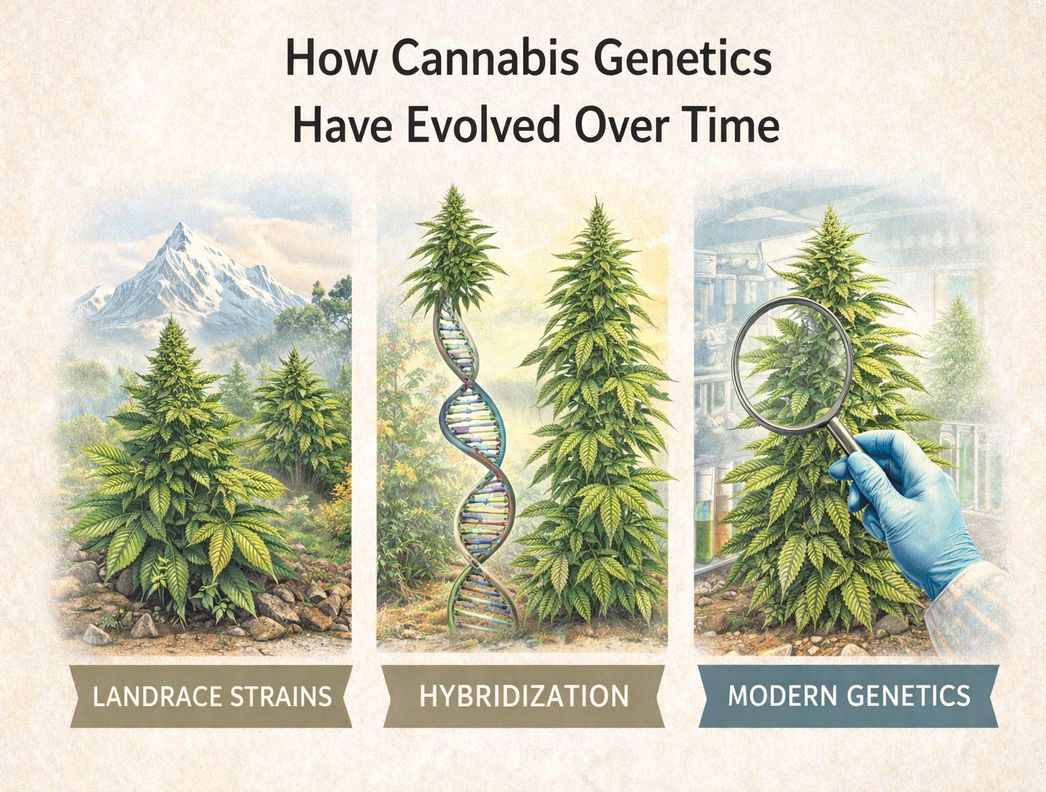
Physical remains are not the only source of historical information. A 2021 study used genome data from cannabis accessions to investigate domestication history. Its analysis supported an early domestication history in East Asia and explored the later differentiation of populations associated with different uses. Ren and colleagues, 2021 (https://www.science.org/doi/10.1126/sciadv.abg2286)
Such work uses present genetic patterns and analytical models to investigate past relationships. It is not the same as excavating a dated field or recovering a written account of a particular cultivation decision. The conclusions depend on the samples, methods and assumptions used.
The strength lies in combining approaches. Archaeology supplies objects and contexts. Genetics can investigate relationships and population histories. Chemistry can identify traces that the eye cannot recognise. Agreement among different kinds of evidence can strengthen an interpretation; disagreement can reveal where a familiar story needs revision.
This makes cannabis history an active investigation rather than a finished timeline. New techniques may allow an old museum collection to answer questions that its original excavators could not ask. A previously unremarkable residue can become informative when researchers develop a way to analyse it.
The time machine, in other words, is partly technological. The past has not changed. Our ability to interrogate what remains has.
The problem with “the oldest”
Superlatives are efficient. They turn an intricate discovery into a phrase that travels. The oldest use. The first ritual. The original medicine.
But these claims require unusually careful boundaries. The earliest surviving evidence of a practice is not necessarily the earliest instance of it. A discovery may be the earliest directly dated chemical evidence in a particular context, while older indirect evidence exists elsewhere. Removing those qualifications changes the claim.
There is also an unevenness in what survives. Some environments preserve organic material exceptionally well. Others destroy it. Some places have been intensively excavated and studied; others have not. The map of discoveries therefore reflects preservation and research as well as ancient behaviour.
For readers, that means a newly identified early example should expand the story rather than close it. Another find may alter the chronology. A revised interpretation may narrow what an object can support. Neither development means archaeology has failed. It means the account is responding to evidence.
The same discipline prevents ancient use from becoming a shortcut to modern medical claims. A material’s role in a burial or shrine tells us something about human history. It does not establish that a contemporary preparation treats a contemporary diagnosis. Historical significance and clinical effectiveness must be investigated separately.
What survives across these discoveries is something more compelling than a claim that ancient people already knew everything. They knew their own worlds, worked with the materials available to them and gave plants meanings that were embedded in particular lives and communities. In 2025, the best cannabis history honours that distance. It can recognise familiarity without pretending the past was a version of the present wearing different clothes.
The wooden vessel remains. The residue offers a clue. The most interesting story begins when we resist filling every silence.