
Cannabis in Ancient Civilizations
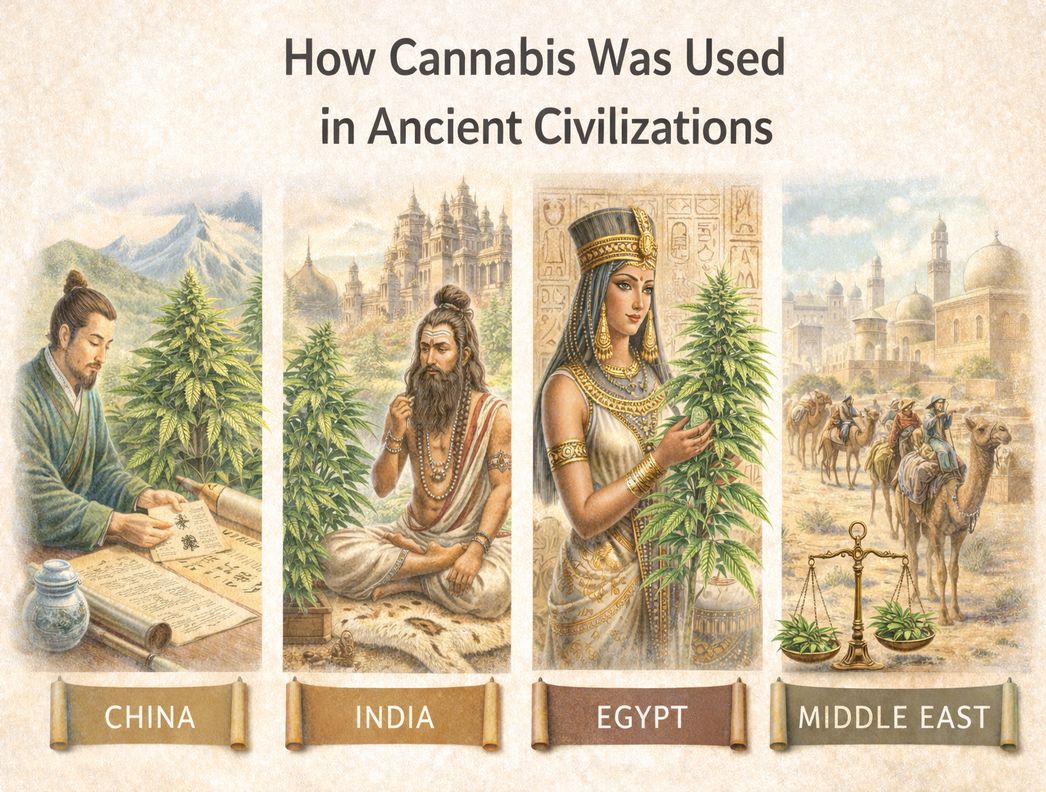
How Cannabis Was Used in Ancient Civilizations
Long before cannabis became a topic
of modern discussion, it was an integral part of daily life in many
ancient civilizations. Across Asia, Africa, and the Middle East,
cannabis was cultivated and valued for its versatility; used in
medicine, textiles, rituals, and trade.
Exploring these early uses
reveals how deeply cannabis is woven into human history and why it has
endured for thousands of years.
Ancient China: Medicine, Fiber, and Innovation
China is widely regarded as one of the earliest regions to cultivate cannabis. Archaeological evidence suggests cannabis was grown as early as 3000 BCE, primarily for its strong fibers. Hemp was essential for making rope, clothing, fishing nets, and early forms of paper -- innovations that supported trade, communication, and agriculture.
Cannabis also played a role in traditional Chinese medicine. Ancient texts attributed to Emperor Shen Nong reference the plant as part of early herbal practices. Cannabis preparations were documented for a variety of traditional applications, reflecting a sophisticated understanding of plants and their properties. In China, cannabis was valued not for a single purpose, but for its practicality -- serving both industrial and medicinal roles in a rapidly advancing civilization.
Ancient India: Spirituality and Ayurvedic Tradition
In India, cannabis held a unique dual role as both a medicinal plant and a spiritual substance. References to cannabis appear in ancient sacred texts such as the Atharva Veda, where it is described as one of the sacred plants of the earth.
Within Ayurvedic traditions, cannabis was incorporated into herbal formulations and consumed in regulated forms. It was also used in religious ceremonies and rituals, particularly those associated with spiritual introspection and devotion. Cannabis in India was deeply connected to philosophy, ritual, and balance; used thoughtfully within cultural and spiritual frameworks rather than as a casual substance.
Ancient Egypt: Medicine and Ritual Use
Evidence of cannabis use in ancient Egypt appears in medical papyri dating back over 3,500 years. These texts describe plant-based remedies used by physicians of the time, reflecting an advanced medical system that relied heavily on natural ingredients.
Cannabis is believed to have been included in certain medicinal preparations, possibly used in topical or oral forms. Some historians also suggest cannabis may have had ritual significance, given Egypt’s strong connection between medicine, religion, and the afterlife. Egypt’s use of cannabis highlights its role within structured medical knowledge rather than informal or recreational use.
The Middle East: Trade, Textiles, and Cultural Exchange
The Middle East played a crucial role in the spread of cannabis through ancient trade routes. Positioned between Asia, Africa, and Europe, the region served as a hub for exchanging goods, knowledge, and agricultural practices.
Cannabis was widely cultivated for hemp fiber, which was essential for making ropes, sails, and textiles: materials critical for transportation and commerce. As trade expanded, cannabis seeds and cultivation knowledge traveled along routes such as the Silk Road, contributing to the plant’s global distribution. In some Middle Eastern cultures, cannabis also held social and ceremonial importance, though its primary value remained agricultural and industrial.
Cannabis and Ancient Trade Routes
One of the most significant factors in cannabis’s global spread was trade. Merchants transported seeds and fibers across continents, introducing the plant to new environments and cultures. As cannabis adapted to different climates, regional varieties emerged; laying the foundation for the diverse genetics known today. These early trade networks transformed cannabis from a regional crop into a global agricultural staple, long before modern breeding techniques existed.
A Plant Rooted in Civilization
Across ancient China, India, Egypt, and the Middle East, cannabis was respected as a multipurpose plant; supporting medicine, industry, spirituality, and trade. Its widespread use was not accidental; it reflected careful observation, cultural integration, and practical necessity.
Understanding cannabis’s role in ancient civilizations provides important context for its continued relevance today. Far from being a modern phenomenon, cannabis is a plant with a long, complex, and deeply human history.