
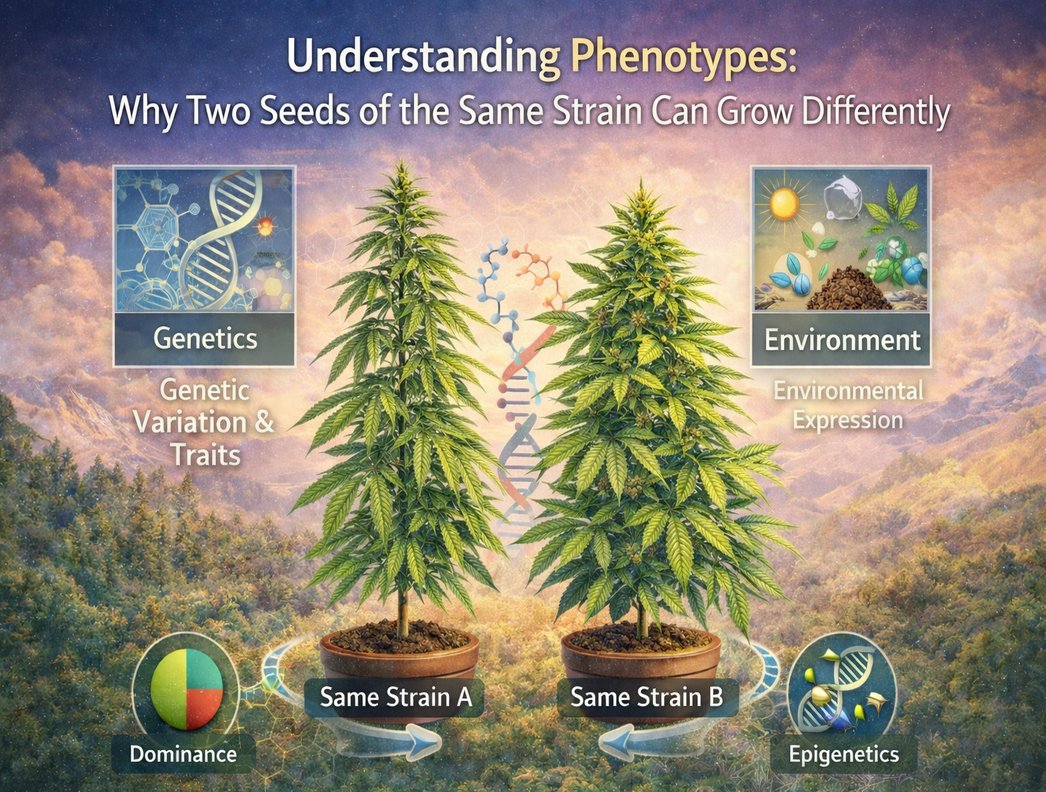
Understanding Phenotypes
Why Two Seeds of the Same Strain Can Grow Differently
One of the most fascinating aspects of cannabis genetics is this: You can plant two seeds from the same strain, grown side-by-side, under identical conditions, and still see noticeable differences.
Why does this happen?
The answer lies in phenotypes, genetic variation, dominant traits, and environmental expression. Understanding this concept is essential for growers, breeders, and anyone interested in the science behind cannabis development.
Genotype vs Phenotype: The Foundation
To understand phenotypes, we first need to separate two key terms:
Genotype
The plant’s genetic code: its DNA blueprint inherited from parent plants.
Phenotype
How those genes actually express themselves physically. Think of genotype as the recipe, and phenotype as the finished dish. Even when seeds come from the same strain, each seed carries a slightly different genetic combination from its parents. That’s where variation begins.
Why Genetic Variation Happens
Cannabis is a highly heterozygous plant, meaning it carries diverse genetic material from its lineage. When two parent plants are crossed, each seed receives:
-
A random combination of dominant and recessive genes
-
Slight variations in structural traits
-
Different terpene expression potential
-
Variation in growth patterns
Unless a strain is heavily stabilized through multiple generations (F4, F5, BX lines), variation is completely normal. This is why two seeds labeled as the same cultivar can show differences in:
-
Height and structure
-
Leaf shape
-
Internodal spacing
-
Resin production
-
Flower density
-
Aromatic profile
Dominant vs Recessive Traits
Every plant inherits pairs of genes, one from each parent. Some traits are dominant, meaning they are more likely to express visibly. Others are recessive, meaning they may remain hidden unless paired correctly. For example:
-
Broad leaf structure may dominate over narrow leaf expression
-
Compact growth may override taller morphology
-
Certain terpene pathways may express more strongly
However, even dominant traits can express differently depending on environmental triggers and epigenetic factors. This is why phenotype hunting is such a critical process in breeding.
What Is “Phenotype Hunting”?
Phenotype hunting is the process of:
-
Growing multiple seeds from the same strain
-
Observing structural and aromatic differences
-
Selecting the most desirable expression
-
Stabilizing that expression through selective breeding
Breeders often grow 10–100+ seeds from a single genetic cross to identify standout phenotypes worth preserving.
Those selected expressions may later become:
-
Stabilized seed lines
-
Backcrossed varieties (BX)
-
Elite clones
-
Refined hybrid foundations
Without phenotype selection, genetic refinement wouldn’t be possible.
The Role of Environment (Environmental Expression)
Genetics provide potential — but environment determines expression. This is where phenotype expression meets environmental influence. Factors that influence how genes express include:
-
Light intensity and spectrum
-
Soil composition
-
Nutrient availability
-
Temperature fluctuations
-
Humidity levels
-
Stress factors
Two genetically identical plants (clones) grown in different environments can even show variation. This phenomenon is linked to epigenetics -- changes in gene expression triggered by environmental conditions rather than DNA changes.
In short: Genetics load the blueprint. Environment activates the switches.
???? Stability vs Variation
Some strains are more uniform than others. Highly stabilized lines (after multiple generations of selective breeding) tend to produce:
-
Consistent structure
-
Predictable flowering patterns
-
Uniform terpene layering
-
Reduced phenotype spread
Less stabilized crosses may display wider variation, which isn’t a flaw, but a natural part of genetic diversity. Variation is how new elite cultivars are discovered.
Why This Matters for Growers
Understanding phenotypes helps growers:
✔ Expect natural variation
✔ Identify standout plant expressions
✔ Recognize dominant structural traits
✔ Make informed breeding selections
✔ Appreciate genetic complexity
It also explains why two growers comparing the “same strain” may describe slightly different experiences in structure and aroma.
They may simply be growing different phenotypes.
The Bigger Picture: Genetic Diversity Is Strength
Cannabis evolution, both natural and breeder-driven, depends on diversity. Without genetic variation:
-
Landrace preservation wouldn’t exist
-
Hybrid innovation would stall
-
Stabilized elite lines couldn’t be developed
Phenotypic variation isn’t inconsistency — it’s genetic opportunity.
Final Thoughts
Two seeds of the same strain growing differently isn’t a mistake -- it’s science.
Cannabis genetics are dynamic, complex, and highly expressive. Each seed carries a unique combination of inherited traits, influenced by dominance patterns and environmental conditions. Understanding phenotypes deepens appreciation for:
-
Selective breeding
-
Genetic stabilization
-
Terpene inheritance
-
Structural refinement
-
Modern cultivar development
Behind every elite strain lies generations of phenotype selection and careful genetic preservation. And that process continues to shape the future of cannabis genetics.