
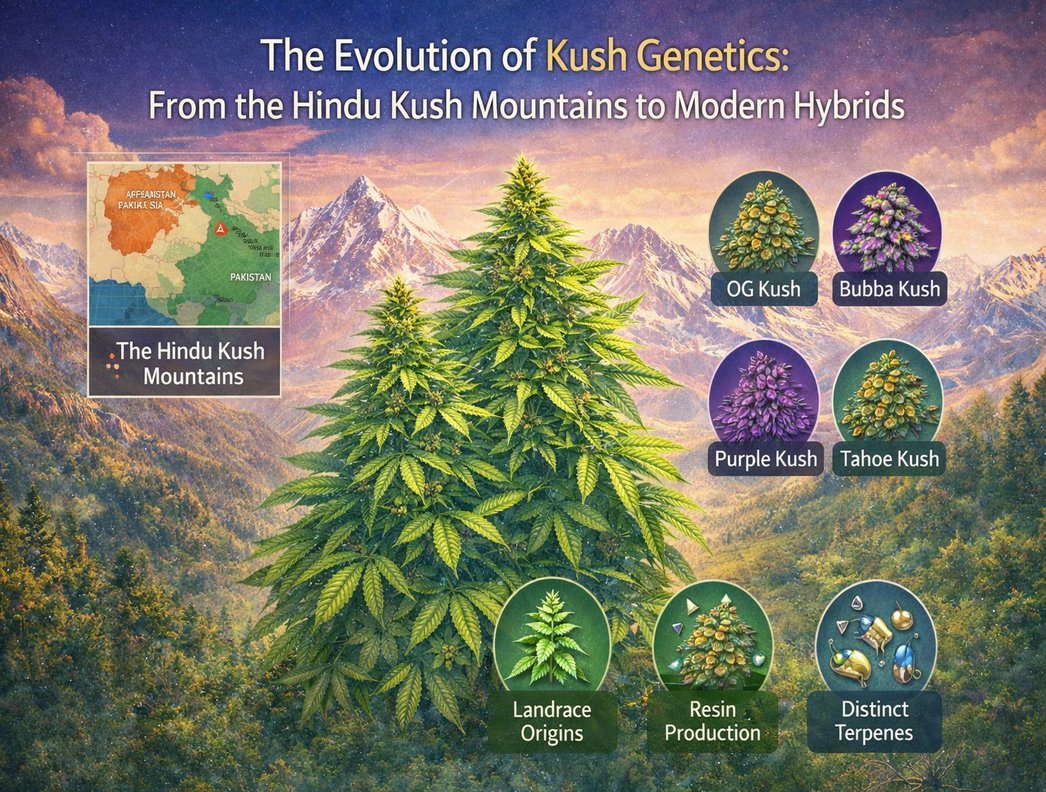
The Evolution of Kush Genetics
From the Hindu Kush Mountains to Modern Hybrids
Few cannabis lineages have shaped modern breeding as profoundly as Kush genetics. From rugged mountain ranges in Central Asia to today’s stabilized hybrid cultivars, Kush has become a foundational pillar in global cannabis development. Understanding Kush isn’t just about history; it’s about appreciating the genetic backbone behind countless modern strains.
Origins: The Hindu Kush Mountains
The name “Kush” traces back to the Hindu Kush mountain range, which stretches across Afghanistan and northern Pakistan. For centuries, cannabis plants grew naturally in this harsh, high-altitude environment. These landrace plants developed unique survival traits:
Dense, compact structure
Broad leaf morphology
Thick resin production
Early finishing cycles
High resistance to cold and stress
Because of the dry climate and intense sun exposure, these plants evolved to produce abundant resin; a natural protective mechanism against environmental pressures. This resilience made Kush genetics incredibly valuable to breeders decades later.
Landrace to Global Icon
In the 1960s and 1970s, travelers and breeders collected seeds from the Hindu Kush region and brought them to North America and Europe. These landrace genetics became the building blocks of many foundational cultivars. From there, selective breeding transformed Kush into stable hybrid lines such as:
OG Kush
Master Kush
Bubba Kush
Purple Kush
Tahoe Kush
Each new generation refined structural traits, terpene expression, and flowering consistency while preserving the core Kush characteristics.
What Defines Kush Genetics?
While modern hybrids vary, Kush lines often share distinct genetic markers and growth traits:
Structural Traits
Short to medium height
Strong lateral branching
Dense, compact bud formation
Resin & Trichome Development
Heavy trichome density
Thick resin glands
High terpene concentration potential
Terpene Profiles
Kush lines frequently express dominant terpene patterns such as:
Myrcene
Caryophyllene
Limonene
Pinene
These terpenes contribute to the aromatic complexity that Kush cultivars are known for in breeding circles.
The Kush Influence on Modern Hybrids
Kush genetics became especially influential when crossed with:
Haze lines (for height and flowering variation)
Diesel genetics (for terpene complexity)
Skunk genetics (for vigor and stability)
This blending created balanced hybrids that combine:
Structural stability
Enhanced resin production
Diverse terpene expression
Improved indoor adaptability
Today, many premium modern cultivars trace part of their lineage back to Kush ancestry.
Why Breeders Value Kush
From a genetic standpoint, Kush offers:
✔ Strong structural stability
✔ Predictable flowering patterns
✔ Dense trichome coverage
✔ Reliable terpene inheritance
✔ Adaptability in controlled environments
Because of this reliability, Kush remains a cornerstone in modern breeding programs.
Kush in Today’s Seed Market
Modern Kush-based seeds are often selected for:
Stabilized phenotypes
Consistent growth patterns
Refined terpene layering
Enhanced resin structure
Breeders continue to preserve original landrace traits while refining performance for contemporary cultivation environments.
Preserving Genetic Heritage
As hybridization expands globally, maintaining authentic Kush genetics becomes increasingly important. Preserving landrace foundations ensures:
Genetic diversity
Strong breeding stock
Historical continuity
Sustainable cultivar development
Kush is more than a strain family; it’s a genetic cornerstone of modern cannabis evolution.
Final Thoughts
From the mountains of Central Asia to sophisticated breeding programs worldwide, Kush genetics have shaped the cannabis landscape in profound ways. Understanding this lineage allows growers and breeders to better appreciate the structure, stability, and terpene complexity found in many of today’s most respected cultivars. The evolution of Kush is still unfolding -- and its genetic influence continues to expand.